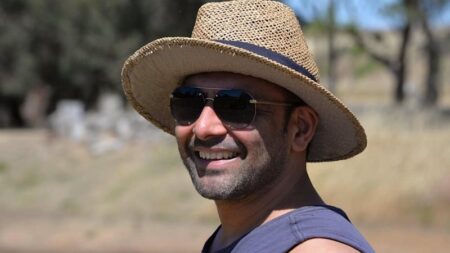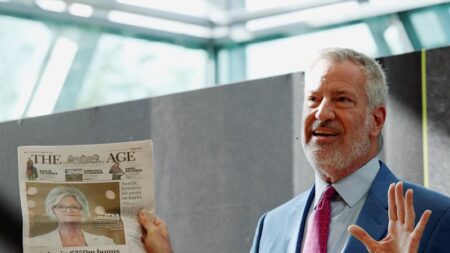



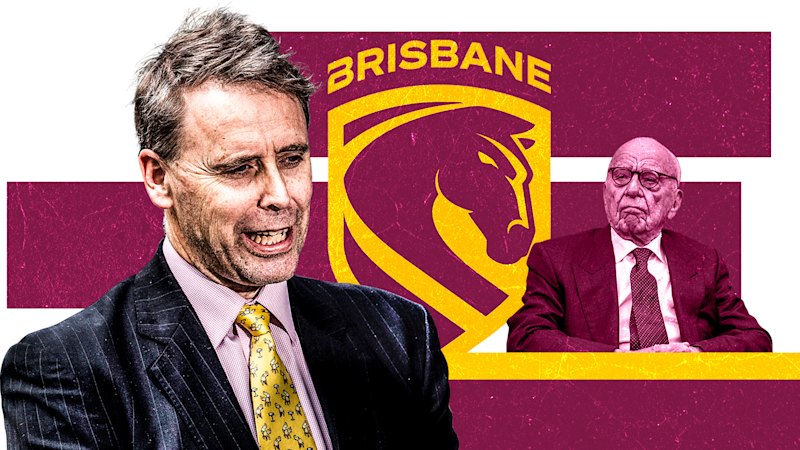
Shareholder activist Stephen Mayne has launched a bid to join the Brisbane Broncos board, with one aim in mind – the removal of News Corp as the club’s majority shareholder.
Mayne said the US-based media company’s 24-year grip on the club represented an unacceptable conflict of interest and was out of step with Australian sporting traditions.
Speaking ahead of the Broncos’ upcoming annual general meeting, at which he will self-nominate for the board, Mayne said News Corp’s near-70 per cent holding in the club was an “anomaly” that would not be tolerated elsewhere in Australian sport.
“The biggest newspaper in Queensland owns and controls the biggest sporting team in Queensland,” he told this masthead.
“That is a massive conflict of interest to start with.”
News Corp, controlled by Rupert Murdoch and headquartered in New York, has owned a majority stake in the Broncos since 2002. It previously held stakes in other sporting teams, including the Melbourne Storm and the Los Angeles Dodgers, but exited those investments years ago.
News Corp’s Broncos ownership was “the last hangover” of the Super League wars, Mayne said, and while private ownership was common in American sports, Australia had traditionally favoured member-owned or not-for-profit structures – particularly in rugby league and Australian Rules football.
“You wouldn’t let an American billionaire come in and buy Collingwood,” he said.
“Everyone would say that’s outrageous. Yet here we have an American-based billionaire effectively controlling the most valuable NRL club.”
Mayne, the founder of news website Crikey, said the problem was not private ownership itself, but concentrated control.
“At the moment, the Broncos have around 1200 shareholders but only one of them controls the club,” he said.
“That’s inappropriate for an institution of this size and significance.”
But Mayne conceded his candidature for the Broncos board was largely symbolic, given News Corp’s voting power.
“I can’t get elected because News Corp will vote against me,” he said.
“That’s the whole point I’m making – it’s effectively a gerrymander that would make Sir Joh Bjelke-Petersen blush.”
Mayne said his campaign focused on two reforms: encouraging News Corp to sell down its stake and pushing the Broncos to adopt hybrid annual general meetings, allowing online participation.
“There are more than 200 Australian companies running hybrid AGMs,” he said.
“You can watch the Broncos play on your phone, but you can’t watch the AGM on your phone.”
Mayne criticised the club’s refusal to allow remote attendance as an attempt to suppress debate.
“Transparency and shareholder participation should be non-negotiable in corporate Australia,” he said.
Comment has been sought from the Broncos.
Mayne said he was unsure whether he would be able to attend the AGM in person, but would have a proxy in the room if he was unable to make the trip.
The Broncos’ notice of meeting was expected to be released to the Australian Stock Exchange shortly, ahead of the AGM scheduled for May 19. Mayne said how the club handled his nomination would be an early test of its governance standards.
“The first test is whether they publish my arguments uncensored,” Mayne said.
“That will say a lot about whether this is a fair election.”
Longer term, Mayne proposed limits on individual shareholdings as a way to prevent future concentration of power, pointing to precedents in heavily regulated industries such as casinos.
“I don’t see why the same concept shouldn’t apply here,” he said.
“Let News Corp sell down over time and move to a model where no one owns more than, say, 5 per cent.”
Such a structure, Mayne said, would better reflect the club’s community role and align it with broader Australian sporting values.
“This isn’t about nationalising the Broncos or forcing an immediate sale – it’s about starting a debate that everyone’s too scared to have because of the Murdochs’ power,” he said.
“Once people point out how abnormal this structure is, the pressure should be on News Corp to voluntarily sell and let the club be controlled by its supporters and shareholders, not one overseas billionaire.”
From our partners
Read the full article here