



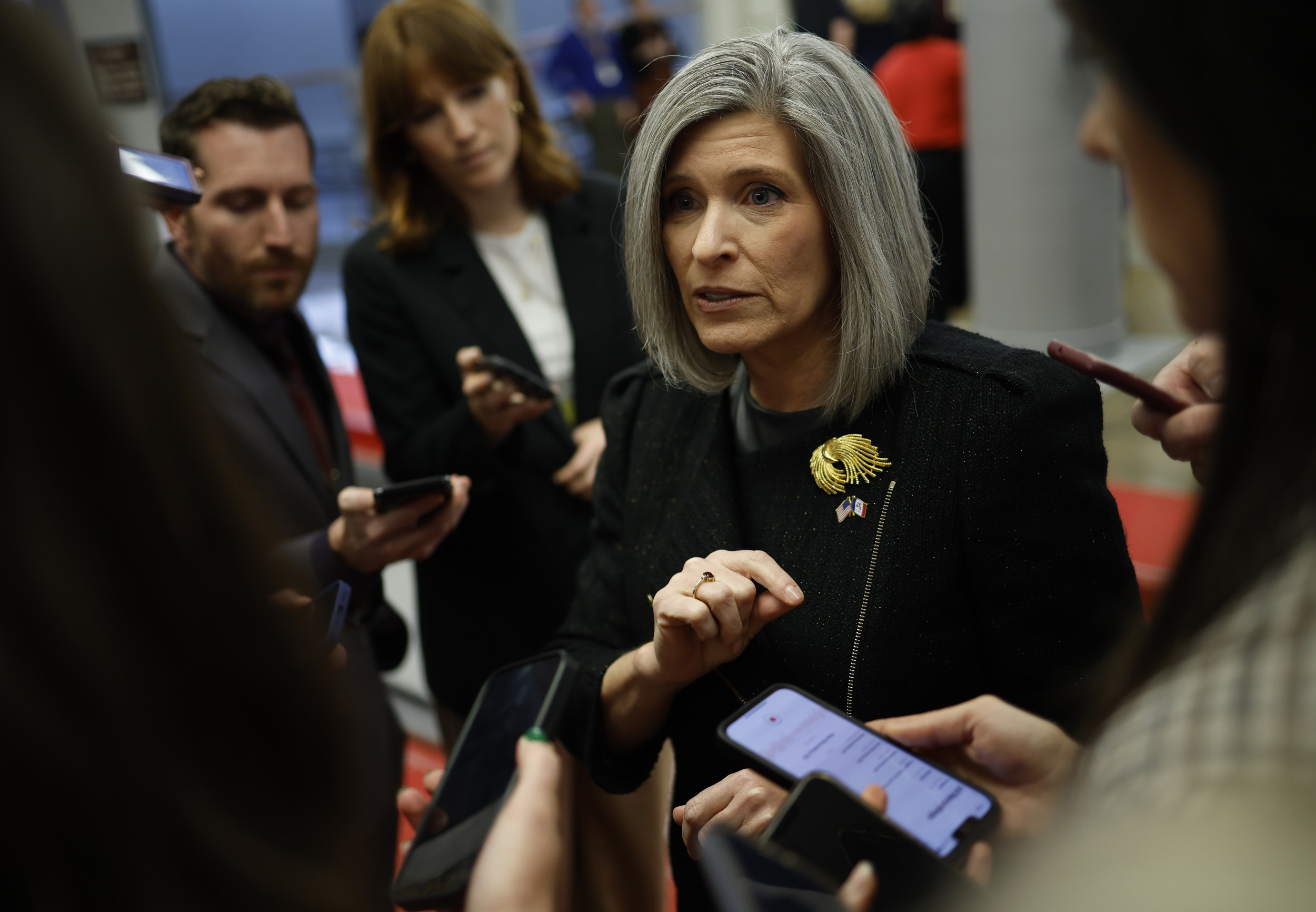
Republican U.S. Senator Joni Ernst of Iowa will not run for reelection, she announced Tuesday, leaving open a race Democrats aim to make competitive despite the state’s conservative tilt.
Timothy Hagle, professor of political science at the University of Iowa, said that open races are generally more competitive than when an incumbent opts to run for reelection. But how competitive the race becomes will ultimately depend on who secures the Democratic and Republican nominations, he added.
Iowa GOP Chairman Jeff Kauffman wrote in a statement that the party is “confident the next generation of Republican leaders will continue building on her incredible legacy.”
Newsweek reached out to the Iowa Democratic Party for comment via email.
Why It Matters
Iowa has shifted rightward over the past decade and backed President Donald Trump by double digits in November, but Democrats are eyeing it as a potential opportunity in the 2026 midterms. Historically, the party of the president performs poorly in the midterms, fueling Democratic optimism about competing in more conservative states.
They’ll need to win in some double-digit Trump states to win a Senate majority, currently held by Republicans, 53-47. Maine, which backed former Vice President Kamala Harris by about 7 points, and North Carolina, which supported Trump by about 3 points, are Democrats’ top targets. But no other GOP-held seat in a single-digit Trump or Harris-won state is up for grabs—meaning they have to turn to states like Alaska, Iowa, Ohio or Texas to compete for control of the upper chamber.
What To Know
Ernst confirmed she will not seek reelection in a video posted to X, saying, “After a tremendous amount of prayer and reflection, I will not be seeking reelection in 2026. This was no easy decision.”
Her announcement leaves the race with a sense of uncertainty, as it’s unclear who will run to replace her on the Republican side. Before her decision to exit the race, she was viewed as the favorite, though forecasters did view the contest as potentially competitive. The Cook Political Report and Sabato’s Crystal Ball classify the race as “Likely Republican,” and it’s unclear whether that would change by Ernst no longer being the candidate.
There has been no polling on how other Republicans would fare against Democratic candidates. Betting odds, however, still gave Republicans an advantage. The GOP held a 68 percent chance of victory in Kalshi’s betting market, down from a 75 percent chance August 26.
Hagle said the party that is not in the White House typically performs better in the midterms but noted that Democrats have also been seeing lackluster polling numbers.
“It’s kind of a headwind that they’re running into,” he said. “So it’s hard to say whether Ernst not being in the race is going to give Democrats much more of a chance. We’ll have to see, of course, it also depends on who the Republicans end up picking as their nominee, as well as who the Democrats pick as theirs in terms of the quality of the candidates and so forth.”
David Peterson, professor of political science at Iowa State University, told Newsweek that Ernst’s decision “is likely to shake this race up a fair amount.”
“First, this is likely to be a competitive Republican primary. I know that people often work behind the scenes to clear the field, but there are a few high profile Republicans who avoid the gubernatorial race who would be well positioned to challenge for this race. A tough primary fight could weaken the nominee more than the clear field that Ernst would have,” he said.
Whoever emerges from that primary will also lack the same incumbency advantage Ernst would have had, Peterson added.
He said he believes the election will likely be “a more competitive race than people might think.”
“Iowa has trended to the right since 2016, but the Democrats are better positioned than they have been in the last several cycles. They will have a top tier candidate for the open Governor’s race in likely nominee Rob Sand. He has already raised a lot of money and is well respected. Two of the four House seats will likely be close again with the Democrats also having strong candidates in those races. If [Ashley] Hinson runs for Senate, her seat will also be close. This is also just likely to be a very good year for Democrats,” he said.
Republican Candidates in Iowa US Senate Race
At the moment, former state Senator Jim Carlin and Joshua Smith, former vice chair of the Libertarian National Committee, are running on the Republican side. But others are likely to jump into the race now that Ernst has made official her plans to retire.
Representative Ashley Hinson, who represents the northeastern region of the state, wrote on X she will “have an announcement soon about how we believe we can best serve Iowa, and how we can help President Trump make America great again.”
NATO Ambassador Matt Whitaker or Attorney General Brenna Bird have also been floated as potential candidates.
A hopeful like Hinson or Bird, who are well known among Iowa voters, may be stronger candidates in terms of name recognition and experience, Hagle said.
“But of course. It’s dependent on the personality and how well those candidates are able to articulate their message and whether they’re talking about the right things for the race as it develops over the next 14 months,” he added.
Democratic Candidates in Iowa US Senate Race
Several Democrats are already in the race, including Des Moines school board member Jackie Norris, Knoxville Chamber of Commerce Director Nathan Sage, state Representative Josh Turek and state Senator Zach Wahls. Former state Representative Bob Krause, who was running for Iowa’s 1st Congressional District, also announced he will instead run for Senate after Ernst’s call to exit.
Iowa Democrats are running stronger candidates across the board than in recent elections, likely because they see 2026 as a stronger opportunity for victory than 2022, viewed as a less Democratic year. But Senate candidates are not necessarily as prolific at this point, Hagle said.
“It’s going to be tougher for somebody who had only been a state legislator to then make that jump up to the U.S. Senate as opposed to maybe taking as a first step U.S. Congress,” he added.
What People Are Saying
Kauffman wrote in a statement: “Senator Joni Ernst is a dedicated public servant, and Iowans have been proud to have her representing our state in the U.S. Senate for the past decade. From the start, Joni set out to make Washington squeal, and she delivered. Her work to cut government waste, stop the abuse of taxpayer dollars, protect Iowa’s farms and small businesses, and pass Sarah’s Law has left a lasting impact. Iowa is better off because of Senator Ernst’s leadership, and we are confident the next generation of Republican leaders will continue building on her incredible legacy.”
Democratic National Committee Chair Ken Martin wrote in a statement: “A few months ago, Joni Ernst said the quiet part out loud: Republicans don’t give a s*** about whether their own constituents live or die, as long as the richest few get richer. That’s precisely why they rammed through a budget bill that would rip away health care and food from millions of Americans, including kids and seniors across Iowa. As Democrats surge in Iowa, Ernst decided to leave the Senate rather than face the music with voters. Democrats have momentum everywhere while Republicans are running away from Trump’s devastating agenda.”
What Happens Next
Iowa’s primary is set for June 2, 2026, and the general election will be held on November 3, 2026.
Read the full article here