



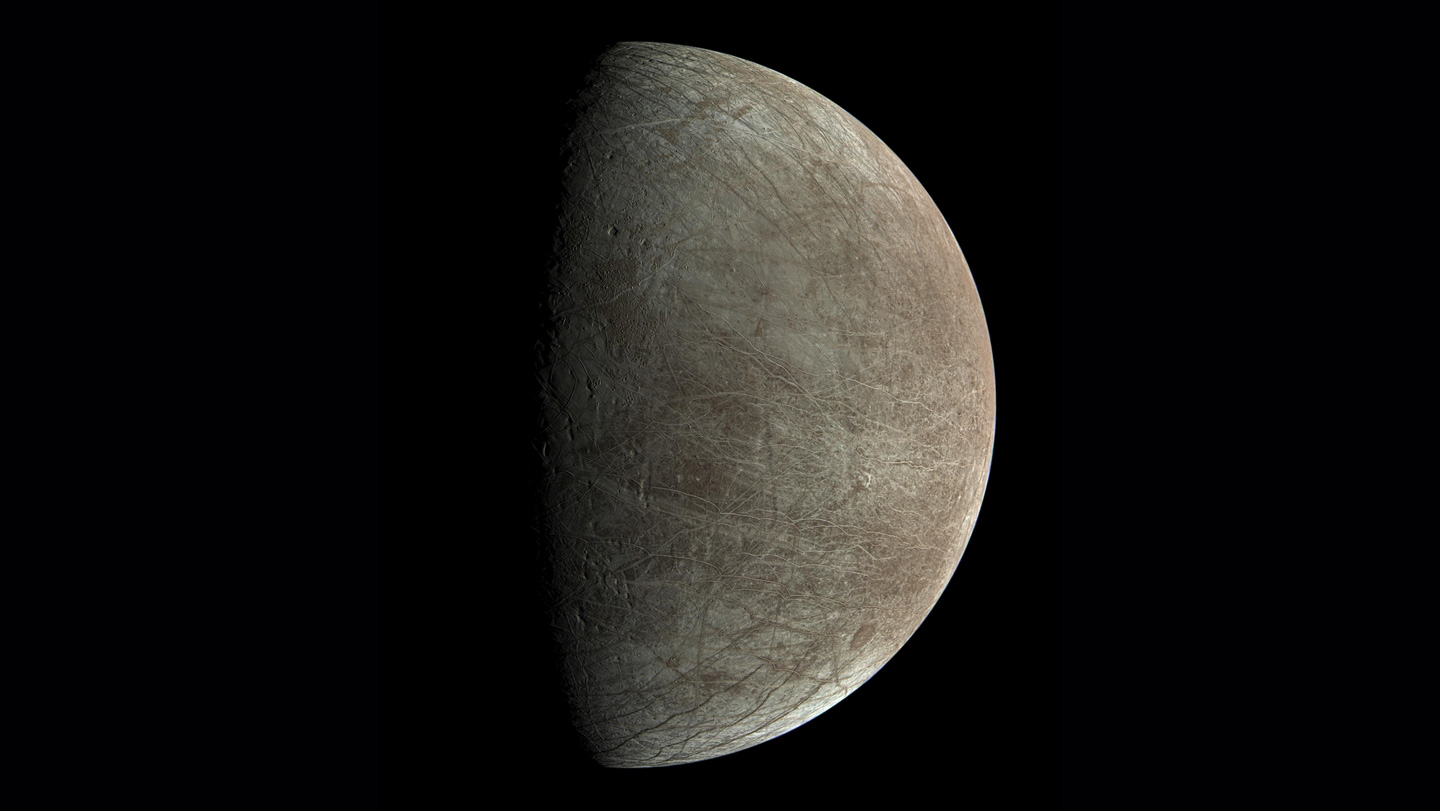
Signs of water plumes spewing from Jupiter’s icy moon Europa have vanished in a hydrogen haze.
An analysis of nearly a decade of Hubble Space Telescope observations of Europa shows no strong evidence for jets of vapor that were claimed 13 years ago, researchers report in the May Astronomy & Astrophysics.
“They disappeared,” says planetary astronomer Lorenz Roth of KTH Royal Institute of Technology in Stockholm. “I don’t think there’s any strong evidence left.” The vanishing act could have implications for the search for life in Europa’s subsurface sea.
Roth and colleagues made a splash in 2013 when they reported excess ultraviolet light from hydrogen and oxygen atoms hovering around Europa’s south pole. The evidence at the time suggested that cracks in Europa’s icy surface opened intermittently and let water from the moon’s inner ocean escape into space.
Europa’s ocean makes it one of the best places to look for life in the solar system. But its kilometers-thick ice shell means the ocean is hard to study. Plumes could let a spacecraft take a sample just by flying by, without having to land or drill.
Roth and colleagues observed Europa with Hubble again and again. The first time, “I thought, we know where and when it is now, we’ll see it again,” Roth says. “And we didn’t.”
In the new study, Roth and colleagues analyzed 20 Hubble observations taken from 2013 to 2020, plus three — two in 2012 and one in 1999 — that drove the original study. In ultraviolet, Europa looks like a fuzzy ball of TV static, even to sharp-eyed Hubble. The new analysis included improved methods for constraining where Europa’s edges are, since being off by only a pixel or two could change the result. The team also included new things learned about Europa in the last 13 years, such as the fact that it has an extensive hydrogen exosphere that Hubble can detect.
Europa’s ultraviolet excess disappeared.
The original plume or smaller ones could still be there, undetected by Hubble, Roth says. NASA’s Europa Clipper spacecraft will be able to check when it arrives at Jupiter in April 2030.
“I’m excited for Europa Clipper having the possibility and the instruments to find smaller things,” Roth says. “But I’m not too optimistic that we find evidence before Europa Clipper. We have another four years of not knowing.”
Read the full article here