


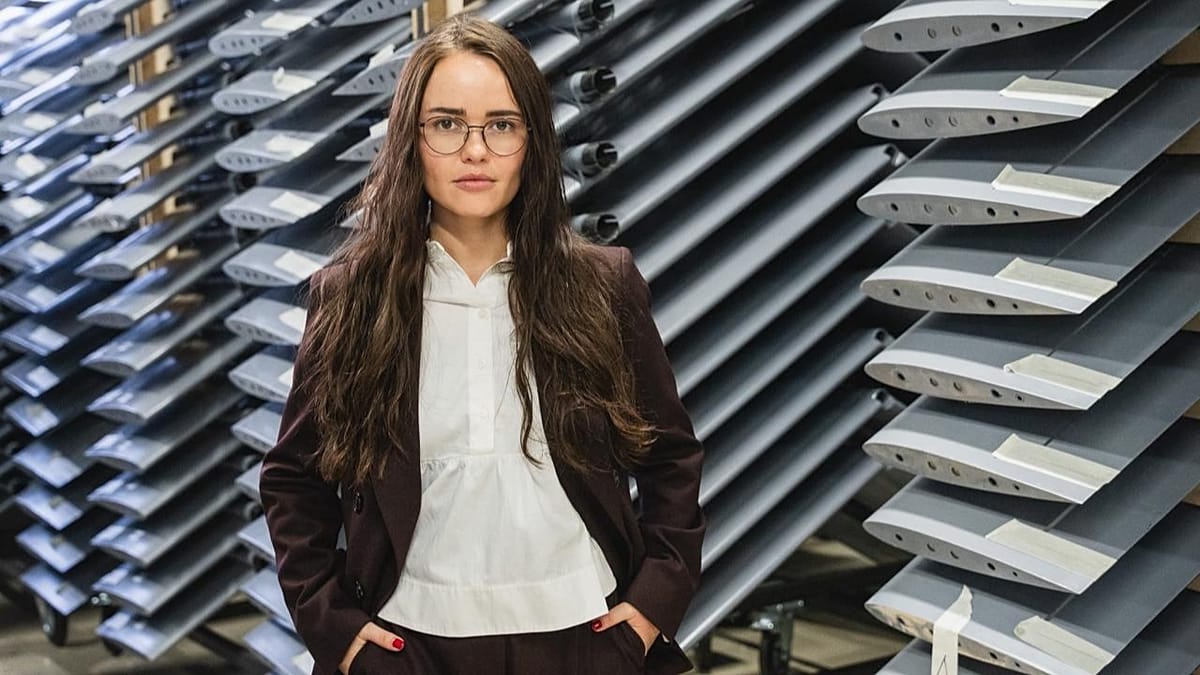
In Norse mythology, Freyja is known as the goddess of war, love and beauty. “A strange combination, until you look at Ukraine today, where all three coexist,” writes Iryna Terekh, CEO of Ukrainian defence company Fire Point, on X.
She continues, saying that those “shared values run across this continent, from the Baltic to the Black Sea”, referencing the Joint Declaration on the Establishment of the Integrated Anti-Ballistic Missile Coalition, which names Freyja as its flagship programme, signed by the Coalition of the Willing in Paris on Monday last week.
The idea is to create a lower-cost, modular missile-defence system by combining Ukraine’s combat and wartime experience with European technology and industry.
Instead of relying on a single manufacturer, different countries would contribute individual components – from interceptor missiles to radars and command systems – to build what participating governments describe as an integrated European missile-defence architecture that complements existing systems, such as the US Patriot air defence system.
Just a year ago, Freyja was little more than a concept put forward by Fire Point. The Ukrainian defence company rose to prominence with its long-range cruise missile FP-5 “Flamingo”, which has been used by Kyiv to carry out deep strikes against targets inside Russia.
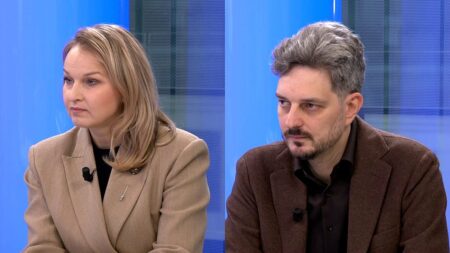
Euronews caught up with Iryna Terekh, the company’s CEO and CTO, one day after the joint declaration’s signing in Paris last week. Will Freyja thrive despite European bureaucracy, and what would the Flamingo’s potential production in Germany mean for deterrence against Russia?
Euronews: Let’s start with the latest Coalition of the Willing meeting and the signing of the Freyja initiative, which was initiated by Fire Point. How significant was last week’s agreement, and what does it mean for the future of the programme?
Iryna Terekh: First of all, I’m completely amazed. I never expected that what started as a brief idea, one and a half years ago, with the first discussions taking place on a napkin, would come this far and end up in a room full of leaders, National Security Advisers, decision-makers, CEOs of prominent companies and all the supporters of the change that we all made together.
So, of course, it’s very inspiring, and I do feel like this change was due for quite some time. We’re very happy that we were able to inspire people to actually start implementing this technological and doctrinal shift that we’re making with Freyja.
Euronews: Now that nine European countries have signed up to the Freyja initiative alongside Ukraine, how quickly do you think this change can actually be implemented?
Iryna Terekh: This is a very cool question because I thought, what’s the difference between security guarantees promised and actual security guarantees executed? That’s why on the first slide of a Freyja presentation, there is a phrase that says “security guarantees are written in steel and not in ink”.
I consider this more important than the Budapest memorandum. And of course, the execution is the most important part of the job. But since we’ve been doing our homework on the b2b level already for quite some time, we see the commitment, the effort, the interest. I’m sure that with the support of the leadership, we will be able to overcome bureaucracy much faster.
The main task for leadership is to remove bureaucratic obstacles, because they sometimes make things worse and help the enemy.
We have to understand that this threat is no smaller than the threat from Russia, for example, because sabotaging critical processes can be extremely harmful – it can even be deadly. That’s why we’ve seen a full commitment from political leaders to help us focus on technological development, while they have our backs in addressing the bureaucratic challenges.
Euronews: We often hear the argument that Europe is still at peace, and that if a war were to break out, production of tanks, missiles and other weapons could simply be ramped up. What do you make of that argument? Do you think Europe can afford to wait until a conflict starts before significantly increasing production?
Iryna Terekh: I would like to mention that it’s completely normal for a human brain to avoid thinking about uncomfortable things. I recently saw statistics about human anxiety and how people react to threats. And the fact is that the closer you are to a threat, the more relaxed you are.
Why is that? Because the worst has already happened and you don’t have to think about it, you just have to act.
The further away you are from the threat, the more you want to avoid uncomfortable things and hide in the normality of today.
Therefore, we cannot judge human brains for being designed in this specific way. But we need to know this and we need to consider this, take it into account while we’re planning big defence things. And while the average time of a ballistic missile reaching the Ukrainian capital takes around two to five minutes maximum, it’s seven minutes to Warsaw, eight minutes to Berlin, and a maximum of 12 minutes to Paris. The difference is not that big.
What we are trying to do is not to use threats as a motivation factor, but to build a whole ecosystem that would be able to react to threats in a correct way. And this is the major thing about Freyja, the whole rethinking of how air protection should work. And the system, the technology should outlive any political cycle, any changes that are happening because if the system is built correctly, it is very resilient. What we’re trying to build is a resilient defence ecosystem.
Euronews: We’ve all seen the reports about dwindling stocks of Patriot interceptors and other missiles. How much did those shortages influence the development of Freyja?
Iryna Terekh: A big role, of course. I love Patriot Systems. As an engineer, I’m completely amazed. This is definitely an example to work with, but it was never designed to be consumed in such amounts as we do in Ukraine. We need to create a product that is relevant to the threat that we have.
Euronews: A few weeks ago, German company Diehl Defence announced an agreement with Fire Point to produce the Flamingo cruise missile in Germany. Can you say anything about the progress of these talks and the cooperation?
Iryna Terekh: I will say abstractly that there are a few layers of negotiations, one with a few German companies and with the German government on creating an industrial cooperation where we can share our Ukrainian experience and help Germany to have cheap and mass-produced weapons.
Euronews: In your point of view, what role is Germany playing at the moment? France and the UK have taken the lead with the Coalition of the Willing.
Iryna Terekh: I would say that in the end, it’s humans talking to each other. As in any country, there are companies that are very like-minded and some that are completely different. We see this inconsistency within Germany and even within Ukraine. It’s the same for each and every country.
And in general, I understand that it’s hard – especially for Germans – to overcome the narrative of never again, where war is something extremely toxic, something that should never happen again. I completely support this, until you are facing a completely unfair attack on yourself.
Freyja is not an offensive system. It is clearly a defensive system. We’re thinking on defence, it’s a completely different narrative, which makes it easier to adopt. In the end, these are all people, you have to find the people who share the same values as you, and then the work will go as smoothly as possible.
Euronews: Coming back to the Flamingo cruise missile. If you look at the European leg of NATO, there’s this so-called deep strike gap. Ukraine seems to have solved that deep strike gap with the Flamingo. Is the Flamingo, in a sense, the deterrence Europe needs? Especially looking at Germany, where there was recently uncertainty about whether the US would station their Tomahawk long-range missiles in Germany after all.
Iryna Terekh: Let’s say Germany can count on us in terms of providing them with deep strike deterrence. Of course, at the moment, the priorities are Ukrainian needs. But we have a very good memory of the good and the bad things and we will be forever thankful to our allies for supporting us during the hardest times.
And of course, as soon as this would be possible in terms of production capacity, we would be able to support Germany as well. With the Flamingo and the modernised version of FP1, we achieved another world record of a distance of 3,000 kilometres. We are rethinking the doctrine of ‘Deep Rear’ and kind of rewriting military vocabulary.
There is no such thing as a deep rear for our enemy at the moment. And that is a good thing for us.
Euronews: Last year, the Flamingo was dubbed a “wonder weapon” and a gamechanger. Has it delivered?
Iryna Terekh: I do not believe in this concept, because if you cannot repeat your own result in a predictable way, you will not make a big change. Yes, you can have tactical success, but this is definitely not what changed the narrative.
We see now on a daily basis that at least 300 Ukrainian drones are flying every night and about the same number during the day, the big drones towards Russian territories. Not the one drone, but the possibility to make daily launches in a predictable way.
So, Flamingo is, of course, a very big card, an important one, a game changer in a way. But the most important part about the Flamingo is that we are increasing its production, that we are increasing its accuracy, that we are using this as a very heavy argument.
Basically, this is our pen to write our conditions for future peace negotiations.
Euronews: When it comes to unmanned systems, it’s known that the advancement proceeds so fast that a drone needs an upgrade every few weeks. Do you adapt the missile after each use?
Iryna Terekh: At the moment, it’s a constant loop. After each and every battlefield use, we change and adjust something to make it more efficient. Let’s say it’s a daily, weekly loop.
You mainly have to adapt the head (guidance unit), which contains the main computing power. The software still fits in the small part, whether it’s a drone or a missile.
Euronews: Does that apply to other missiles, too? Or is Ukraine a sort-of front runner in this case?
Iryna Terekh: I think it’s mostly a Ukrainian thing because we can afford this from a bureaucratic perspective at least. I don’t know whether or not it’s a common practice for Western weapons because the amount of paperwork behind every change is crazy. Therefore, I’m not so sure about this.
Read the full article here