




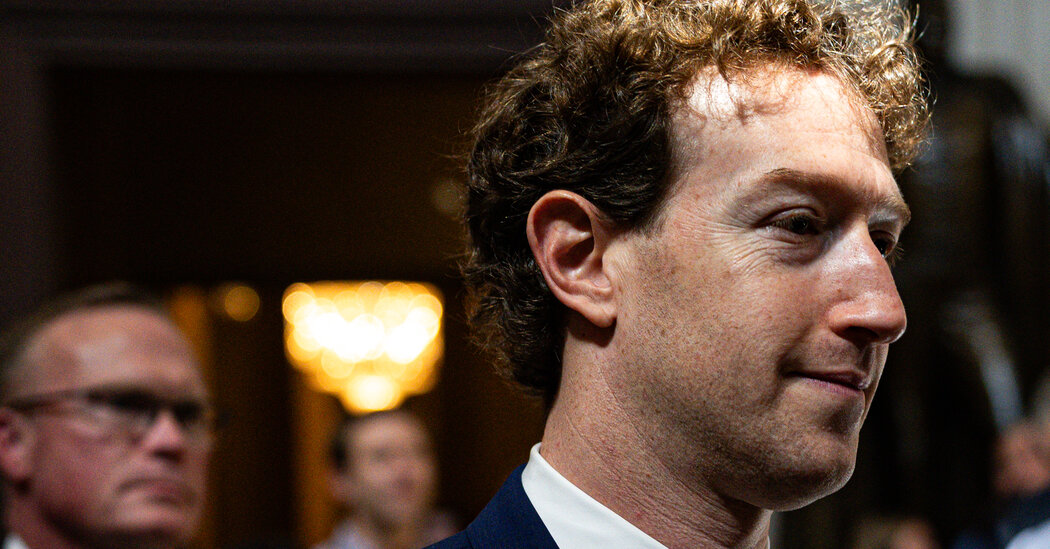
Five major publishers — Hachette, Macmillan, McGraw Hill, Elsevier and Cengage — and the best-selling novelist Scott Turow have filed a class-action copyright infringement lawsuit against Meta and its founder and chief executive, Mark Zuckerberg.
The complaint, which was filed on Tuesday morning in United States District Court for the Southern District of New York, accuses Meta and Zuckerberg of illegally using millions of copyrighted works to train their artificial intelligence program Llama, and of removing copyright notices and other copyright management information from those works.
The lawsuit asserts that Meta’s engineers relied on pirated books and journal articles to train the program by downloading unlicensed copies through websites like Anna’s Archive, an open source search engine for piracy sites including LibGen and Sci-Hub. The suit also claims that “Zuckerberg himself personally authorized and actively encouraged the infringement.”
Representatives for Meta did not immediately respond to a request for comment.
The plaintiffs argue that Meta’s A.I. program poses a threat to the livelihoods of writers and publishers because the technology can be used to quickly produce A.I.-generated copycat books and to summarize the plot and themes of copyrighted books in such great detail that readers don’t have to buy them.
“These A.I.-generated books are already flooding the world’s largest book marketplace, Amazon, in volumes that materially displace human-authored works,” the complaint states. The filing cites several authors whose works the plaintiffs claim were used to train Llama, including V.E. Schwab, N.K. Jemisin, Lemony Snicket and Turow.
Some of the evidence cited in the complaint purportedly comes directly from Llama. When asked to produce a travel guide in the style of the writer Becky Lomax, Llama rapidly produced “a convincing rendition of Lomax’s local insider voice,” the complaint says. Then, when asked how it was able to reproduce Lomax’s style so accurately, Llama allegedly replied, “While I don’t have personal interactions with Becky Lomax, I’ve been trained on a vast amount of text data, including her published works.”
Llama is also able to summarize books in detail. When asked to give a synopsis of Turow’s “Presumed Innocent,” Llama confirmed that it had “been trained on a digital version of the book, which allows me to access and analyze its content,” according to the complaint.
In an email to The Times, Turow said Meta’s use of pirated works amounted to “shameless, damaging and unjust behavior.”
“I find it distressing and infuriating that one of the top-10 richest corporations in the world knowingly used pirated copies of my books, and thousands of other authors, to train Llama, which can and has produced competing material, including works supposedly in my style,” Turow wrote.
By producing “knockoffs and imitations” of authors’ works, Meta’s A.I. program could “dilute the overall market for literary works,” the plaintiffs argue.
“These outputs are similar enough to copyrighted works — in subject matter, plot details, sequencing of events, character names and traits, or other creative choices — that they replace the original work for many readers or consumers,” the complaint says.
The lawsuit is the latest effort by authors and publishers to rein in tech companies’ use of copyrighted works to train their large language models.
Writers have brought lawsuits against tech companies including OpenAI, Anthropic, Google and xAI for the companies’ unauthorized use of their work. Last fall, Anthropic agreed to pay a $1.5 billion settlement to writers whose books had been used to train its A.I. program.
(The New York Times has sued OpenAI and Microsoft, as well as Perplexity, accusing the companies of copyright infringement of news content related to A.I. systems. The companies have rebutted the claims.)
Authors have challenged Meta in court before. In June 2025, a judge ruled in Meta’s favor, finding that the plaintiffs had not presented enough evidence that Meta’s A.I. product would create “market dilution” by producing a flood of A.I.-generated books.
The lawsuit filed on Tuesday against Meta brought together trade and education publishers, academic publishers of scientific and medical journals and a best-selling author of legal thrillers. The plaintiffs are seeking an order requiring Meta to destroy all illegally acquired copies of works copyrighted by the plaintiffs that Meta used in A.I. training and to “cease all unlawful activities,” as well as requesting any “further relief as the Court deems proper.”
“We’re focused on a much more sustainable A.I. landscape — something that’s transparent and fair and participatory and has guardrails against harm for authors and publishers,” said Maria A. Pallante, president and chief executive of the Association of American Publishers, a trade group that acts as a law and policy advocate for the book publishing industry. “The harm is already evident.”
Read the full article here