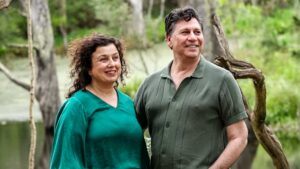



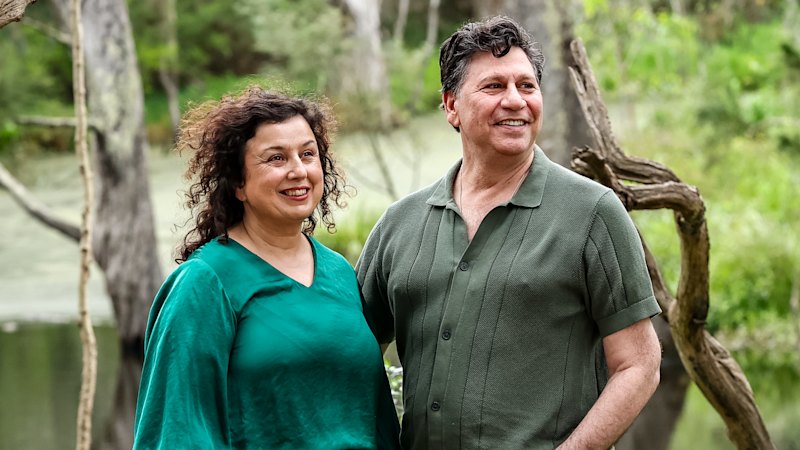
When three-time cancer survivor Sarina Sorrenti and her husband, Sam Pitruzzello, visit their GP, they don’t just leave with scripts for pharmaceutical medications – their doctor also prescribes nature.
“Nature walking,” GP Vicki Kotsirilos wrote on a recent script for Sorrenti, alongside a list of vitamins.
The pair follow the doctor’s orders faithfully, regularly walking beneath the towering gums that line the banks of a billabong near their home in Melbourne’s north.
“It’s about absorbing and noticing all the details, everything from the bark on the tree trunk, to the branches, even the leaves,” says Pitruzzello, who has a rare medical condition called myositis, which leads to muscle weakness and pain. “It’s not just ‘go for a walk for exercise’ – now it’s time to heal.”
For the first time, the Royal Australian College of General Practitioners has endorsed new guidelines for prescribing nature.
Developed by the not-for-profit People and Parks Foundation, the Nature Dose resource details how GPs can prescribe the outdoors for patients as part of their routine care. More intentional than simply being in nature, the practice requires people to make a point of tuning in to sights, sounds, smells and textures. This might include walking near water, feeling the texture of bark or listening to the sound of insects and birds.
The guidelines state as little as 20 minutes a day, or two hours a week, can reduce stress, improve mood and wellbeing, enhance sleep and reduce blood pressure. Nature dosing is offered to patients in addition to traditional medical treatment, and is always individualised.
People and Parks director Alison Hill says “intergenerational indoorsness” has led to a situation where many people no longer experience the benefits of nature.
She believes this disconnect from nature is fuelling existential crises like climate change, and leading to poor mental health and chronic diseases.
“Part of the solution is helping people reconnect with nature and remember that they are part of [it],” she says. “This helps them realise that when we are caring for nature, we are also caring for ourselves now and into the future.”
While a growing body of evidence supports the movement, many of the sample sizes are small and rely on self-reporting.
A recent UK study of 171 participants found nature prescribing significantly improved wellbeing while reducing symptoms of anxiety and depression.
In Australia, a study of 39 young people with mild to moderate mental health issues found two hours of weekly nature dosing improved their wellbeing, easing psychological distress and significantly reducing loneliness.
The participants, who lived in the Shepparton area in northern Victoria, went on bushwalks and engaged in nature journaling, yoga, tree planting and nature photography.
A larger UK study of almost 20,000 participants found spending at least two hours a week in nature was linked to significantly greater self-reported health and wellbeing.
Advocates have several theories about why nature dosing works. It could provide an escape from the stresses of modern living, or diversify the body’s microbiome through exposure to different bacteria and fungi.
Or perhaps, our bodies are simply designed to thrive in the natural world.
Dr Kuljit Singh, the national chair of the RACGP’s social prescribing specific interests group, says while anyone can spend time in nature, a formal nudge, as well as guidance from a doctor, can make all the difference.
“It’s empowering,” the Gold Coast-based GP says. “The doctor is telling you to do this, and you are doing it to prevent illness. It gives patients an alternative to a prescription, or a powerful adjunct to one.”
Singh, who has been prescribing nature to her patients for about 20 years, says the practice is transformative.
“It makes a huge difference, from children right through to our seniors,” she says. “For children who have erratic behaviour, panic attacks, or anxiety, spending time looking, listening, and feeling nature really calms them.”
While more than 1000 GPs already prescribe nature to their patients, Singh says the RACGP’s endorsement of the new guidelines will encourage more to follow suit.
“When we qualify as doctors, we are always taught to look at lifestyle measures first before we reach for a pill,” she says. “It hasn’t always been given enough weight.”
Nature dosing has already been used as part of trials for cancer patients at Alfred Health’s Paula Fox Melanoma and Cancer Centre and at headspace in Shepparton. As part of another study, new parents in the City of Banyule in Melbourne’s north-east were prescribed group-based nature dosing to reduce their risk of loneliness.
Vicki Kotsirilos says prescribing nature is a no-brainer.
“There is surprisingly lots of evidence demonstrating regular exposure to nature is beneficial to human health physically, mentally, emotionally and spiritually,” she says.
“Nature contact can improve sleep and mental health, reduces symptoms of depression and anxiety, ADHD, reduce aggression, and brings greater happiness, wellbeing, life satisfaction and social connectedness.”
The shift has been profound for Sorrenti and Pitruzzello.
As frogs croak in the billabong and dragonflies skim the water’s murky surface, Sorrenti says her nervous system is now back in balance. She feels more energised than she did in her 20s and 30s. Her mental health, which took a battering following three separate cancer diagnoses, has also improved.
As well as daily walks in nature, Sorrenti stands barefoot in her garden for 15 minutes every morning.
“People just want to go to doctors and ask them to fix them,” she says. “You have to be part of the healing.”
For Pitruzzello, regular nature dosing has improved his motivation to stay fit and healthy. It’s also helped him come to terms with having a chronic health condition.
“When you have chronic conditions like mine, it affects your mental health,” he says. “You can just get into this spiral … you want to make sure that you live with it the best you can.”
Start the day with a summary of the day’s most important and interesting stories, analysis and insights. Sign up for our Morning Edition newsletter.
 Henrietta Cook is a senior reporter covering health for The Age. Henrietta joined The Age in 2012 and has previously covered state politics, education and consumer affairs. Email her via henrietta.cook@theage.com.au or henrietta.cook@protonmail.comConnect via X, Facebook or email.
From our partners
Read the full article here