



Inside the small club of students across NSW who take on the hardest level of Higher School Certificate mathematics, certain papers are notorious for their difficulty.
There was the final locus problem in 2023. The 2001 paper’s last question is still discussed on obscure parts of the internet.
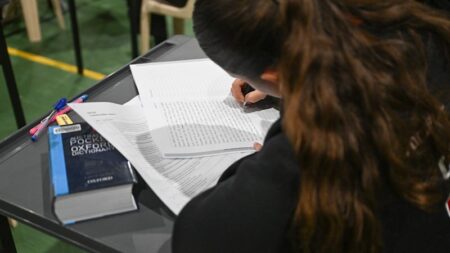
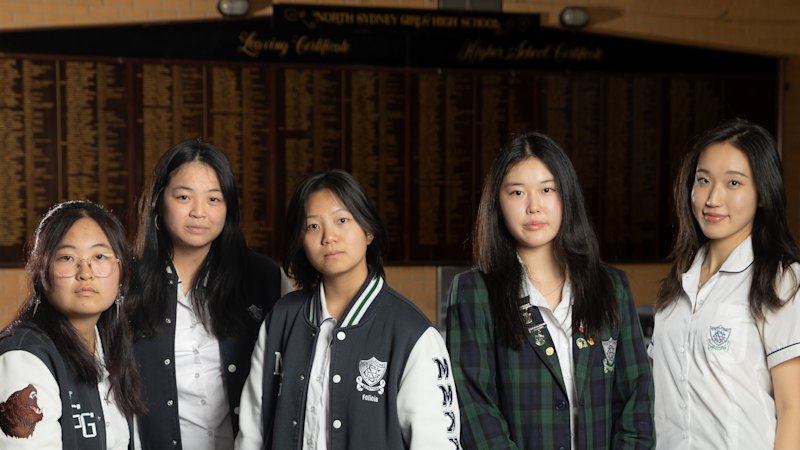
When North Sydney Girls High School student Angela Lin, 18, woke up on her birthday on Monday, she was feeling comfortable about the exam she would sit alongside 3769 NSW students.
“I was pretty chill about it,” she said.
But then she received word that the mathematics advanced paper that morning was extremely difficult, and the stress over extension 2 began. But once the exam started, that anxiety subsided.
“I saw a lot of diagrams, and I was like, ‘OK … I’m probably going to have to slow down and understand those first’,” she said.
The final and most difficult question, 16C, was on vectors, with a diagram of a sphere similar to the 2025 exam.
In mathematics, a vector is a quantity which has length or size, coupled with direction.
It had its challenges, but it was not a repeat of the difficulty faced by students in 2023.
“I thought it was a pretty good paper. Especially the last question,” she said.
The problem was split into three parts. The first section asked students to prove that the vector had a length of 1. The second asked them to find intersections between two circles in three-dimensional space, by solving two vector equations simultaneously.
The final stage was more difficult, requiring students to make connections between the information provided in the question and vector projections, to derive the vector equation of a circle in 3D space passing through two given points.
For Annie Chen, 18, the lack of any odd shapes or eccentric graphs in the paper was welcomed, but the last question threw a few curveballs.
“There were hiccups with trying to relate again to the last part, to the previous parts of the question. I think that requires a little bit of thinking,” she said.
The backdrop to Monday’s HSC exam is a mathematics world in turmoil.
This month, Open AI released full or partial solutions to just over 370 mathematical problems spanning algebra, mathematical logic as well as theoretical computer science. Last month, the company said it had solved one of the Millennium Prize problems, which comes with a million-dollar reward, in 88 hours. Terence Tao, one of the world’s greatest living mathematicians, has declared he’s on a “war footing” with AI.
But can AI help students study and practice mathematics extension 2?
Not according to North Sydney Girls’ head of mathematics, Madhu Narayanan, who says AI risks making students lazy.
“An important skill to be successful in a course like extension 2 is persistence. Because things are going to be hard, and you don’t want to give up easily,” she said.
“I tell my students, a good problem will fight back.”
This year, 75 students enrolled in extension 2 mathematics at North Sydney Girls, almost half the year 12 cohort.
For Felicia Wu, 17, she never thought she had the mathematics skills to tackle the course because she did not attend after-school tutoring. But she now believes her lack of tutoring was an asset.
That’s because students who were being coached outside of class spend all their time studying, that they just lose the joy of doing maths.
“I like doing the harder questions where you have to think about it,” she said.
Sophia Zhu, 17, was not always a strong mathematics student. But she has enjoyed extension 2.
“You have to actually think,” she said.
Start the day with a summary of the day’s most important and interesting stories, analysis and insights. Sign up for our Morning Edition newsletter.
From our partners
Read the full article here