


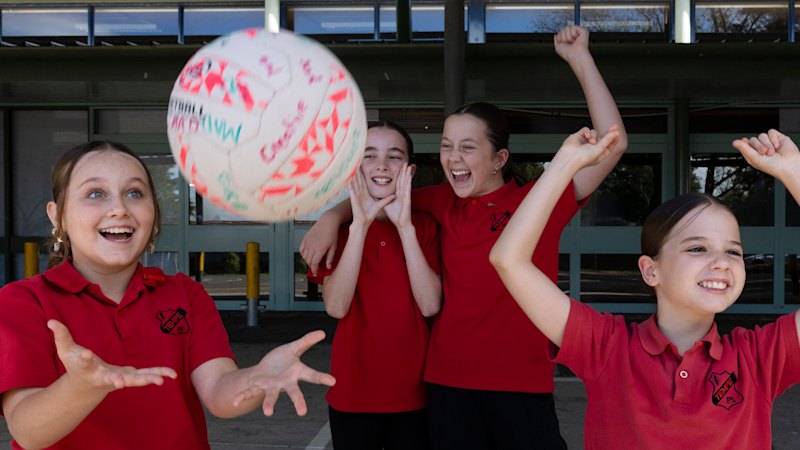
Children kick a Texta-covered ball around a field. The students from Tempe Public School have written their anxieties on the ball’s surface: Homework. Big kids. High school.
With every bounce, those worries rub off.
As schools across the country battle a rise in childhood anxiety, activities such as the scribbled-on soccer ball have become crucial parts of the school day – as important as maths or spelling.
The average age for first anxiety diagnosis has fallen to 11 years old, according to the National Mental Health Commission, while a 2020 survey of 700 primary school principals found 81 per cent thought children’s anxiety was a significant issue within their school.
To address the escalating challenge, the NSW government announced a $450,000 investment for the Gotcha4Life Mentally Fit Schools program last week, enabling the charity to expand its reach to a further 20 schools in the state’s central west and south coast.
At Tempe, Gotcha4Life participants invented a strategy to make their school a more “mentally fit” environment. As part of their student voice project, year five students Georgie, Eva, Stevie and Mina created the “forget about it ball” on which they wrote all their anxieties.
“You kick it back and forth to a friend, and you’re basically just forgetting about your bad emotions,” Georgie said. “Gradually [the writing] will come off, symbolising letting go of your worries.”
The girls said they worried about getting enough sleep, making new friends, balancing school and hobbies, forgetting tasks, and public speaking.
Stevie said the ball concept was also about being physical and socialising with a friend: “You’d talk to someone in your village about how you feel, and as you talk to them, then you should feel … calmer, and let go of your worries.”
Founded by media personality Gus Worland, with Karl Stefanovic also a board member, Gotcha4Life’s ethos is grounded in the preventative skill of so-called mental fitness, built around the organisation’s three protective factors: emotional adaptability, help-seeking behaviour and social connectedness.
Gotcha4Life’s chief executive, Belinda Elworthy, said the program upskilled teachers to recognise when students were struggling, including how they could escalate their concerns: “Part of what the Gotcha4Life program does [is] build that village of support.”
But the Australian Association of Psychologists’ Policy Coordinator Carly Dober said that teachers shouldn’t be expected to manage their students mental distress on top of their daily workload, and warned that while well-intentioned, universal mental health programs can do more harm than good, particularly for vulnerable children.
“There might be kids or young people who already have existing mental health conditions, and the programs don’t actually fit their need at all,” she said.
She said if a child’s distress stemmed from bullying or hate speech, and the school hadn’t addressed the root of the problem, mental wellbeing programs could exacerbate the situation: “It can actually increase their distress if nothing tangibly different is going to occur at school … it’s just hot air, essentially.”
The mental health system remains under-resourced and unreachable for many families, Dober said, which can place added pressure on a student.
“[If they’ve] reached out … they need psychological intervention, and they can’t afford it, where does that trickle down to?” she said. “If you’ve got stressed parents, you’re going to have stressed kids.”
Elworthy said Gotcha4Life’s three-year program was comprehensive and tailored to each school, supporting teachers, students and parents.
“The work that we are doing is prevention, it’s skill-building, it’s capacity-building,” Elworthy said.
The latest Kids Helpline impact report found NSW had the highest overall contact volume in the country – although it is also the state with the greatest population – and recorded a 41.6 per cent increase in contacts over two years, from 29,083 in 2023 to 41,170 in 2025.
NSW Mental Health Minister Rose Jackson said there was more work to be done when it came to supporting the mental health of children.
“It does start with early intervention and prevention, so these programs are critical,” she said, “[Gotcha4Life is] coming in right in the early years, and teaching those skills of how to make friends, how to manage behaviour and emotions, how to look for help if you need it.”
She said enhanced Headspace centres and the new Medicare Kids Hubs were available for more complex presentations. Jackson opened the first free children’s mental health centre in Sydney earlier this month, however experts in the field criticised the hub as a “piecemeal” approach which would have little impact on the escalating youth mental health crisis.
Year six students at Tempe said they were nervous but excited about transitioning to high school – where “other kids will be a lot bigger and what you learn is a lot harder” – but planned to lean on their friends for support.
Start the day with a summary of the day’s most important and interesting stories, analysis and insights. Sign up for our Morning Edition newsletter.
 Emily Kowal is a Walkley award-winning education reporter for The Sydney Morning Herald.Connect via email.
From our partners
Read the full article here