


Updated ,first published
NSW Attorney-General Michael Daley has blasted an upper house inquiry that made damning findings against the state’s top prosecutor as a “stitch-up”, after a majority of the committee concluded she gave false evidence in parliament.
In an explosive report likely to spark fears of politicisation of the agency, a 4-3 majority of upper house MPs recommended the state government consider establishing a new parliamentary oversight committee for the Office of the Director of Public Prosecutions.
The majority of the inquiry made damning findings that DPP Sally Dowling, SC, authorised her office to give a negative story about District Court Judge Penelope Wass to Sydney radio station 2GB in 2024 and “falsely denied having done so in her evidence to the committee”.
But Daley described it as “the worst parliamentary committee report that I have seen in my nearly 21 years in parliament” and said it was “further evidence of the wayward misbehaviour we regularly see coming out of the legislative council”.
“The report makes findings that are unsupported by the evidence. It reaches conclusions that are contrary to sworn testimony. It treats mere suspicion and speculation as fact,” he said.
“It was a stitch-up from the outset.”
He said he had full confidence in Dowling and the DPP “is, and must remain, an independent statutory office holder who operates free of political interference”.
“Given my serious concerns about the recommendations and findings made in this report, I will instruct the Crown Solicitor’s Office to brief senior counsel to review it.”
The Public Service Association of NSW condemned the majority’s findings and said the committee was “embroiled in political farce”.
“These committees are not there to operate as a star chamber or as a de facto court,” it said.
The 2GB story was aired amid an apparent rift between the ODPP and some District Court judges, including Wass, over sexual assault prosecutions.
“The committee is satisfied the story was pitched in retaliation for Judge Wass’ previous criticisms of the [ODPP] … and perhaps for additional reasons unknown to the committee,” the majority said.
The majority recommended Daley “consider establishing a formal inquiry with compulsory powers” to examine the incident, “with a view to determining whether there are grounds to remove” Dowling from office.
It said the mandate of any new oversight committee for the ODPP “should be similar to existing committees with responsibility for oversighting the Independent Commission Against Corruption, the NSW Crime Commission, and the Ombudsman and Law Enforcement Conduct Commission.”
‘Unfounded and biased findings’
But the findings caused a deep rift in the committee. Greens MP Sue Higginson and Labor MPs Cameron Murphy and Bob Nanva did not support the findings and recommendations.
Higginson said in her dissenting statement that the majority’s “unfounded and biased findings … are both irresponsible and incredible”.
“The report’s assertions that the director possibly broke the law by providing false evidence to the committee, and that the director’s conduct possibly warrants her removal from office, are profoundly serious allegations that have been made irresponsibly and erroneously. They should be rejected.”
Murphy and Nanva said in a separate dissent: “When a parliamentary committee makes findings that could seriously impact an individual, their career and, in the case of this report, the administration of justice, those findings should be rigorously tested and be based on actual evidence.”
They said the findings and recommendations concerning Dowling “fall far short of this standard”.
“The consequences are grave, yet the evidence is staggeringly absent,” the Labor MPs said.
Legal heavyweights back DPP
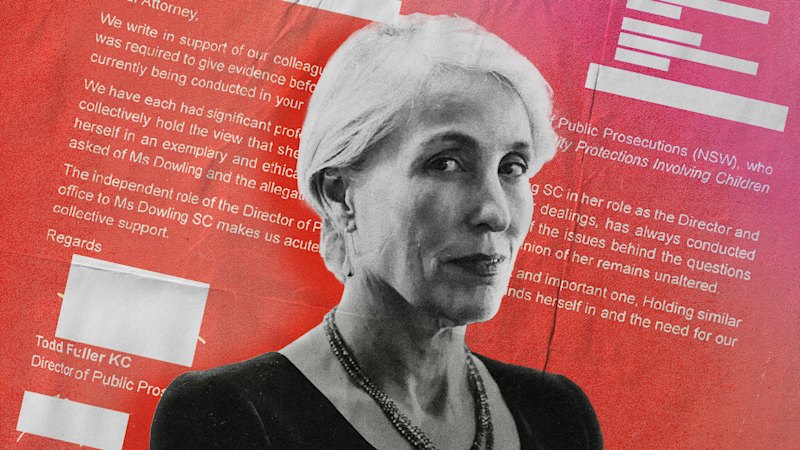
In a letter to Daley on June 30, days before the report was released, Dowling’s Commonwealth, state and territory counterparts locked in behind her.
The top prosecutors said Dowling was a “person of integrity who, in our dealings, has always conducted herself in an exemplary and ethical manner”.
During her evidence before the upper house justice and communities committee last year, Dowling admitted her office effectively gave a story about Wass to 2GB in October 2024.
Dowling vehemently denied she authorised the ODPP’s media manager providing the information to 2GB, and said she only became aware that her office was the source of the story days before the parliamentary hearing in December 2025.
Damning findings
The majority of the upper house committee – the Shooters, Fishers and Farmers Party’s Robert Borsak, Labor’s Stephen Lawrence, and Liberals Susan Carter and Natasha Maclaren-Jones – found Dowling’s evidence was false in this respect and that she authorised the story being given to 2GB.
They concluded Dowling’s false denials included her claim that “she only discovered in December 2025 the story had been pitched by the Office of the Director of Public Prosecutions”, even though she attended an internal meeting where the topic was discussed a day before the 2GB story.
Lawrence backed the majority’s findings but went further in a dissenting statement that said: “Powerful people have a particular tendency to inspire loyalty and support, including from their subordinates, but also their peers.
“This report reveals a failure to properly administer media comment guidelines and the improper use of information. Public confidence in the ODPP needs to be restored and protected.”
‘Foregone conclusion’
Higginson said in her dissenting statement that the committee could not be satisfied on the evidence before it that Dowling “knowingly authorised the pitching of the story to 2GB”.
“The report discards sworn testimony and relies on confected evidence and inference to assume guilt on the part of the director, pointing towards a foregone conclusion on the part of some committee members.”
The inquiry
The upper house inquiry was ostensibly set up to examine statutory identity protections for children in criminal proceedings, but it focused almost exclusively in its hearings on Dowling and Wass.
There was no hint in its name or general terms of reference to suggest it had an unrelated purpose, leading some observers, including prominent Sydney silk Geoffrey Watson, SC, to label it a “hatchet job”.
Judge’s explosive submission
In an explosive 68-page submission to the inquiry, quietly published on the NSW parliamentary website the night before Dowling was due to give evidence, and reported on the front page of The Australian that morning, Wass accused the ODPP of giving 2GB information to “embarrass and defame her”.
Wass alleged that it “forms part of a deliberate strategy by some of those within the ODPP, including Ms Dowling” to attack her personally or to influence her judicial conduct, or both.
The judge said the committee might consider referring senior ODPP officers to the governor “for removal from office”.
‘Ambush’ by committee
The ODPP said in a later submission to the inquiry that it was “difficult to avoid the inference that the committee intended to ambush [Dowling] with the judge’s submission at the inquiry hearing”.
The 2GB story concerned Wass’ invitation to an Indigenous youth she was sentencing for an aggravated break and enter involving the sexual touching of an elderly woman.
Wass invited him to give what she called a “Welcome to Country”. Rather than a welcome, which was not culturally appropriate, he delivered a short acknowledgement of the “traditional owners and custodians of this land” via video link.
Ben Fordham, host of 2GB’s breakfast program, described the “welcome” on air on October 25, 2024, as a “local scandal”.
The parliamentary inquiry heard Dowling was present at an internal meeting with the ODPP media manager and an external media consultant a day before the 2GB story aired.
Dowling told the committee she did not dispute that her media manager “had a mistaken understanding” after the meeting that she was authorised to raise the story with 2GB. But she said she “did not, and would not have, approved this occurring”.
Dowling said that she “was, as is my usual practice, also reading emails and texts concerning various prosecutions and other ODPP business” during that meeting.
“I deeply regret now not giving that meeting my complete attention,” Dowling said.
The 2GB story followed a wave of negative publicity for the ODPP.
The majority of the committee said they were “not persuaded by Ms Dowling’s explanation” in light of the “long-running dispute between the DPP and the judge”.
Alleged ‘#MeToo overkill’
Some District Court judges, including Wass, had delivered decisions criticising the office’s handling of sexual assault cases, prompting The Australian to report on an alleged “#MeToo overkill”. The judges had expressed the view the ODPP was running unmeritorious prosecutions.
Dowling lodged complaints with the Judicial Commission about two decisions, by judges Peter Whitford and Robert Newlinds. The watchdog said in 2024 that their comments were inappropriate and had no evidentiary foundation. Both judges apologised.
The only connection between Wass, Dowling and identity protections for children is that the ODPP gave 2GB the name of the Indigenous offender who was invited to perform the “welcome” to confirm the story.
However, in line with a statutory prohibition on publishing or broadcasting information to the public that identifies children in criminal proceedings, he was not named on air by 2GB.
Wass said in her submission that she contacted the police after the 2GB broadcast because she was concerned this prohibition may have been breached.
However, she also said that “on the scant information currently known, the ODPP is correct to contend that no breach of that provision has occurred”.
Police concluded their investigation early last year. No charges were laid.
Borsak said in his foreword to the committee’s report: “Notwithstanding that a breach of the legislation was not established, the disclosure should never have occurred, a fact acknowledged by all parties.”
Higginson said in her dissenting statement that “the proactive pitching of a story [by the ODPP to 2GB] gave rise to an impression that negative media coverage was generated due to a dispute between the judge and the director”.
“The potential for such an impression is an example of why the proactive pitching of stories about proceedings involving children and young people should not happen.”
Higginson said that the ODPP’s involvement in media coverage should be limited to verification of facts on a reactive and cautionary basis.
An ODPP spokesperson said the office and Dowling valued Daley’s support and full confidence and welcomed his decision to brief senior counsel to review the findings.
“The ODPP acts with integrity and independence,” the spokesperson said. “That is not going to change.”
Start the day with a summary of the day’s most important and interesting stories, analysis and insights. Sign up for our Morning Edition newsletter.
From our partners
Read the full article here