



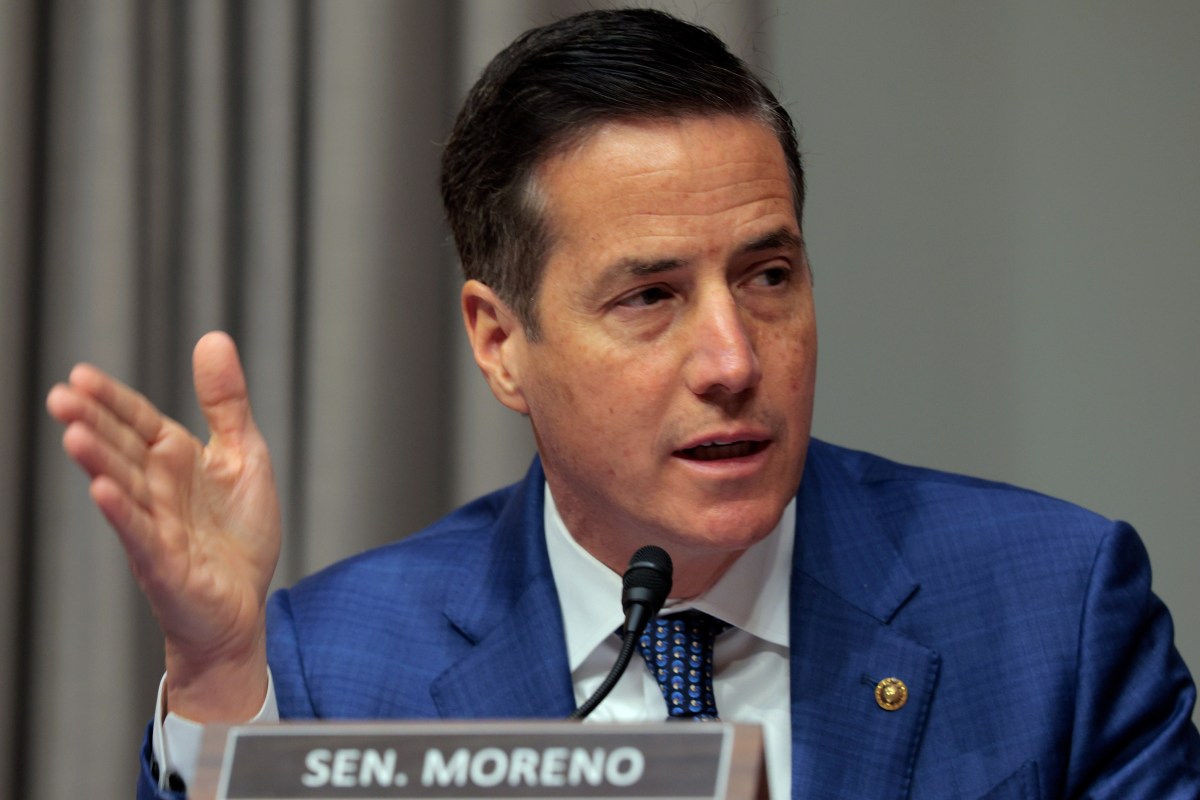
Senator Bernie Moreno, an Ohio Republican, introduced a bill that would prohibit sitting senators from participating in prediction markets.
Prediction markets are platforms that allow users to wager on the outcomes of real‑world events, including elections, economic data releases and geopolitical developments.
The proposal, introduced Friday, would amend Senate rules to bar members from entering into any financial agreement in which a payout depends on whether a specific future event occurs.
“Any Senator who comes to Washington, D.C. to cash in, play the markets, or treat public office like a side hustle is a betrayal to the people they swore to serve,” Moreno said in a statement.
Why It Matters
Lawmakers from both parties have sought to tighten oversight of prediction markets, including whether traders can profit from advance knowledge of military or political events. The fears have prompted several bills to be introduced in Congress to clarify how the markets are regulated.
Moreno said his proposed bill is intended to prevent conflicts of interest and reinforce ethical standards for lawmakers.
Prediction markets have grown rapidly in recent years, with contracts tied to elections, economic indicators and geopolitical events. Much of these events are directly influenced by Congress. As a result, lawmakers’ participation in those markets has raised questions about whether elected officials could profit from information obtained through their official roles.
What To Know
Under the proposal, senators would be explicitly prohibited from entering into “any agreement, contract, or transaction” that provides a financial benefit based on the outcome of an event, according to the resolution text.
Such language is designed to cover prediction markets, which allow users to buy and sell contracts tied to whether a particular event happens or does not happen, including political and economic outcomes.
“If you’re here to enrich yourself instead of fight for the American people, this a clear abuse of power and you have no business holding public office,” Moreno said in a statement.
The measure would modify the standing rules of the Senate rather than create a new federal criminal statute, meaning enforcement would fall under the Senate’s internal ethics framework rather than the Department of Justice (DOJ).
“Moreno is targeting prediction markets because, at their core, they function like betting markets operating in a gray area,” Kevin Thompson, the CEO of 9i Capital Group and the host of the 9innings podcast, told Newsweek. “They’re lightly regulated, susceptible to insider information, and increasingly showing signs of being gamed. While the Commodity Futures Trading Commission classifies them as derivatives, the real-world activity suggests something far less controlled.”
Alex Beene, a financial literacy instructor for the University of Tennessee at Martin, called the proposed bill an “attempt to lead by example.”
“Over the last year, applications and platforms that monetize prediction betting are gaining more scrutiny. While many of these marketplaces are technically banned in the United States, that hasn’t stopped some from still finding ways of placing risky bets on these platforms, often on global occurrences,” Beene told Newsweek. “The fear would obviously be those in power using insider information to bet or encourage betting on high-level decisions.”
If the law passes, it could signal further legislation at federal and state levels on the same prediction market platforms, Beene said.
“The incredible risk involved combined with the type of situations bet on are more than likely going to continue to generate criticism,” he added.
What Happens Next
Because the proposal is a resolution to amend Senate rules, its adoption would require action by the full Senate. Moreno said he plans to call for the measure to be passed unanimously.
The resolution applies only to senators and does not extend to House members or other officials.
“If this gains traction, it could mean more scrutiny on both the markets and lawmakers themselves, potentially pushing a revisit of the STOCK Act with stronger enforcement,” Thompson said. “But realistically, if it passes, it’ll be watered down…Congress regulating itself has never exactly been its strong suit.”
Read the full article here