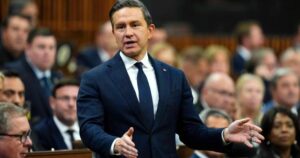


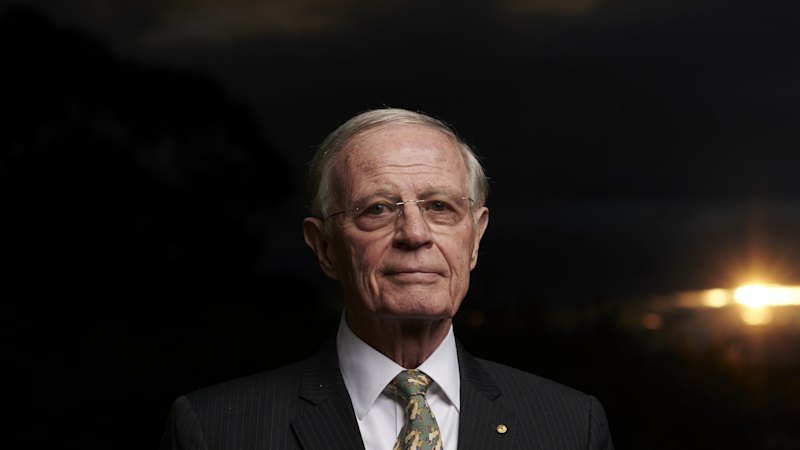
When former Australian Defence Force chief Chris Barrie and Australian Coal Association ex-chair Ian Dunlop co-write an article decrying the glacial pace of renewables adoption in Australia, and our resulting energy insecurity, our government should take heed and act (“Stop defending unsustainable past, April 18). Since the repealing of the carbon tax 12 years ago, there has been complacency and government inertia, with populist politics trumping prescient policy. Though Australia is blessed with intellectual and physical resources, we have twiddled our thumbs while the world has changed. We need to act now, and boldly, on fast-tracking electrification through renewables. Our prime minister needs to be braver – much braver. Rowan Godwin, Rozelle
I have argued all my adult life that sustainable energy makes economic sense. Now former ADF chief Chris Barrie argues that it makes strategic sense, too. If the bad guys bomb Eraring, it wouldn’t be such a disaster if every community was capable of generating its own power. Unfortunately, it doesn’t seem to make political sense. The Coalition is too wedded to fossil fuels to even consider it, and Labor does nothing for fear of losing another election. The only policy that makes sense is for Australia to become self-sufficient in energy, including the manufacture of solar panels, turbines, transport and arms, so ending our dependence on the Persian Gulf, China and the USA. David Neilson, Uralla
Get trucks on gas
It is relatively easy to convert a diesel engine to run on natural gas, a fuel Australia has in abundance, and would make good sense to convert our fleet of long-distance trucks to run on LPG. The main argument against it is that the lower energy density of gas means that a truck would need to carry more fuel by weight to travel the same distance, or simply refuel more often. So instead of wasting money drilling for uneconomical oil deposits, we should be converting trucks to gas. This would reduce our dependence on oil imports with have the happy side-effect of reducing pollution. Why aren’t our big trucking companies doing this and claiming it as an R&D tax offset? Alan Stanley, Upper Corindi
Decades ago, I worked on a priority project in South Africa and received rationed vouchers to buy fuel manufactured domestically from coal by energy company Sasol. Establishing such a plant on our coal fields to produce at least diesel would give miners certainty of employment and the nation improved fuel security. John Woodward, Ashfield
Who will pay the piper?
Shane Wright’s article makes sombre reading (“Australia’s debt hits $1 trillion this year – what did we spend it on?” April 18). In the post-Howard era, all governments, federal and state, have gone on debt-fuelled spending sprees for new projects and existing programmes, particularly in the run-up to elections. The reality is that all this needs to be paid for at some stage. As Wright points out, every extra dollar paid on the interest bill is a dollar less spent on essential services. Don’t hold your breath for the current crop of politicians to make the hard decisions to fix the problem. When the effects hit home, they’ll be cushioned by their generous taxpayer-funded pensions. Mike Kenneally, Manly
Shane Wright identifies the main causes for a rise in government spending over the past 20 years. He quotes economist Chris Richardson: “The financial crisis and pandemic were the key drivers of the explosion in debt.” Richardson invites us to “look around and see how the economy would have been without it”. The key debt problem is that the overall level of taxation has not increased to match this unavoidable increase in spending. Scare campaigns have made it almost impossible to implement urgently needed taxation reform, let alone a net increase in taxation. Most other well-performing, developed economies have higher overall tax income than Australia. We have to say goodbye to the simplistic knee-jerk “small government, lower taxes” mantra of yesteryear. While many distrust the political class, most people value government services and infrastructure and know they have to be paid for. David Hind, North Sydney
Robert Carling from the Centre for Independent Studies doesn’t think there is a lot to show for a trillion-dollar debt, then in the same breath goes on to say that most of it has gone towards the NDIS, aged care, education and child care. Yep, nothing much to show for it at all, Mr Carling. Is it any wonder people don’t think a lot of many economists? Gerald Smith, Adelaide (SA)
‘Inject’ some sense
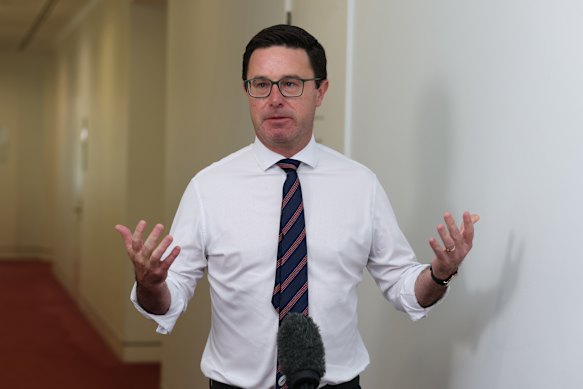
Someone should remind Nationals MP David Littleproud that the last time Australia was “injected” into the Middle East (“Australia should ‘inject’ itself into Middle East conflict: David Littleproud”, April 19) side-effects included more than a million dead Iraqis, the formation of ISIS and destruction of Syria and Afghanistan. The state’s many overseas “military injections” since World War II have never proven to be an effective remedy. Richard Phillips, Ashfield
Australian by degree
A thought-provoking article by Denise Sivasubramaniam (“When a politician talks about ‘Australian values’, my brown skin crawls”, April 18). The meaning of “Australian values” depends on the person using the phrase. If Pauline Hanson or Angus Taylor could lay it out as a framework against which people can be evaluated, it might be a workable starting point for an immigration discussion. Of course, it would also have to apply to current Australians. There’s no point in bringing in immigrants who are more Australian than existing citizens. Neville Turbit, Russell Lea
I like to think there are such things as Australian values like the oft-cited “fair go”, but they are hard to pin down and are unevenly applied. Unlike the Liberal Party, I’m confident new Australians will get “the vibe” as long as we follow Denise Sivasubramaniam’s suggestion that we live our values, particularly in our dealings with people who live or look different from us. Colin Stokes, Camperdown
Maureen Partridge, I also became a naturalised citizen in the 1980s (Letters, April 18). Apart from all the opinions to be found on your social media, I wonder if our letters to the Herald would also come under scrutiny as one part of an Australian values test? Pauline McGinley, Drummoyne
Race to the bottom
It’s no surprise that this current NSW state government has failed to fulfil its electoral promises (“NSW’s $1 billion clean energy fund yet to invest a single dollar”, April 19). If one were to compare the Minns government with that of the preceding Berejiklian/Perrottet fiasco, the sole conclusion which could be drawn is that the only difference is the colour of the ties they wear. Be it transport, energy, discrimination or welfare of the people, the current incumbents have merely won back the wooden spoon from their predecessors. Ian Usman Lewis, Armidale
Hats off to the NSW government for funding a new pedestrian route across Sydney (“Foreshore path links Opera House to Parramatta”, April 18). Spending a few million on projects such as these, compared to billions on motorways, is a happy walk in the park. Alison Orme, Manly
PM on the right path
Salvotore Sorbello criticised the prime minister’s “weakness” in dealing with Donald Trump (Letters, April 18). On the contrary, Anthony Albanese has handled Trump impeccably and refused to indulge his tantrums. Suggesting he step down is a bit rich. Albo has also engaged with other foreign leaders, including President Xi Jinping, and has done much to repair relations with China after the Scott Morrison debacle. Peng Ee, Castle Cove
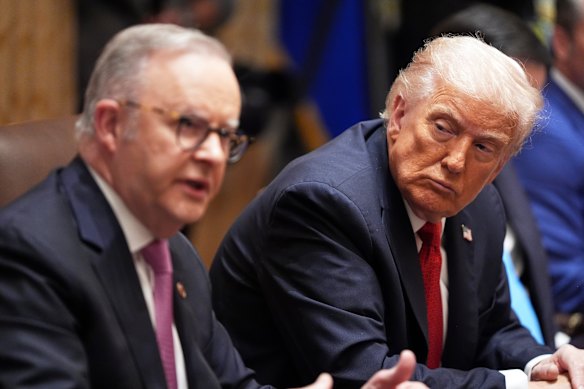
My favourite religious text is Monty Python’s The Life of Brian. In it there is a line from a woman who says of Brian: “Only the true Messiah denies his divinity.” To me, this is irrefutable proof that Donald Trump is not the messiah. However, under his stewardship it is getting increasingly difficult to always look on the bright side of life. Craig Jory, Albury
Thank you, Herald
Thank you, Sydney Morning Herald, for being a part of my life for more than 40 years (“A unique Australian aperture on the world,” April 18). My father, John “Dot” McCarty, has had the newspaper delivered to our home every single day for as long as I can remember. It was always there on the table, something constant, familiar and quietly important. Over the years much has changed. Like many, Dad has adapted with the times and now often reads his Herald online. Despite this, he still makes sure the paper is delivered each day so my mum can sit down and enjoy her crosswords. That simple ritual says a lot about what the Herald has meant to our family, not just as a source of news, but as part of our daily life over many decades. In a world that moves quickly and often feels disconnected, those small traditions matter. So I wanted to take a moment to say thank you: for the stories, the routines and the role you’ve played across generations in our home. Isabel McCarty, Petersham
I couldn’t keep my eyes from the magnificent image of Sydney Harbour on the front page of Saturday’s Herald (“How the Herald has told the stories you want to read”, April 18). It’s just one of the many over 195 years that tell a story and show us something from a different view. Thanks to Robert Pearce and all the photographers who contribute to the Herald – your photos are much appreciated. Lisa Williams, Dulwich Hill
Thank you so much for my daily dose of news and opinions. For many years, my day has begun with the SMH and a cup of tea – a routine shared by so many Australians who have come to depend on its high standards of journalism. Elizabeth Kroon, Randwick
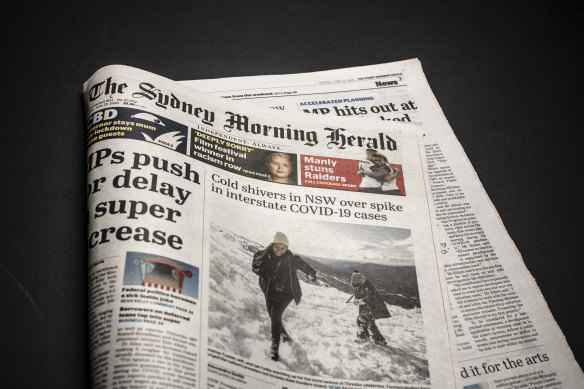
Bravo, Kate McClymont, prepared to investigate and chase down the crooks, no matter how long it takes. Bravo, Ross Gittins, wising us up in plain language about economics and political manoeuvring. Bravo to all the journalists, photographers and letter writers who make this paper a joy to open every morning. Bravo to the next 195 years. Andrew Raymond, Parramatta
Congratulations on your 195th. As Geraldine Brooks says, the Herald is indeed “Sydney’s paper”, but up here north of the border, it’s also ours. It brings us news and opinions not found in the other papers on our newsstands. How good that I can buy it every day on my shopping trek. Three cheers! Rob Wills, Brisbane (Qld)
Sydney’s best newspaper even made it into Nino Culotta’s They’re a Weird Mob. Asked by Nino for a newspaper containing job ads, the paper-boy replied “Erald’s the rag.” Peter Hughes, Macquarie Fields
Keep 2SER alive
Well said, Robbie Buck – Radio 2SER-FM is too important for Sydney to lose (“Shutting this priceless asset would hurt” April 18). As a former news/current affairs producer and trainer at 2SER, I helped train hundreds of developing broadcasters, including several mentioned or pictured in Robbie’s article. I’ve always felt satisfaction and pride in seeing our trainees continue to develop, at the ABC and elsewhere, the skills and journalistic standards they first practised at 2SER. Many thousands have done this. Meanwhile, the 2SER programs they’ve worked on have won international awards against quality competition from all sectors. Macquarie Uni has made a bad mistake in withdrawing funding. UTS, other unis and media training centres should grasp the opportunity to become involved in a workplace where trainee broadcasters can develop their skills to provide our city with a critical and diverse alternative to the sometimes formulaic, product-driven content of much of Sydney radio. Stafford Sanders, Balgowlah
No politics for Pope
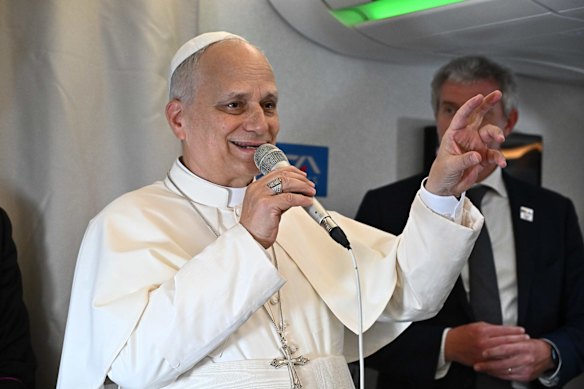
I am not a Catholic, so the Pope’s directives don’t affect me personally, but I fear he is becoming more a political figure in his own right rather than a purely spiritual leader (“Trump’s taken aim at the Pope. It’s another holy war he can’t win”, April 18). Not all Protestants support Trump, but in America many do, as do a large number of Catholics. So who is Pope Leo trying to persuade, or is he just trying to damage the Republican Party itself? His Bible quotes are selective; he fails to mention the directives of his own apostolic forefathers, St Peter and St Paul, to obey and respect the ruling powers. A more conciliatory approach would go a long way with President Trump, while dialogue with Islamic extremists will achieve nothing. I believe the Pope should do more to bring the war to an end, or he is being a hypocrite? Vivienne Parsons, Thornleigh
Fines in poor taste
Councils are issuing heavy fines to people who camp overnight. Surely a backpacking couple who pull up in their car near a beach and toilet do little harm and spend money in the community. The same goes for grey nomads and the unemployed or homeless. It’s especially poor form at a time when housing is out of reach for so many. Philip Dowle, Wickham
Fuel’s gold
Your article quotes the ACCC saying businesses must not engage in anti-competitive conduct (“Independents cut fuel prices”, April 18) . If that’s true, it must be through clairvoyance that fuel prices in our suburb on the Central Coast always go up simultaneously. Greg Lilly, Kincumber
Tops the lot
Ah, the good old days, when men extended “simple courtesies” to women, such as tipping their hats, but denied them the complicated ones such as basic rights and equal pay (Letters, April 18). I won’t be going back for my hat. Peter Fyfe, Enmore
Paragon shake-up
The decline of the Paragon cafe in Katoomba is a real shame (Letters, April 18). It was where, as an impoverished student almost 40 years ago, myself and three other similarly impoverished students ordered one milkshake with four straws. Pasquale Vartuli, Wahroonga
- To submit a letter to the Sydney Morning Herald, email letters@smh.com.au. Click here for tips on how to submit letters.
- The Opinion newsletter is a weekly wrap of views that will challenge, champion and inform. Sign up here.
Read the full article here