


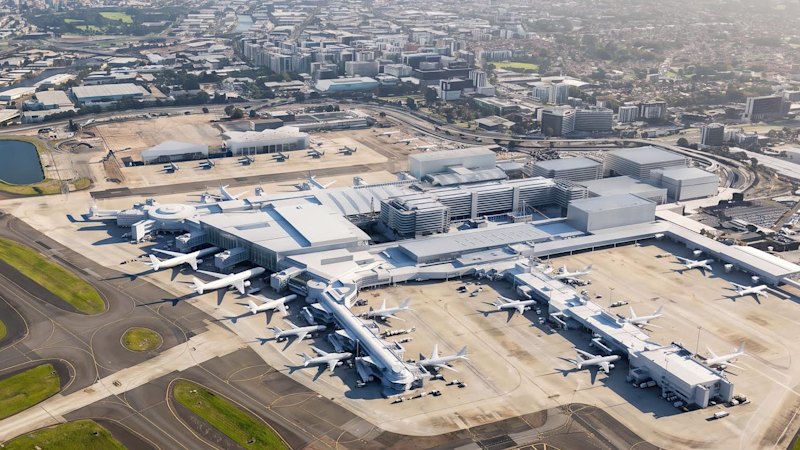
Sydney Airport is set to start a major expansion of its domestic terminals within the next two years that comprises up to a dozen new gates capable of handling international aircraft and helping reduce time on taxiways and other “friction issues” for passengers.
Two months before passenger flights start at Western Sydney International Airport, the federal government has approved ambitious expansion plans for Kingsford Smith over the next decade.
The green light for Sydney Airport’s 20-year master plan helps clear the way for it to merge the T2 and T3 terminals into a single precinct, which will lead to 12 new gates for both domestic and international aircraft. An extra two gates are also planned for the T1 international terminal’s pier B.
Sydney Airport chief executive Scott Charlton said merging the T2 and T3 domestic terminals was planned to be built in stages, the first of which involves at least seven new aircraft gates and would take about three years to complete from 2028.
“We’ll then continue to build them out. You’ll see a new terminal rise up,” he said, noting the plans were subject to further approval from the federal government given the airport is on Commonwealth-owned land.
Under the plans, some of the gates at the so-called rotunda at the end of the T3 terminal will be converted to handle international aircraft. “We’d like to use swing gates and make it more efficient for both international and domestic passengers,” he said.
Charlton said connection times for passengers would “drop dramatically” if the domestic terminal precinct had international gates, while cutting the time it took for aircraft to taxi to the terminals and bussing fliers between them.
“Hopefully, you see less taxi time, less time on the tarmac and quicker turnaround times. Customers are going to see a lot smoother process … and less of these sorts of friction issues,” he said.
“Right now, with all of international on one side and all of domestic on the other side, we can’t use the airport infrastructure, particularly the runways and the taxiways, as efficiently as we’d like.”
The first phase of the domestic terminal expansion, which also entails airfield work, is expected to cost about $3 billion. The following stages are anticipated to be completed between 2035 and 2040, depending on growth in travel demand.
The redevelopment will be the airport’s largest terminal expansion since Sydney hosted the Olympics 26 years ago.
The airport is forecasting a 75 per cent rise in passengers to 72 million annually by 2045. International fliers are forecast to grow from just under 40 per cent to half the total number over the next two decades.
Federal Transport Minister Catherine King said Kingsford Smith was the country’s busiest airport, and had to remain fit for the future.
“Airports aren’t artworks, they’re constantly evolving to become more efficient and improve the passenger experience, and this new master plan maps out the airport’s plan to do just that,” she said. “As demand grows, a modern Kingsford Smith will remain crucial.”
The approval comes as passengers at Australia’s largest airport have endured delays to flights lately due to a shortage of air traffic controllers forcing a cut to aircraft frequencies. A second near-collision between planes on the tarmac in two weeks also cast a spotlight on the airport and Airservices Australia, which oversees the country’s civilian airspace. A third safety incident occurred on August 9.
Charlton said Sydney Airport had been told that Airservices should be in a “good position” to deal with increased flights during the spring school holidays and the Christmas period, which is the busiest time of the year for air travel.
“We really need them to deliver. We want to see an acceleration [in air-traffic control recruitment] because it has taken longer than everyone has expected to get back to the staffing levels,” he said.
Start the day with a summary of the day’s most important and interesting stories, analysis and insights. Sign up for our Morning Edition newsletter.
 Matt O’Sullivan is transport and infrastructure editor at The Sydney Morning Herald.Connect via X or email.
From our partners
Read the full article here