



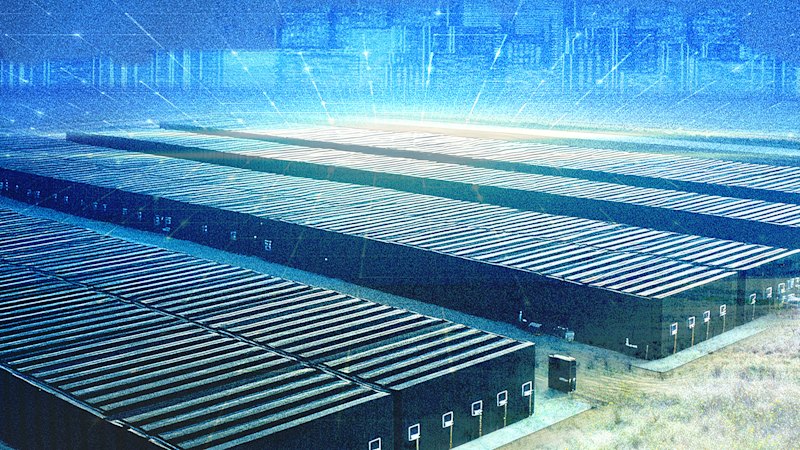
The largest data centre ever publicly proposed in Australia is being quietly mapped out for Melbourne’s outer west, with the 350-hectare mega-hub so big it will need its own gas turbines to avoid tripping the power grid.
Dubbed the “Victorian AI Hub”, the precinct aims to attract global tech giants with a planned 2.4-gigawatt capacity, representing a maximum power demand that exceeds the total output of Loy Yang A, the state’s largest remaining coal plant.
At 350 hectares, the project would cover the equivalent of 175 MCG playing fields.
Its developer Syncline Energy says the hub in Plumpton – 30 kilometres northwest of Melbourne’s CBD – will enable Victoria to capitalise on the AI boom, and be a job creation centre for the northern and western suburbs.
It would feature two data centres on a site next to the state-backed Melbourne Renewable Energy Hub battery storage facility – originally developed by Syncline and now part-owned by the State Electricity Commission (SEC) – where five major transmission lines intersect.
According to a submission to the Australian Energy Market Operator (AEMO) seen by The Age, the data centres will rely on localised gas power turbines to buffer the network against sudden 40 per cent swings in energy demand typically triggered by intensive AI training models.
Syncline Energy chief executive Scott Galloway said the precinct would rival the largest data centre projects in the United States, Malaysia and India.
“In Victoria, we have the grid capacity at that location, we’ve got climate, we’ve got a supply of reclaimed water, and we’ve got the connectivity,” he told The Age.
Galloway said the first stage would come online in 2030, ramping up to full capacity by 2035.
He conceded data centres posed distinct planning challenges due to their imposing scale and cooling system noise. However, he argued the Plumpton location was better suited than established suburban areas.
“We just don’t think it’s appropriate to shoehorn those into residential areas or even most industrial areas,” he said.
The sector’s capacity to spark local backlash is already evident in West Footscray, where the fast-tracked expansion of a major data centre has fuelled concern over constant construction noise, imposing buildings, and a low-frequency background hum.
The Plumpton hub’s building component will span about one-third of the 350-hectare site, which Syncline has been in prolonged talks with landowners to access.
While data centres typically require vast amounts of water for hardware cooling, Syncline’s proposal outlines plans to use, process and store reclaimed water sourced from Melbourne’s outer suburbs.
Galloway said he was in talks with the state government, and they had been positive about the proposal.
A spokesman for Premier Jacinta Allan said any proposal would be assessed on its merits and in accordance with the relevant planning scheme. The government is yet to receive a formal application for the site.
“Data centres are the backbone of our digital economy, and we’re going after the jobs they create,” he said.
“Our plan will position Victoria as the national leader in data centre investment.”
Data centres are frequently criticised for devouring land and power while offering few long-term jobs once construction wraps up.
The company does not yet know how many workers will be required to run the site once it is up and running, although Galloway maintained it would be substantial.
He said the project’s multi-phased construction pipeline, running until 2035, would support at least 12,000 jobs and secure years of steady employment vital for training new apprentices.
Ultimately, he said, establishing local high-speed infrastructure would act as “an absolute enabler of Australia’s economy in the future”, partly by eliminating the lag of routing data through US or Malaysian servers.
However, the massive scale of the proposal and its location in a green wedge – an undeveloped area heavily protected from urban sprawl and development – reveals an emerging tension between the Allan government’s lofty data centre ambitions and its planning laws.
Josh Maitland, Colliers’ urban planning director, said Victoria’s planning rules should be loosened to allow more data centres, arguing the industry was too reliant on the goodwill of the government of the day to get them off the ground.
Speaking at a Property Council of Australia event in Melbourne last week, he praised the development facilitation program – which had seen some data centres approved within four months – but said that was not enough on its own.
“We need to start from a position of support,” he said.
Acknowledging it would generate controversy, Maitland said data centres should be allowed to build in green wedges, pointing to areas including Plumpton which had strong availability of land.
The massive proposal at Plumpton also comes amid growing uncertainty about the volume of data centres in the pipeline likely to proceed and the strain they will ultimately place on Victoria’s transitioning energy grid and water supply.
The Allan government has made no secret of the fact that it is aggressively courting global tech titans to establish operations in Victoria, seeing itself in a race with Sydney to attract billions in capital investment.
However, the state is already facing a tight energy supply outlook as it races to replace ageing coal generators with renewables, and faces an impending gas supply crunch. The boom could also force an $840 million expansion of Victoria’s desalination plant to begin within five years.
Galloway said more than 80 per cent of the precinct’s power generation would be supported with renewable energy and be able to mop up excess solar power.
“In addition to that, we’ll have gas turbines. They won’t be [baseload] fired by gas, but they are providing inertia into the system,” Galloway said.
Industry lobby group Data Centres Australia has sought to downplay fears of an unsustainable pipeline, saying that the vast amount of connection requests made to energy agencies – which exceed 18 gigawatts in Victoria alone – are highly unlikely to proceed.
A major data centre cluster has already emerged in Melbourne’s west – across Truganina, Derrimut, Laverton, West Footscray, and Brooklyn – driven by access to power and available industrial land. Another major precinct is developing at Fishermans Bend.
But data centres are also venturing into regional Victoria. In the Latrobe Valley, the Morwell Data Centre is in early-stage development with a planned capacity of 720 megawatts.
 Daniella White is a state political reporter for The Age. Contact her at da.white@nine.com.auConnect via X or email.
From our partners
Read the full article here