




He led the creation of a rating system to highlight the state’s best builders, convinced a prickly parliament to pass sweeping legislative reform and cleaned up the industry to the extent that NSW is now the only state to have insurers return to offer consumers 10-year insurance for serious building defects.
But he has also resigned and un-resigned, got in trouble over his brash social media posting and gone viral with footage of him eating concrete on a worksite.
The Mascot Towers scandal was among the low points of David Chandler’s tenure.Credit: Louise Kennerley.
How did David Chandler end up here?
Everybody with their hair on fire
It was a Friday morning in early 2019 when Chandler, ending an adjunct professor role at Western Sydney University, got a call from a department official requesting a coffee that afternoon.
At the meeting, it was explained that the government would be establishing a new position: building commissioner. The following Monday, he had an official hour-and-a-half interview, and two hours later he got a call. When could he start?
‘The first couple of months were a kitchen of hell, in a way … it was a bit of a free-for-all.’
Building Commissioner David Chandler
“Soon,” he said – but not first without talking once again to his mentor Colman, who warned him: “It’s a big job, a bit of a poison chalice … All you’re doing is reacting to Grenfell Towers’ flammable cladding, Mascot Towers and Opal Towers. You’ve got everybody with their hair on fire, and they’re asking you to jump in the saddle.”
Chandler accepted the job, with a remit to investigate misconduct in the industry and reform the state’s building legislation. Almost immediately, it was “pretty volcanic”.
“The first couple of months were a kitchen of hell, in a way,” he recounts. “The [Labor] opposition was very focused on making the government embarrassed about the state of the industry, planning and all that stuff. So it was a bit of a free-for-all.”
“What I wasn’t expecting was the poor quality of buildings I ran into. I’ve had a pedigree career; I’ve only been on good quality projects. So to be confronted with some of this stuff, I just shook my head and said ‘what the hell?’”

Ragazzi’s gigli pork and chilli sausage pasta.Credit: Steven Siewert
Chandler’s interventions, including stop-work orders and building rectification orders, were deeply unpopular among some industry figures. Chandler shows me an album on his phone of the online abuse he receives semi-regularly, mainly on his very active LinkedIn page.
Trolls in the industry use his inbox “as an abusive platform to get shit off [their] liver”, he says before taking another swill of wine.
From New Guinea to Sydney
This urban Italian restaurant could not be further from where Chandler began life. Born in Medang, New Guinea (now in Papua New Guinea), his parents “came south” to Sydney when he was two, before relocating once more to New Guinea when he was 10. His father worked in aviation.

Beef tartare.Credit: Steven Siewert
His parents separated when he was 13, and news of the scandal spread quickly in Port Moresby, Chandler remembers. Within a week, the teenager was flown down to Sydney’s Trinity Grammar School, where he’d spend the new few years boarding. It was “midterm and bloody cold”.
During school holidays, Chandler would return to the island and head “straight to Kokoda with my mate”, spending his school holidays on a rubber plantation near Kokoda village, 100 kilometres from Port Moresby.
The disparate experiences of life in New Guinea and in one of the country’s most prestigious schools were connected by an unlikely force: the Church of England. His parents were involved in a church in Port Moresby while, in Sydney, he says he experienced an education in ethics, so much so that he began considering joining the church for full-time ministry when he left school.
“My mother said, ‘Well, that’s a nice idea, but if you’ve got that in your mind now, then, before you do it, I want you to go around the world for a year, and I’ll pay for it.’”
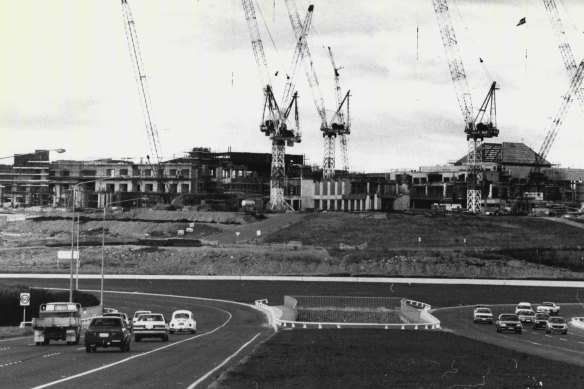
The construction of Parliament House was behind schedule when David Chandler stepped in.Credit: David James Bartho/Fairfax Media
He never got on the plane: he was introduced to a family friend working in construction, who eventually encouraged him to study the subject at UNSW.
Rising from a construction cadet to project manager, Chandler was eventually recruited to solve the ticking time bomb that was Canberra’s new parliament house. The building project was two years behind schedule. Barely any money had been spent, and the Queen was due to visit on Australia Day 1988. The brash 34-year-old, thrilled by the challenge, got it done.
“I gained a reputation for being very good at finishing hard projects in strife,” he says.
It was that reputation that made Chandler’s surprise resignation as commissioner in 2022 so alarming to those who knew him.
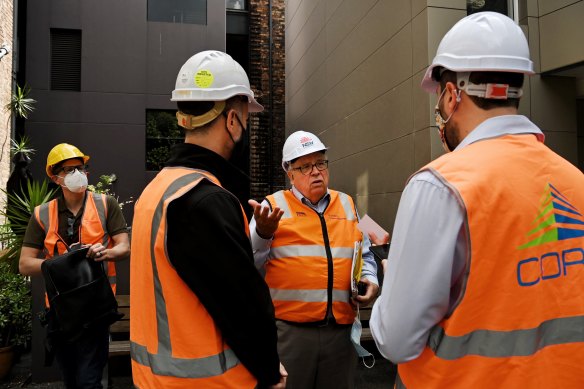
Chandler on site during his time as Building Commissioner.Credit: Kate Geraghty
A leaked video showed him telling construction workers that he had an “informal list” of certifiers that should not be trusted, sparking claims that he had misled parliament. Fair trading minister Eleni Petinos announced an internal investigation, which exonerated him. He resigned anyway.
In an explosive resignation letter, which then-premier Dominic Perrottet referred to the Independent Commission Against Corruption, Chandler revealed concerns about “an advised relationship” between Petinos and Sydney developer Coronation Property. Former deputy premier John Barilaro had recently joined the company’s board.
Petinos was sacked over unrelated bullying allegations and rejected all allegations against her. Chandler returned shortly after.

David Chandler (centre) wrote a resignation letter containing allegations against then-fair trading minister Eleni Petinos (left), which was referred to ICAC by Dominic Perrottet.Credit: Wolter Peeters, Kate Geraghty, NCA Newswire
I’m curious to know what went on behind closed doors, but the usually chatty commissioner doesn’t want to talk about it. “That’s got brackets around it at the moment that are best not for me to go down,” he says solemnly. “It’s got other elements, but it’s best I stay out of it.”
‘I’m still angry now’
We turn to a piece of paper he has been doodling on in between courses. He is drawing the structure of a Zetland building made so badly that he still gets emotional thinking about the cost to its residents.
“He’d done a shambles of a job,” Chandler said of the developer. “The roof failed, everything failed, and all of the timber became soaked, all the plasterboard fell off the walls.”
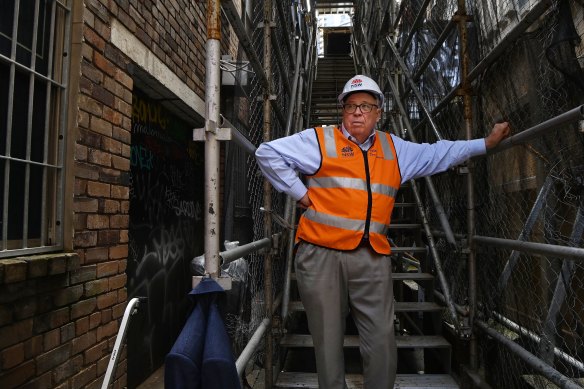
Chandler has been heartbroken by the state of some of the buildings he has investigated.Credit: Kate Geraghty
The residents, mostly single female essential workers purchasing their first properties, came to Chandler to request help.
“There was nothing I could do. That was the most heartbreaking experience, and very frustrating.”
“There are a number of projects where I’ve felt 100 per cent impotent. That’s pushed me on to be less accommodating. The [dodgy builders] that pop up now, they probably get a bit of that thrown in: I’m still angry now, so you can have a bit of it.”
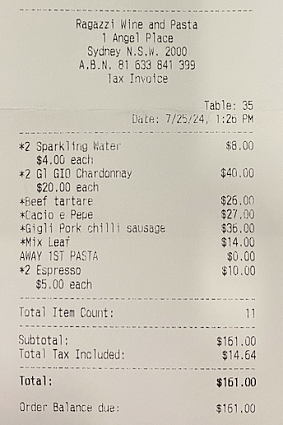
The bill.
That anger will propel him to 5pm on August 14, and then he’ll take a break.
“I’m exhausted … I look in the mirror and think, ‘Mate, you’ve worn yourself out with this one.’”
But after that? He’s open to suggestions, but is thinking about how to showcase excellent construction work. (But he won’t do it for nothing: he says if you’re not paid, you’re not valued.)
There’s some poetry to Chandler’s life. The man who once wanted to enter the church ended up a reformer of the industry connected to Australia’s most popular religion: homeownership.
“Don’t ever hold me up to be saintly,” he says as two espressos arrive at our table. Chandler recites his school’s Latin motto: Detur gloria soli deo, let glory be given to God alone.
‘If I could have nothing else on my tombstone, I’d like it to be that I had a resolve to my ethics.’
David Chandler
“Well, I don’t buy into that, but what I do believe in is that your life should be defined by an attempt to do good, and that’s what you take to your grave.
“If I could have nothing else on my tombstone, I’d like it to be that I had a resolve to my ethics.”
Read the full article here