



We’re approaching the danger point. As winter gives way to spring, every Australian starts looking up, warily cataloguing flashes of black and white among the branches of trees.
As magpie-nesting season begins in earnest, plans are hatched to stave off attacks from the territorial birds. Some of us will share morsels of minced meat with them to try to earn safe passage, convinced the birds have long memories and it’s possible to endear ourselves to them. School kids start carrying long sticks, hoping a few seconds of defensive flailing will grant them time for a getaway. Because we all know what could happen if the sound of wings rings too close in our ears at this time of year.
For radio broadcaster Lauren Taylor, a morning dog walk in Melbourne turned bloody last year when, out of her peripheral vision, came a black-and-white blur. Then a nesting magpie latched onto her face. “I wasn’t sure if it was the beak or its claws that popped into my eye,” Taylor recalls. “I had to physically grab it, while it was attached to my eye, and pull it off. I looked down and it was like … the jelly of my eyeball [on the ground]. I got myself to the eye hospital, and they told me if [the puncture] had been a millimetre over, I would have been in serious trouble.”
To add ironic insult to gnarly injury, this happened at Victoria Park – the historic home of the AFL’s Collingwood Magpies.
Taylor’s eye healed but her daily routine changed. She abandoned the Magpies’ home ground, rerouting her walks along the banks of the Yarra. And she wore sunglasses as a protective shield.
Taylor’s trauma is shared by dozens of Australians every spring. According to a study in the Clinical and Experimental Ophthalmology journal, between 2006 and 2022 the vast majority of bird-related injuries that presented to the Royal Victorian Eye and Ear Hospital were caused by territorial swooping birds.
For a country that prides itself on innovation – the birthplace of Cochlear implants, the goon sack, the black box flight recorder and the lamington – the collective defence against a known threat has amounted to little more than googly eyes and cable ties atop bike helmets. God help the runner trying to hit their 10,000 steps or the parent juggling a pram if they happen to take a wrong step near a nest.
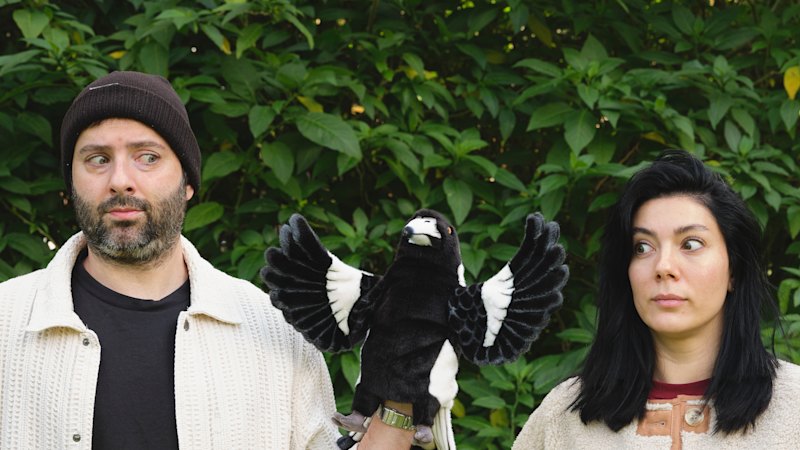
Melbourne couple Burak and Naz Kaya have taken stock of the mounting injuries and come up with a different solution. Their app, Magpie Radar, launched earlier this year. After being swooped and attacked by maggies, Burak realised that, while we can’t change the behaviour of wild animals, we can adjust our own to avoid them.
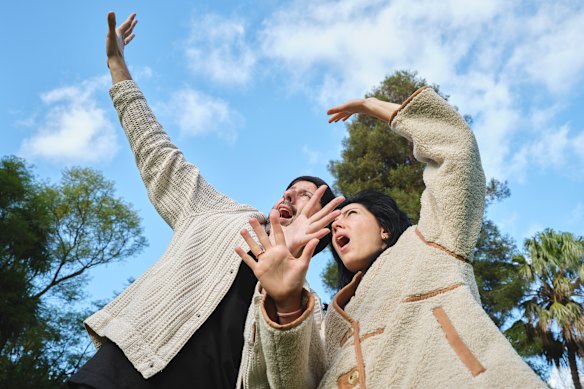
“These birds have been in these lands for thousands, millions of years,” says Burak, a technology project manager. He and Naz met in Türkiye, and moved to Australia, where his mother is from, in 2019. “To them, we’re the ones who are not familiar to this land. They’re doing their best to protect their nests.”
His solution was a warning app using crowd-sourced information – similar to those alerting Australians to other threats, such as sharks at the beach or ticket inspectors on the train – and real-time navigation. Over four months, Burak collaborated with a team in India to develop the app, while Naz – who balances the project alongside her work at the family’s Turkish restaurant – designed the user experience.
When users open Magpie Radar, they can see any recently reported attacks. If swoops have happened on their running route, the app can recalculate a safer one. A yearly subscription costs $5 for use of both functions: reporting and route functionality. As independent developers, Burak and Naz say that’s to cover the $4000-$5000 they spent to make the app, and for the ongoing upkeep of web hosting, maintenance and sending SMS alerts.
As young parents, the couple also saw the potential of the product to take the fear out of magpie spotting. “We wanted to build something serious but fun at the same time,” Burak explains. “It’s a bit gamified, almost like Pokémon Go [where you catch virtual creatures in the real world using your phone] – people can go around and search.”
Burak has plans for how the app can be used to alert his neighbours to other threats – such as snakes – and less terrifying local sights. “At Christmas time, I’m thinking of putting [houses with Christmas lights] on the app, as it’s hard to discover them. And on Halloween, families can use it to see tagged houses giving out lollies.” It’s almost a type of next-gen neighbourhood watch, putting the power of staying safe and keeping kids engaged in our collective hands.
For Lauren Taylor, the app might not have saved her from a magpie swooping, but she could have at least warned others – and also answered the one question that nagged her long after the stealth attack.
“I was like, ‘What is my responsibility? Should I have reported that to the council, or to other people?’ ” she says. “I think I would use an app like that so I didn’t have to be worried about magpies.”
Get the best of Good Weekend delivered to your inbox every Saturday morning. Sign up for our newsletter.
Read more from Good Weekend:
Read the full article here