



The cost of raising children has become so high that parents and those hoping to become them are being forced to shrink their intended family size, Australia’s leading parenting advocate says.
New data from national advocacy organisation The Parenthood shows the cost of raising one child per year now sits at around $17,800 a year, and two or more costs more than $36,500.
Georgie Dent, a mother of three and chief executive of The Parenthood, will address the National Press Club on Wednesday warning that Australians are at risk of being priced out of parenthood. It comes two days after Treasury released its latest intergenerational report, which forecasts the nation’s steep birth rate decline will reshape the economy in coming decades.
“The birth rate has plummeted and a significant part of that drop is not in desire, it’s in affordability,” Dent told this masthead. “Parents are genuinely beside themselves; so many families are very genuinely squeezed.”
The intergenerational report predicts that the national fertility rate will drop to 1.34 by 2065-66 (a fertility rate of 2.1 is needed for the population to be replaced from one generation to the next without migration), meaning deaths would outnumber births. This compares with the stated wish of Australian men and women to have more children: “Men want exactly two kids, and for women it’s 2.1 – but that’s not what’s happening,” Dent said.
Australia is already wrestling with rock bottom birth rates, which fell by 25 per cent to a record low of 1.48 in 2024 from a peak of 2.02 in 2008.
Dent says that without better access to childcare, a big increase in paid parental leave and more support from workplaces, this will only worsen.
The Parenthood’s research, commissioned analysis from consultancy ConnellGriffin, found that over the last two decades, the cost of running a family has risen 32 per cent higher than family incomes grew over the same period.
“What it actually takes to run a family has risen 134 per cent, but the money that lands in the bank each week has risen only 102 per cent [in the last two decades],” Dent will say in her Press Club address. “Childcare has climbed from 27 to 33 per cent of the cost of raising a child.”
Previous research commissioned by The Parenthood also found the struggle for parents in regional, rural and remote areas to access childcare is so great that 86 per cent “are experiencing financial stress as a result”.
The costs measured by ConnellGriffin are higher than those released by the Australian National University’s Centre for Social Policy in June, which estimated one child costs roughly $13,000 per year, and two costs $23,000 – a figure that equates to about $391,000 over 17 years.
Public policy changes such as increasing the minimum paid parental leave scheme from the current six months to the OECD average of one year, and providing “genuinely universal” affordable, accessible, quality childcare delivered by a professionally paid and supported workforce would free parents both to work the hours they need and afford subsequent children, Dent said.
“In 2020, only 12.5 per cent of centre-based [childcare] services had average fees above the fee cap. Today, it is about 43 per cent.”
Dent has campaigned for 18 months for a national Early Childhood Education and Care Commission to oversee delivery of quality, accessible universal childcare.
Given one-third of Australia’s current workforce has dependant children, and Treasury’s Centre for Population estimates that if people’s fertility intentions had been realised between 2001 and 2022, Australia could have had an additional 881,000 births, Dent will argue that doubling parental leave and boosting childcare will have a meaningful impact.
“Remove the childcare subsidy and fund it like schools,” she told this masthead on the eve of her speech. “These changes would enable people to afford the number of children they could really like.”
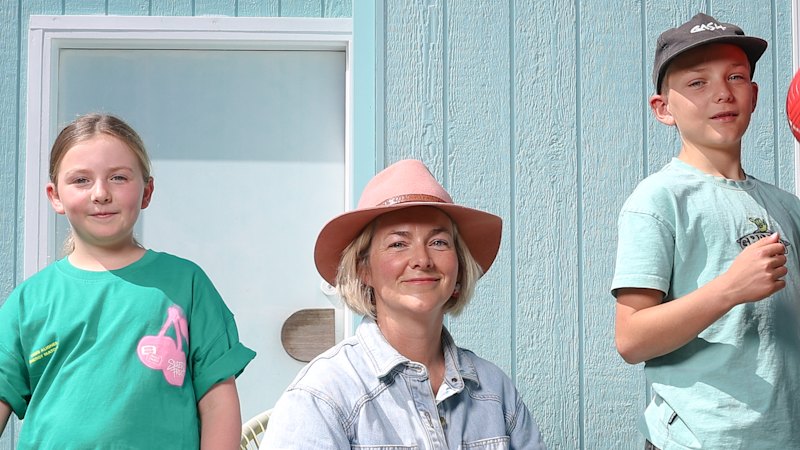
Mother of three, Francesca Steele, who recently wrote to Dent about the incompatibility of federal and state childcare subsidies, will observe the speech from the home she shares in Jan Juc on Victoria’s surf coast with her husband and three children aged 11, eight and two-and-a-half.
Steele, an associate director of human rights and social impact at KPMG, and her husband, Simon, a winemaker, say that although they consider their family to be financially comfortable, the rocketing cost of living has forced them to cut back on holidays and children’s extracurriculars, among other expenses.
Of cost of living increases recently, Steele says, “it feels exponential”.
“I feel very privileged, [but] when we look at our monthly income, costs and outgoings, we’re actually going backwards,” she said.
Many parents also need to help support elder relatives as their children are entering their teen years, because of failures or gaps in the aged care system and costs associated with specialist dementia care, she said.
Families like Steele’s, who are navigating this and the fact that mothers’ incomes and job promotion opportunities have historically been curtailed by the need to cover childcare, are pushed to find the extra money to also support their parents’ needs.
“We don’t go out to eat or get takeaway food, we’re not spending money on extravagant things like clothes; we live a pretty simple life,” Steele said. “I have no idea how other people are surviving.”
Start the day with a summary of the day’s most important and interesting stories, analysis and insights. Sign up for our Morning Edition newsletter.
 Wendy Tuohy is a senior writer focusing on social issues and those impacting women and girls.Connect via X or email.
From our partners
Read the full article here