

A pineapple-sized fungus has quietly grown undetected in the forests of southwestern China – until now. The massive mushroom may set a size record for a major branch of the fungal family tree.
The fungus — named Dianjunus rex — may also represent a previously unknown family, researchers report September 28 in Frontiers in Fungal Biology. Fittingly, D. rex is part of a lineage that split off from other fungi right after the dinosaurs — like T. rex — went extinct.
In 2024, researchers in China were conducting a survey of fungal diversity in a tropical rainforest in Yunnan Province when local farmers tipped them off to an unusual fungus in the area. The farmers included photos, says Indunil Chinthani Senanayake, a mycologist at the Kunming Institute of Botany in China. Some of the farmers who’d made the discovery took a bite of the mystery fungus, Senanayake says, and the tipster “wanted to confirm whether it was edible or not.”
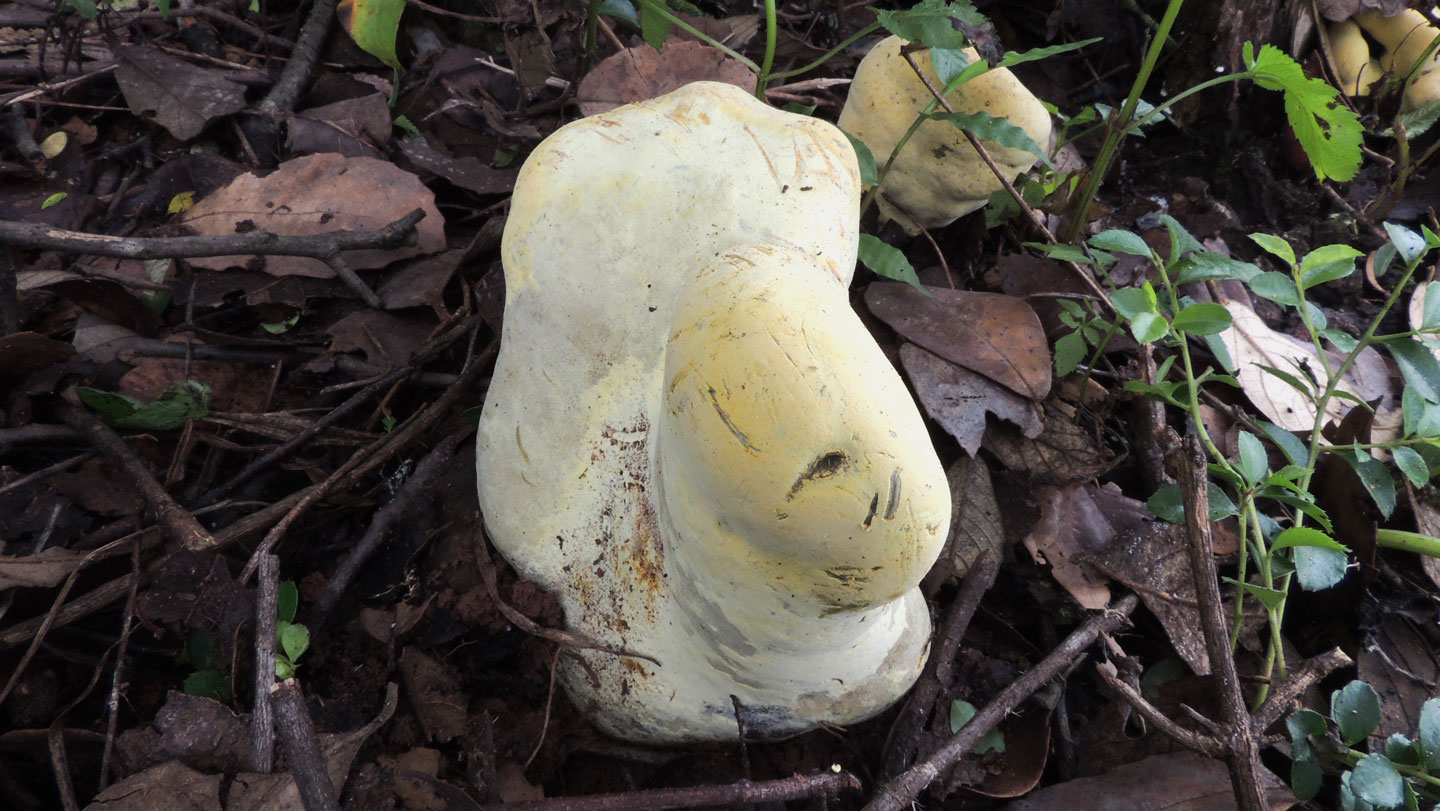
When Senanayake and her colleagues went to the location, they found strange, yellowish, tentacle-like and spatula-like mushrooms growing out of decaying tree roots. These were some kind of ascomycete, or “sac fungi”. Sac fungi like morels, truffles and molds make their spores in microscopic bladderlike receptacles, unlike the bowling pin-shaped reproductive structures in club fungi, the group that includes most culinary mushrooms.
The mushrooms we see growing out of the ground are called fruiting bodies and make the spore-producing cells for the often hidden or subterranean fungus. Most sac fungi have relatively small fruiting bodies. But the mushrooms growing off these mysterious Yunnan fungi were enormous, with some reaching 50 centimeters tall. The team took samples of the fungi back to the lab for further study and found that they weighed up to 2.2 kilograms. By their estimates, these are the largest spore-making fruiting bodies among all sac fungi.
Torda Varga — a mycologist at the Royal Botanic Gardens, Kew in Richmond, England who was not involved with the research — notes that some truffle species are known to get close to the bulk. D. rex appears to be the largest sac fungal fruiting body he’s aware of. “What I find particularly remarkable is that a fungus with such an enormous fruiting body appears to have remained scientifically undocumented until now,” says Varga, though he adds his experience has mostly been within Europe.
The researchers compared samples of the fungus’s DNA with those from other fungi to determine its evolutionary relationships. They found that it was a relative of species like candlesnuff fungus and dead-man’s-fingers, which make fruiting bodies only a few centimeters tall, but that it was probably in its own, unique family. The team gave the new species the name Dianjunus rex, referencing both the Latin “rex” for “king” and the ancient Dian kingdom of the region.
The team’s genetic analysis suggests D. rex’s family first evolved in the aftermath of the mass extinction at the end of the Cretaceous Period that wiped out the dinosaurs, some 65 million years ago. “During the dark, cold, postimpact years after the mass extinction, fungi that decompose dead organic matter could keep functioning better than light-dependent photosynthesizers,” Senanayake says.
Varga wonders if searching databases for bits of DNA shed into the environment could help uncover other members of D. rex’s royal family in the absence of physical specimens.
“Some of these [genetic] sequences might belong to previously undocumented relatives of Dianjunus rex,” he says. Finding these hidden species could tell researchers more about the biology and evolutionary history of this king of the sac fungi.
Read the full article here