



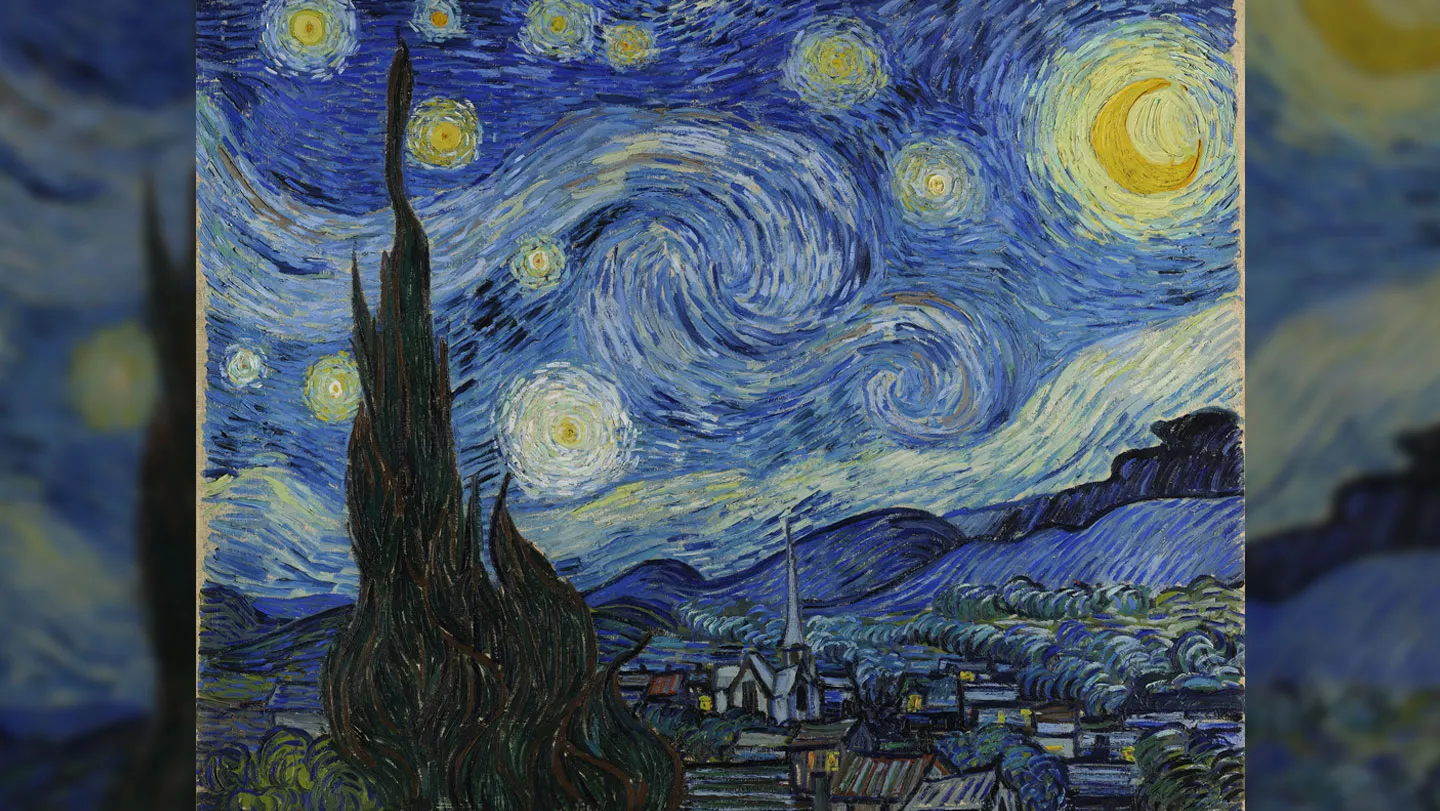
Vincent van Gogh’s “The Starry Night” may have been based on one specific night sky: July 22, 1889, just before dawn over France.
If that’s true, it means the famous painting was based on real observations, not just van Gogh’s imagination, astronomer Elijah Jeong-hyun Kim and colleagues report October 22 in Scientific Reports.
“How could an invented sky fit the sky of a particular date this closely?” the team writes. “Observation and imagination have commonly been treated as an either/or, yet ‘The Starry Night’ shows the two coexisting on one canvas.”
Art historians typically date “The Starry Night” to mid-June 1889, based on one of van Gogh’s letters to his brother Theo.
“At last I have a landscape with olive trees, and also a new study of a starry sky,” van Gogh wrote on or about June 18. About a month earlier, van Gogh had entered a hospital in Saint-Rémy-de-Provence, France. “The Starry Night” is thought to represent the view through the window of his room. A short time later, van Gogh experienced an illness during which he didn’t paint for about six weeks, so most historians think “The Starry Night” must have been painted before then.
That letter is taken as strong evidence, says astronomer Donald Olson of Texas State University in San Marcos, who has written about how astronomy shows up in art history. Historians favor the June date because “van Gogh himself said so,” he says.
That assumption has led to some confusion, though. In the 1980s, two astronomers tried to match the painting’s stars to real skies in Saint-Rémy in mid-June. One proposed that the sky was from June 19, 1889, and the collection of swirly stars is the constellation Aries.
But the other concluded it couldn’t have been painted on June 19, based on cloudy weather reports in Aix-en-Provence, France, about 70 kilometers away. That study claimed the painting was “a celestial composite, constructed to make an image of the morning sky.”
Kim, who founded a telescope-building company called SLABB INC in Seoul, South Korea, didn’t know about the June date when he became interested in “The Starry Night.” “Unlike previous astronomical studies, we could start freely,” he says.
Given his job, Kim had an intuition for which stars would be visible when. “People like me, who guide a telescope through its first alignment with the sky, naturally memorize where the stars are,” he says.
He was skeptical of the Aries theory. The stars in that constellation are faint enough that they wouldn’t be all that visible in the predawn sky, “hardly enough to inspire a painter,” he says.
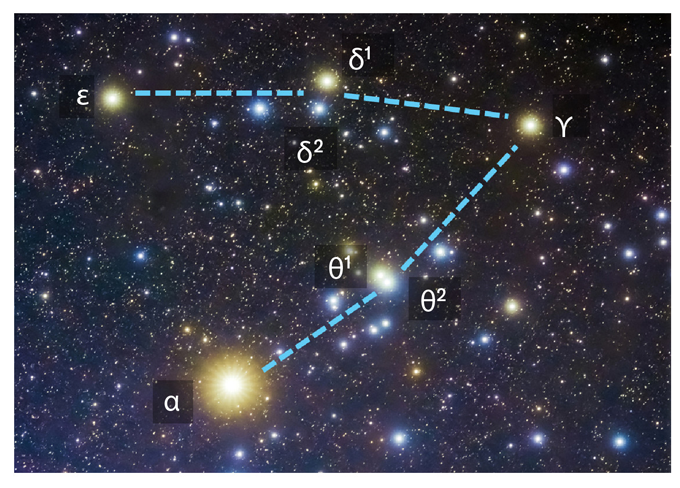
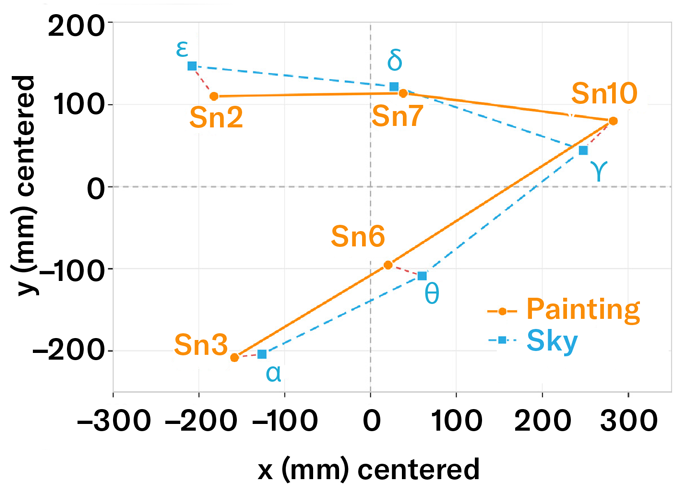
Instead, Kim saw the stars as the Hyades star cluster, which forms a sideways V shape in the constellation Taurus. To test that theory, he and his colleagues applied a statistical technique called Procrustes shape analysis to put a number to how well the stars in the painting matched any particular constellation.
Celestial alignment?
Researchers compared the V-shaped collection of stars in “The Starry Night” (first image) with those in the Hyades star cluster (middle image). The resulting graph (last image) maps the real stars (blue) and the painting’s stars (orange) against each other. They don’t overlap perfectly, but they’re suspiciously close, researchers say. The label Sn stands for “The Starry Night.” while the constellation’s Greek letters represent typical astronomy notation.
-
E.J. Kim et al./Scientific Reports, 2026 -
E.J. Kim et al./Scientific Reports, 2026
The team tested the method on another van Gogh skyscape, “Starry Night Over the Rhône,” which clearly depicts the Big Dipper. “Apart from the Big Dipper, there is no star pattern we can say for certain that Vincent painted,” Kim says. The degree of matching between the art and the sky for both paintings turned out to be similar, a major clue.
Kim also used the position and phase of the moon (a waxing gibbous on June 19, in contrast to the sharp waning crescent in the painting) and Venus to further constrain the painting’s date. He used computer simulations that weren’t available in the ‘80s to calculate the positions of celestial objects on certain dates in 1889 down to the second. He even traveled to France in June and July 2019 to try to find the field of view van Gogh would have seen from his window. Ultimately, July 22, 1889, was the best fit for the team’s data.
“I still cannot forget the moment we finally found the spot, overlaid the drawing on the view and saw it fit perfectly,” Kim says. “I was standing where Vincent had stood 130 years earlier. And the thrill I felt when I confirmed that the moon, the Hyades and Venus of July 22, 1889, fit exactly within the drawing’s field of view is still with me.”
Not to douse Kim’s enthusiasm, but that field of view may not be exactly what van Gogh saw, Olson says.
“The authors’ assumed narrow field of view, essential for their theory that the stars of the Hyades fill most of the canvas, is inconsistent with the much wider field of view required to encompass ‘The Starry Night’s’ round hills and cliffs,” he says. That casts doubt on the paper’s conclusions.
Olson proposes an experiment: Tell an amateur astronomer that “The Starry Night” depicts the Hyades and ask them to point out the star Aldebaran, which is at the bottom left of the V. In real life, this is the brightest star in the Hyades. But the painting has other much more prominent stars.
“If [the authors’] theory is correct, then this should be easy,” Olson says. Kim and colleagues identify Aldebaran as one of the two stars to the left of the cypress tree in “The Starry Night.” But Olson thinks others will see it differently. “A decent guess is that an experienced amateur astronomer, even when prompted to see the Hyades, will not identify Aldebaran as either of the two stars to the left of the cypress tree.”
Read the full article here