



Andrew Gollan has had quite the career. After completing an arts degree in Latin and ancient Greek in the 1990s, he moved to America, became a US resident and worked in Silicon Valley as a software engineer. But he felt there was more to life than writing code.
“I really wanted to do something which, I thought, was important,” he said.
After completing a master’s degree, where the language of instruction was Latin, he worked as a teacher across America before returning home to Australia. In 2019, he arrived at the Shire’s Caringbah High to relaunch the classical language at the school.
Across NSW, Latin has had some difficult decades, falling from 1558 enrolments – about 8 per cent of all students in the first year of the HSC – in 1967 to 129 students this year.
It is a long, steep decline which some might describe as terminal, so it might seem strange that Caringbah High would revive the language.
German had been on offer but struggled to attract students past year 8. The then-principal, who had his own fond memories of studying Latin, felt it might be a better fit. “That’s how he presented it to me at least,” Gollan says.
Six years on, things are going well. Year 7 students entering high school do a medley of languages, a term each is spent on French, Japanese and Latin before choosing one. So far, Latin has enough students to fill two year 8 classes and a decent-sized year 9 class. “I lose a couple between year 9 and year 10,” says Gollan.
The first cohort of year 7 students who commenced in 2021 sat the HSC Latin continuers exam this year. And six students who commenced the subject when in year 8 completed HSC exams last year.
“It’s a big ask for a school like this to run classes that are this small, and to do it regularly enough so the kids know that they’ve got a decent pathway to the HSC and they’re not going to be, sort of, chopped off at the knees,” he says.
In NSW, it’s not just Latin in crisis but other languages too. In the 1960s, over a third of students learnt a language other than English. Now it is about 6 per cent. When the NSW curriculum was reviewed in 2020, it was recommended requiring every student to commence learning a second language in primary. But it was never adopted.
Part of the problem is a lack of teachers – a French teacher at Newtown High pocketed a $20,000 sign-on bonus just for taking the job earlier this year.
Students in public schools are aware of the challenges with running languages, including Caringbah High’s Sarah Napper, 18. She associates Latin with exclusive private and certain selective schools. By comparison, she says while her school is selective, it’s commonly perceived as a “mid-tier”.
“I don’t think Latin should be exclusively taught in selective schools or these upper-tier private schools … I think everyone can do difficult things, and I think doing Latin has been really good for me,” she says.
While she enjoys the subject now, she says it was a steep learning curve.
“It’s an analytical language, which basically means that instead of using many words like English to encode a meaning, it instead encodes meaning through changing the words itself,” she said.
HSC enrolment data shows over the past 15 years, Latin has dropped from 176 students to 140 last year. But some schools have seen a small bounce in Latin enrolments, including some selective and certain private schools.
Among them is all-boys school Shore, where eight students took the subject last year. Latin teacher Joanna Watkins likes to categorise students who choose the subject into three distinct groups.
“The students with a maths brain enjoy the decoding of Latin,” she says.
There are the linguistic-inclined and then those with an interest in all aspects of ancient Roman culture. She’s also noticed something else.
“More recently, we get kids who have been tutored in Latin before they come into year 7,” she said.
She is unsure what exactly is driving that. “I can only guess that the parents are looking at schools which offer Latin,” she said.
She linked the subject’s popularity with the school’s high performance in the subject, while students aspiring to study at universities overseas saw it as an advantage. “In the US, those universities tend to value Latin. Cambridge and Oxford have a strong tradition.”
Dr Robert Kowalski, who has taught Latin and Classical Greek at the University of Sydney and numerous private schools and now works as a tutor, said the demand was driven by parents. “I think they want to have the kids very well-educated. If you give the kids an opportunity, they will pick it up.”
Across Sydney, the biggest enrolment of students in Latin is Sydney Grammar.
Its head of classical languages, Nathan Bottomley, said there were about six boys in his Latin class when he attended the school as a student in the 1980s. This year, there are almost 30. He said some believe it is useful when it comes to getting a high ATAR for university entry.
“Sometimes they get the impression, which we try to dispel, that it scales very well.
“The kids who I teach are genuinely enthusiastic,” he said.
But success comes with persistence and practice. “Students always want the trick. And the answer is always really boring – you just have to keep doing it. There’s something about being inquisitive in mastering a complex system, the pleasure of getting good at something.”
The next biggest cohort of students in Latin is Sydney Girls followed by Meriden, which has also seen a bounce.
Meriden principal Lisa Brown said it had strong enrolments in languages across the board and there was no special push to boost Latin enrolments.
“You have to have an ability and a real interest in Latin to be able to persevere. It is not an easy subject, you can’t just have a go at it, there has to be a deep interest and an ability to work hard.”
St Joseph’s College in Hunters Hill normally has about five students enrolled in HSC Latin. Last year it was just one studying the subject.
Director of teaching and learning Darren Frost said the school runs an “off-timetable” class in year 8.
“The boys love it, compared to the other languages. It is a skill they can transfer, which is one of the big reasons we maintain it,” he said.
When it comes to the HSC, he has noticed across the board a narrowing of the curriculum.
“The breadth is so important for our society,” he said. “People are gaming the system, as opposed to what education is about, and the passion of learning is lost.”
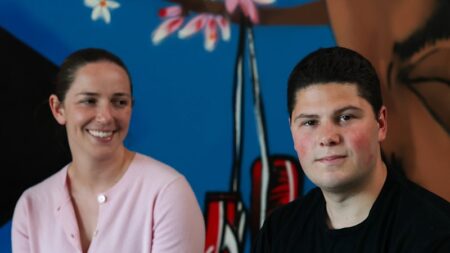
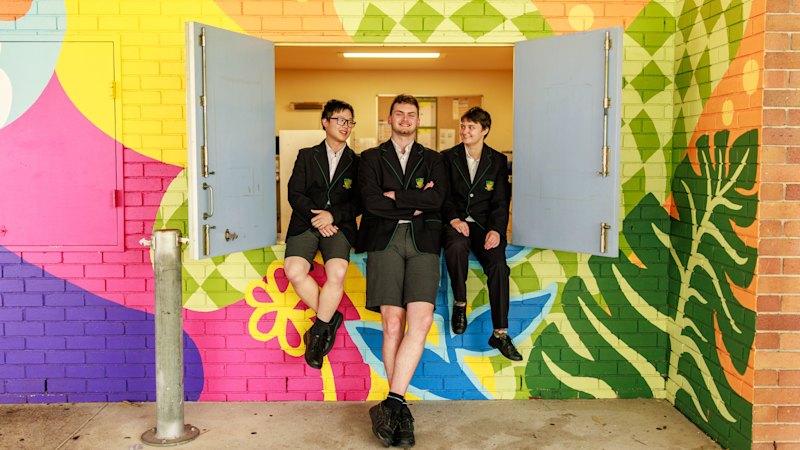
Back at Caringbah High, Xander Ezzy, 18, knows there’s only a small community in Sydney where he can converse in Latin. But its power was connecting with people who lived thousands of years ago.
“That was most enjoyable being able to connect it to a whole lifestyle that isn’t the lifestyle we have today,” he said.
Start the day with a summary of the day’s most important and interesting stories, analysis and insights. Sign up for our Morning Edition newsletter.
From our partners
Read the full article here