




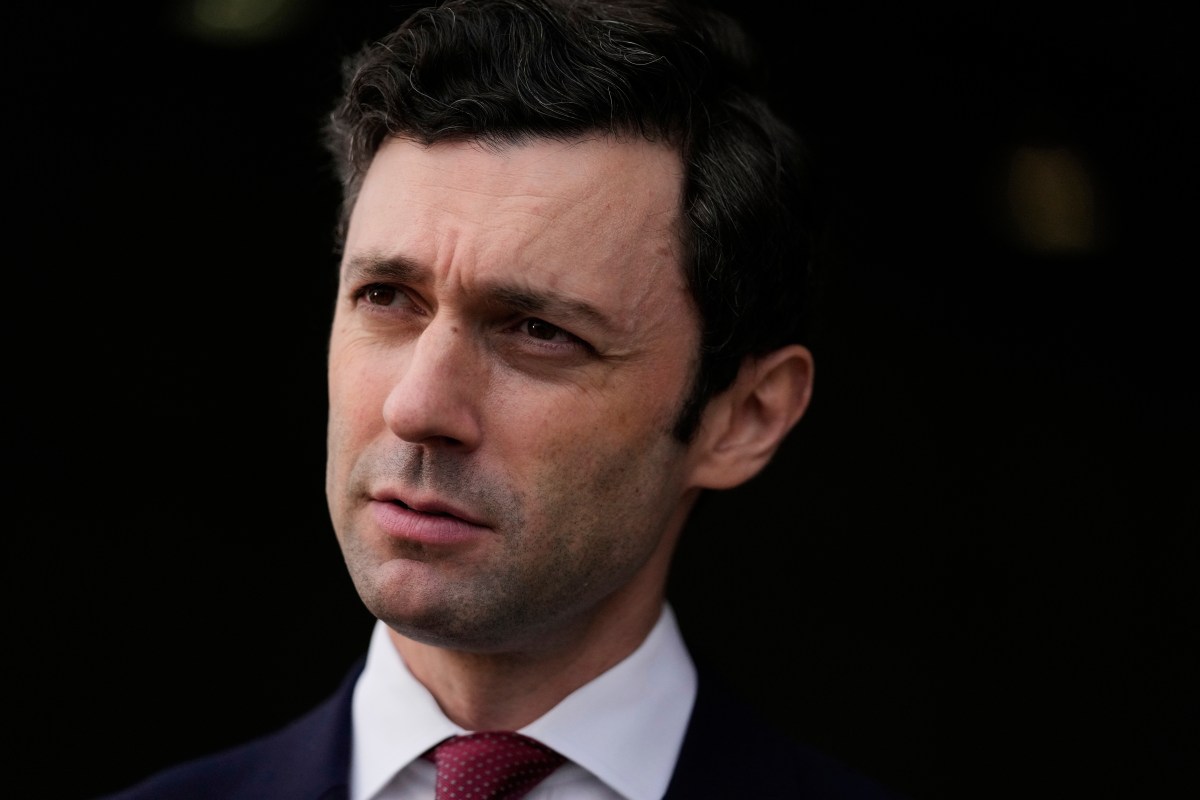
Democratic Senator Jon Ossoff may be in a stronger position for reelection than previously expected as Republicans head into a runoff between Mike Collins and Derek Dooley after neither candidate secured more than 50 percent of the vote in this week’s GOP primary.
While Ossoff has been viewed as one of the most vulnerable Democratic senators up for reelection given his seat in Georgia, his popularity could complicate Republican efforts to flip the seat, and recent polling still shows him faring better than his GOP counterparts.
Georgia is one of the key battlegrounds in the 2026 Senate map, where control of the chamber could hinge on a handful of competitive races. Last month, the Cook Political Report shifted the race from a “toss-up” to “Lean Democrat,” matching the rating from Sabato’s Crystal Ball.
Newsweek reached out to Ossoff’s campaign for comment via email.
Georgia’s Senatorial Race
Ossoff was first elected to the Senate in January 2021 after defeating Republican incumbent David Perdue in a closely watched runoff election that helped hand Democrats control of the chamber. His victory, alongside that of fellow Democrat Raphael Warnock, marked a historic shift in Georgia’s political landscape, long considered a Republican stronghold.
He is now running for reelection in one of the few Democratic seats being defended in states that President Donald Trump won in 2024. Republicans control the U.S. Senate 53-47, and Georgia is viewed as a must-win state for Democrats if they want to reclaim a Senate majority, given the difficult map they face in the midterms.
Trump has not yet endorsed a candidate in the race, leaving Georgia Republicans without a clear standard-bearer in one of the party’s opportunities to unseat a Democratic senator this year. The race comes as Trump’s approval ratings have slipped amid the Iran war and continued concerns over the cost of living. Still, Trump has largely maintained his influence over Republican primary voters, as the recent GOP primary in Kentucky demonstrated.
Republican Governor Brian Kemp has thrown his support behind Dooley.
Collins received 40.5 percent of the vote in Tuesday night’s primary versus Dooley’s 30.2 percent and Earl L. Carter’s 25.1 percent.
Ossoff also holds a major fundraising advantage over the unsettled Republican field. He raised more than $14 million in the first quarter of 2026 and entered April with more than $31 million in cash on hand, according to the Federal Election Commission (FEC) filings.
National Republicans are expected to pour more money into Georgia once the party has a nominee. The Senate Leadership Fund, the top GOP-aligned Senate super PAC, has already announced plans to spend $44 million in the state as Republicans target Ossoff’s seat.
What the GOP Primary Runoff Polls Show
A new InsiderAdvantage poll paints a tighter picture of the GOP primary runoff. The poll of 800 likely primary voters conducted May 20-21 found Collins leading Cooley, 46 to 40.6 percent in the runoff. About 13 percent of voters were undecided.
The poll has a margin of error of plus or minus 3.46 percentage points.
Connor Whitney, a spokesperson for Dooley’s campaign, told Newsweek on Friday, “Derek Dooley is the only political outsider in this race and the only candidate who can go on offense against Jon Ossoff’s failed record. They know Derek is the one to beat, and it’s why Georgia Democrats and the Washington establishment are doing everything they can to attack him.”
In a Quantus Insights snap poll of 739 likely Republican primary voters conducted on May 20, the day after the GOP primary, found that Collins leads Dooley by double digits, 53.5 percent to 37.2 percent. About 9 percent of voters were undecided.
The poll was conducted from 8 a.m. to 3 p.m. on Wednesday among 782 likely Republican Georgia primary voters. The survey polled 782 likely voters with a margin of error of 3.9 percent.
Corbin Keown, a spokesperson for Collins’ campaign, told Newsweek on Wednesday, “Despite being outspent 15-to-1 in advertising, Mike Collins came out with 40% of the vote in a five-way primary on Tuesday because Georgians recognize and reward hard work, authenticity, and a record of results. Derek has been unable to demonstrate any of those characteristics, and voters are acting accordingly.”
Depending on the winner of the runoff, Collins or Dooley would face off against Ossoff in November in the Peach State’s high-stakes senatorial race. The runoff will take place on June 16.
How Republican Candidates Are Performing Against Ossoff
Georgia has been one of the country’s most competitive battleground states in recent election cycles, with several statewide races decided by narrow margins. Trump carried Georgia by about 2.2 percentage points in the 2024 presidential election, after Joe Biden won the state by roughly 0.2 points in 2020. Trump won Georgia by about 5 points in 2016, while Mitt Romney won it by roughly 8 points in 2012 and John McCain by about 5 points in 2008.
The state currently has two Democratic U.S. senators and a Republican governor, highlighting its increasingly competitive and mixed political landscape.
There have been relatively few general-election polls testing the Republican and Democratic candidates, though the surveys conducted so far have generally shown Ossoff leading his potential Republican challengers.
In the general election, an April poll from NetChoice and Echelon Insights, a Republican-aligned polling firm, found Ossoff ahead of Collins by 7 points and Carter by 9 points in potential head-to-head matchups. It did not ask about a potential matchup between Ossoff and Dooley. The survey questioned 377 likely Georgia voters April 3-9 and has a margin of error of plus or minus 6.5 percentage points.
An Emerson College poll released in early March shows Ossoff with 49 percent of the hypothetical vote, compared to Dooley’s 41 percent, and 10 percent are undecided. The same poll shows Ossoff has 48 percent compared to Collins’ 43 percent, with 9 percent undecided. The poll was taken from February 28 to March 2 among 1,000 likely voters in Georgia, with a margin of error of 3 percent.
What Prediction Markets Say
Prediction market Polymarket gives Ossoff an 83 percent chance of retaining his Senate seat, while Kalshi places his odds at 84 percent.
Read the full article here