



More than one in three Australian babies thought to have a peanut allergy do not have the condition, according to a landmark study set to overhaul how food allergies are diagnosed and managed.
In Australia, most babies who react to peanut and test positive via a skin prick or blood test are told to strictly avoid the allergen.
But a world-first study led by the Murdoch Children’s Research Institute and the National Allergy Centre of Excellence, in collaboration with 10 paediatric hospitals across Australia, upends this decades-long approach.
The researchers were surprised to discover that 35 per cent of babies who had recently reacted to peanut butter, and also tested positive through a skin prick or blood test, could safely eat the legume without reacting during a medically supervised oral food challenge.
“It’s paradigm-shifting in terms of how we diagnose infant peanut allergy,” said MCRI population allergy group leader and NACE director Professor Kirsten Perrett. “We were all surprised.”
Australia is known as the allergy capital of the world, and has one of the highest reported rates of childhood food allergies, with peanut allergy affecting about one in 30 children. An estimated one in 10 babies have a food allergy.
The researchers came across the “serendipitous” finding as part of the ADAPT oral immunotherapy program, which involves treating babies with peanut allergies by giving them a daily dose of peanut powder.
As part of this program, which is offered at 10 paediatric hospitals including the Children’s Hospital at Westmead, Royal Children’s Hospital in Melbourne and Sydney Children’s Hospital, babies are first required to undertake an oral food challenge to confirm their allergy.
This involves consuming increasing amounts of peanut powder under strict medical supervision.
A total of 271 of the 778 babies involved in the program passed the oral food challenge, which meant they could lose their allergy label.
They did not need to embark on the immunotherapy program and were instead instructed to regularly keep peanut in their diets, according to findings published in the Journal of Allergy and Clinical Immunology: In Practice on Thursday.
Perrett said a history of a reaction, plus a positive skin-prick or a blood test, was insufficient to confirm a diagnosis in many babies.
“The gold-standard test, the oral food challenge, should be considered in young children so peanuts can safely be reintroduced immediately back into their diet if they do not react,” she said.
The researchers believe some infants may show a “transient allergy”, which might include hives and swelling, which resolves within a short timeframe of around six months. Another theory is that their initial reaction does not translate to an ongoing reaction with further exposure.
About 65 per cent of babies had a reaction during the oral food challenge, with 12 per cent experiencing anaphylaxis.
The researchers warned parents to never reintroduce allergens that have triggered a previous reaction without oversight from an allergy specialist.
Almost all babies who reacted during the oral food challenge embarked on oral immunotherapy, with 97.5 per cent successfully starting treatment at a dose guided by their challenge results.
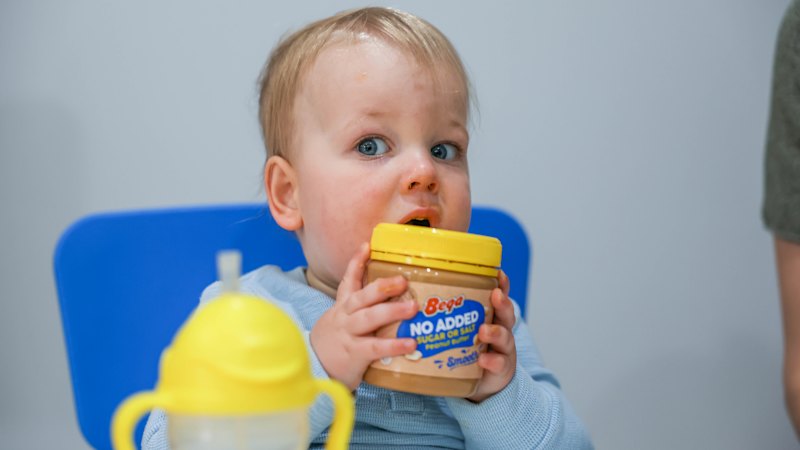
When Arthur was five months old, he broke out in hives after eating a teaspoon of peanut butter.
“It was certainly a little bit scary,” said his mother, Leah, who fed her son the allergen at their home in Geelong, south-west of Melbourne.
The family’s GP referred Arthur to an allergist, who confirmed the allergy with a skin-prick and blood test.
He was also referred to the ADAPT program at the Royal Children’s Hospital where, to the surprise of his parents, he passed an oral food challenge 10 months after his initial reaction.
An allergy nurse fed Arthur increasing amounts of peanut powder every 15 minutes, and he eventually consumed just under two tablespoons of the allergen without any signs of an allergic reaction.
While Leah was anxious ahead of the food challenge, she said the results were life-changing.
She has now been instructed to regularly feed her son peanut butter to ensure the allergen stays in his diet.
“It’s a bit weird after avoiding it for so long,” she said. “But it’s also reassuring every time that he’s fine and there’s no response.”
Leah is calling for better access to oral food challenges, particularly in regional Australia.
Ahead of the food challenge, Arthur and his family had to travel to Melbourne and book overnight accommodation.
Access to resource-intensive oral food challenges remains a challenge across Australia.
Public hospital clinics face heavy demand, while the ADAPT program has limited capacity and treats only babies.
In the private sector, families often face hundreds of dollars in out-of-pocket costs because Medicare does not have a dedicated item number for oral food challenges.
National health guidelines advise parents to introduce peanut butter or finely ground peanuts as soon as infants start solids to lower the risk of developing an allergy.
Mild to moderate allergy symptoms include hives, itching, lip swelling, tingling in the mouth, and abdominal pain. Signs of anaphylaxis, which is a life-threatening medical emergency, include difficult or noisy breathing, tongue swelling, a persistent cough or wheeze, and becoming pale and floppy.
The hospitals involved in the ADAPT program are John Hunter Children’s Hospital, The Children’s Hospital at Westmead, Royal Prince Alfred Hospital, SA Women’s and Children’s Network, The Royal Children’s Hospital, Campbelltown Hospital, Perth Children’s Hospital, Fiona Stanley Hospital, Children’s Health Queensland and Sydney Children’s Hospital, Randwick.
Clinicians hope to expand the ADAPT program to other allergens, most likely starting with cashew, which is the most common tree nut allergy in Australia.
It’s not known how the findings will impact the management and diagnosis of food allergies in older children and adults.
In older children, oral food challenges have traditionally been used to test if a child is naturally outgrowing an allergy.
Clinicians monitor their biomarkers over many years (watching for a drop in skin-prick or blood test numbers) before offering a challenge to see if the allergen can be reintroduced into their diet.
Start the day with a summary of the day’s most important and interesting stories, analysis and insights. Sign up for our Morning Edition newsletter.
 Henrietta Cook is a senior reporter covering health for The Age. Henrietta joined The Age in 2012 and has previously covered state politics, education and consumer affairs. Email her via henrietta.cook@theage.com.au or henrietta.cook@protonmail.comConnect via X, Facebook or email.
From our partners
Read the full article here