



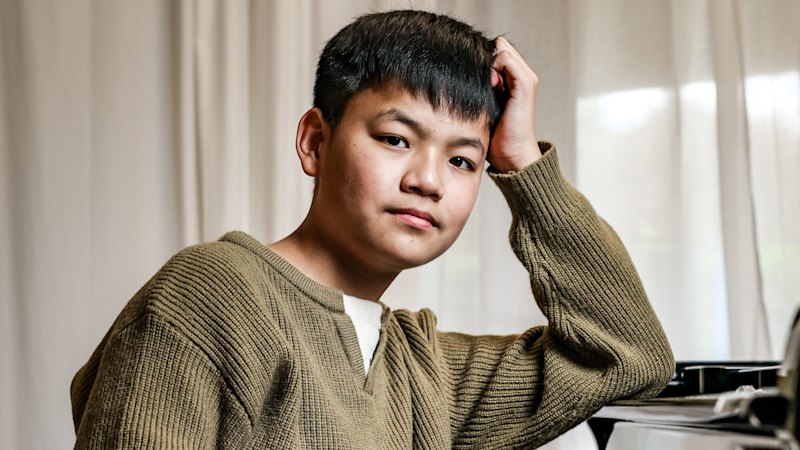
When Charlie Wu returned to school last week, he had an incredible yarn to tell his classmates about what he’d been up to during the holidays.
While other kids rode bikes and played video games over their winter breaks, 13-year-old Charlie travelled to the other side of the world to compete in one of the world’s top junior piano competitions – and won.
In his final performance for the Grand Piano Competition in Russia, Charlie conquered what is known as the Mount Everest of piano pieces, Rachmaninoff’s Concerto No. 3, accompanied by the Moscow Philharmonic Orchestra.
His mother, Ashleigh Wu, said she was proud and excited to witness Charlie’s triumph at Moscow’s Tchaikovsky Concert Hall, where he came equal first with Russian 10-year-old, Emir Zakaria.
“I think all his hard work paid off,” Ashleigh said.
Charlie admitted that he was nervous at first, but took a deep breath and immersed himself in the music.
“I tried to play my heart out,” he said.
Charlie began learning piano at age six; within a year, he had progressed to playing pieces by Beethoven – a strong sign of his potential and innate talent.
His piano teacher, Glenn Riddle, a Melbourne Conservatorium of Music senior lecturer, said he was “thrilled to bits” with Charlie’s win, describing the year 8 Caulfield Grammar student as a world-class pianist.
“By far and away, I think he’s the most outstanding talent I’ve ever seen in Australia. No question,” Riddle said.
Riddle, who also travelled to Moscow for the competition, described Charlie’s chosen piece of music as “virtuosic”, saying “the technical skills needed to play it are extraordinarily demanding”.
In the 1996 movie Shine, based on the true story of Australian pianist David Helfgott, playing “Rach 3”, as Rachmaninoff’s Concerto No. 3 is also known, triggers his mental breakdown.
“The second movement is very brooding, lyrical and intense,” Riddle explained. “And for the final movement, imagine the most thrilling carnival ride you’ve been on at Luna Park … it’s like that from go to woah, it’s like one giant rollercoaster ride. You barely get a chance to breathe.”
In addition to Charlie’s technical precision throughout his performance, Riddle said the 13-year-old showed engagement with the music and was able to communicate his passion for it to the audience.
“To keep the audience on the edge of their seats for an entire 25- or 30-minute concerto – that’s something very special,” he said.
“And he was playing what’s often not only regarded as being the hardest, but also the most passionate concerto in the piano repertoire.”
In response to the June 19 performance, the audience “went wild for him”, Riddle said. “They called him back for three encores. A lady burst out of the audience and presented him with flowers.”
Though the winning prize was a baby grand piano, Australia was deemed too far to ship such an item.
Instead, and on top of the cash prize of 400,000 Russian roubles ($7273), Charlie was given a cash prize of €17,000 ($27,000).
But for Charlie, simply travelling to Russia and being able to play with the Moscow Philharmonic Orchestra on “one of the greatest stages in the world” was prize enough. Winning the grand prix, he said, “was an excellent bonus”.
Get the day’s breaking news, entertainment ideas and a long read to enjoy. Sign up to receive our Evening Edition newsletter.
From our partners
Read the full article here