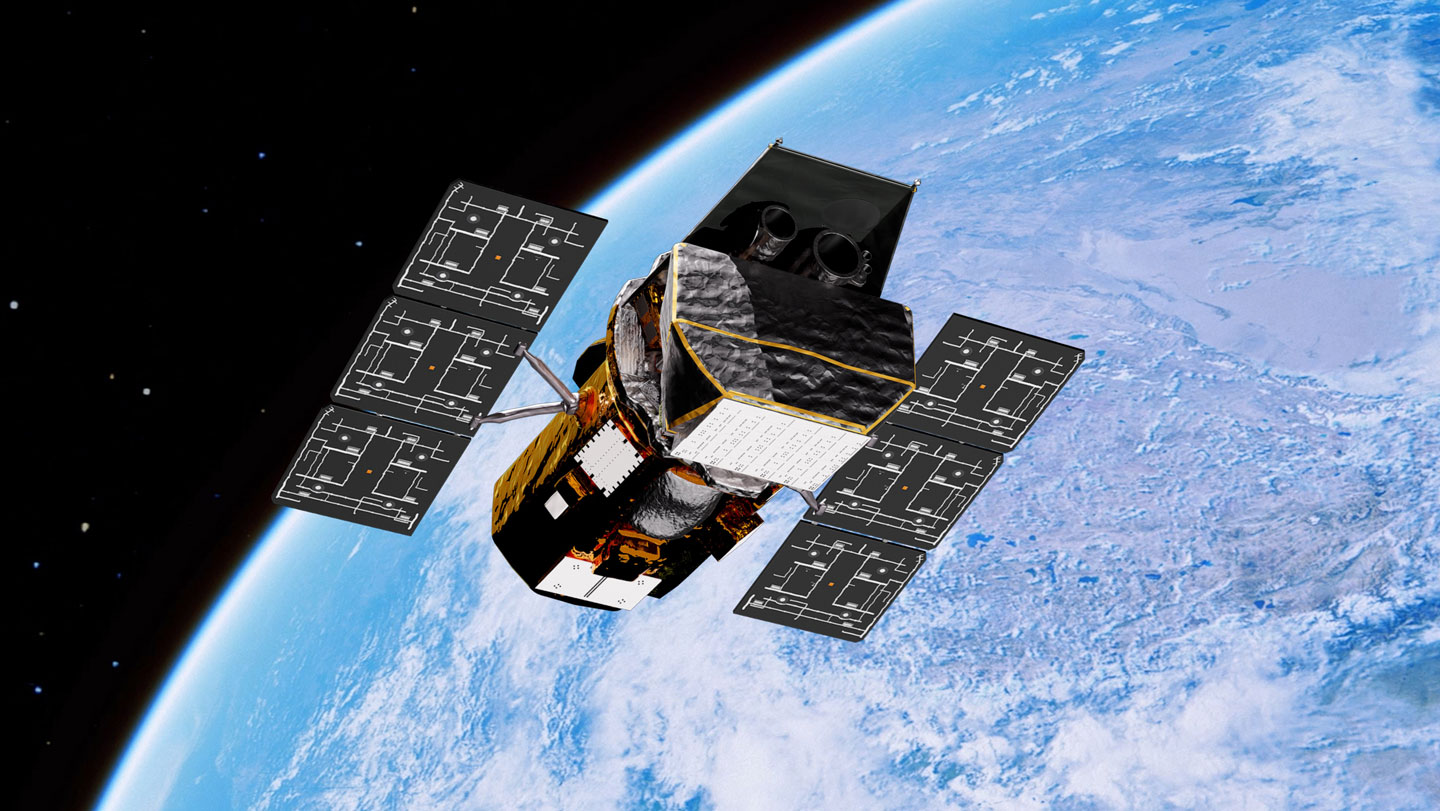
For two decades, when the high-energy universe called, NASA’s Neil Gehrels Swift Observatory has answered. But now, the spacecraft’s science tenure is ending, just when its skills might be more valuable than ever. The Swift spacecraft is falling uncontrollably, destined to burn up in Earth’s atmosphere in just a few days.
The telescope launched in 2004, tailored to reveal the secrets of gamma-ray bursts. These outbursts are the most powerful kind scientists have ever seen, but they often faded before earlier telescopes could respond. Swift took its name from its ability to jump to work when a flash went off. That talent both illuminated these elusive bursts and made the observatory a cornerstone of modern astronomy for far longer than scientists ever dreamed.
“This was designed to be a two-year mission,” says astrophysicist Brad Cenko of NASA’s Goddard Space Flight Center in Greenbelt, Md. “We’re coming up on year 22. We are so fortunate to have had the opportunity to do all the things that we have.”
Over the decades, the spacecraft has lost about half its original altitude as it constantly slammed into molecules in the atmosphere. Those minuscule impacts infinitesimally slowed the observatory, pushing it closer to Earth. The sun’s relatively high activity in recent years has accelerated the process, leaving the spacecraft unable to continue into the 2030s as engineers hoped. A spacecraft commissioned by NASA to loft Swift out of danger launched in early July, but by late August, technical issues made a boost attempt impossible.
Swift is doomed — with nothing lined up to replace its unique capabilities.
Glimpsing gamma-rays
When scientists dreamed up the Swift mission, the massive energy and elusive nature of gamma-ray bursts made them one of the most tantalizing phenomena out there. Astronomers desperately wanted to understand how they worked.
Swift was equipped with three instruments. Its Burst Alert Telescope gave scientists eyes on gamma-ray emissions from up to half the visible sky, with the resolution to pinpoint where light is coming from. The agile spacecraft could then swing itself and its other instruments — one tuned to X-rays and the other to visible and ultraviolet light — to quickly give scientists a view of a patch of sky across a swath of types of light. It was a combination unlike any observatory before or since.
“It’s such a unique telescope,” says astrophysicist Wen-fai Fong of Northwestern University in Evanston, Ill., who is not part of the mission team. “It has all these views of the universe, all in one observatory, which by itself is rare, but it can also rapidly point any of these instruments.”
Swift’s roster of accomplishments speaks to the power of that recipe. “Almost immediately after launch, Swift started discovering things,” says astrophysicist Lynn Cominsky of Sonoma State University in Rohnert Park, Calif. That’s not an exaggeration: One record-breaking observation, taken just the month after launch, revealed that stellar corpses with powerful magnetic fields undergo outbursts that create a distinct kind of gamma-ray signature.
That observation pushed back against scientists’ existing categorization of gamma-ray bursts. Before Swift, the bursts fell into two buckets. Long gamma-ray bursts lasted as long as minutes, and scientists believed they stemmed from exploding stars triggering supernovae. Short gamma-ray bursts, in contrast, lasted less than two seconds and were believed to originate in merging neutron stars, the superdense remains of a star large enough to explode but too small to create a black hole.
Swift confirmed this basic sketch, but also complicated it by finding bursts that didn’t cleanly fit into this binary. “The more data you get, the more confused you get,” Cominsky says. Other notable bursts the telescope observed included the brightest (gamma-ray burst) of all time, nicknamed BOAT, the highest-energy photons from such a burst, and multiple claimants to the title of most distant burst.
Notably, all of Swift’s data was public right away, even as team scientists were still working to understand what the telescope had seen. “That was very new,” Fong says, crediting the mission with inspiring other observatory teams to follow suit.
Beyond gamma-rays
As other astronomers heard about Swift’s work, they realized how powerful the observatory might be for their own interests as well. As Swift’s tenure unfolded, astronomers started asking to borrow the nimble observatory to study a whole range of objects changing on the sky.
“With scientists, if you give them a tool to do something, they will other find other things that you can do with that tool,” says astrophysicist Phil Evans of the University of Leicester in England. In its later years, Swift observed between five and 10 “targets of opportunity” most days, tallying hundreds or even thousands in a year.
Perhaps its most ground-breaking collaborations were partnerships with observatories hunting for ghostly neutrinos that travel nearly as quickly as light but don’t interact often, and for gravitational waves, the ripples in spacetime triggered by massive objects. In 2017, Swift participated in back-to-back discoveries: the unique explosion caused by two neutron stars merging, then the first neutrino traced back to its origin.
Since then, all efforts to observe light affiliated with a neutrino or gravitational-wave signal have come up empty. “We had these two really close together and then nothing since,” Evans says. “Which is frustrating, but also kind of fun.”
A grand finale
A range of current and future observatories will be able to take over some of Swift’s work, but not all of it. Even during the six months this year when Swift paused operations to prepare for the boost attempt, scientists felt its loss, says astrophysicist Judith Racusin of NASA Goddard. Racusin worked with Swift during its early years before turning her focus to NASA’s Fermi Gamma-ray Space Telescope, which launched in 2008 but boasts different strengths than its colleague. “We’re going to miss out,” she says of Swift’s loss. “Not just on the common events we have thousands of, but the really rare, unusual ones, which are often the ones we learn the most from.”
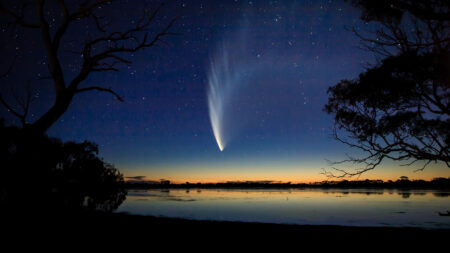
Mission personnel had Swift cram in as much science as possible as its demise approached. After the boost attempt was called off, the team turned Swift’s instruments back on for a scientific swan song. That included technical observations to ensure the utility of all its recent data, as well as indirect observations of Earth’s atmosphere at lower altitudes than many spacecraft are able to withstand. Swift even caught glimpses of a comet in its final weeks.
And, of course, there were gamma-ray bursts. One particularly intriguing burst came in late September and was rather far away but remarkably energetic.
“It feels a little bit like a last hurrah of Swift,” Racusin says of the event. “It’s a burst that we’ll be studying for some time, so I’m really glad we got Swift data on it while we could.”
Read the full article here