


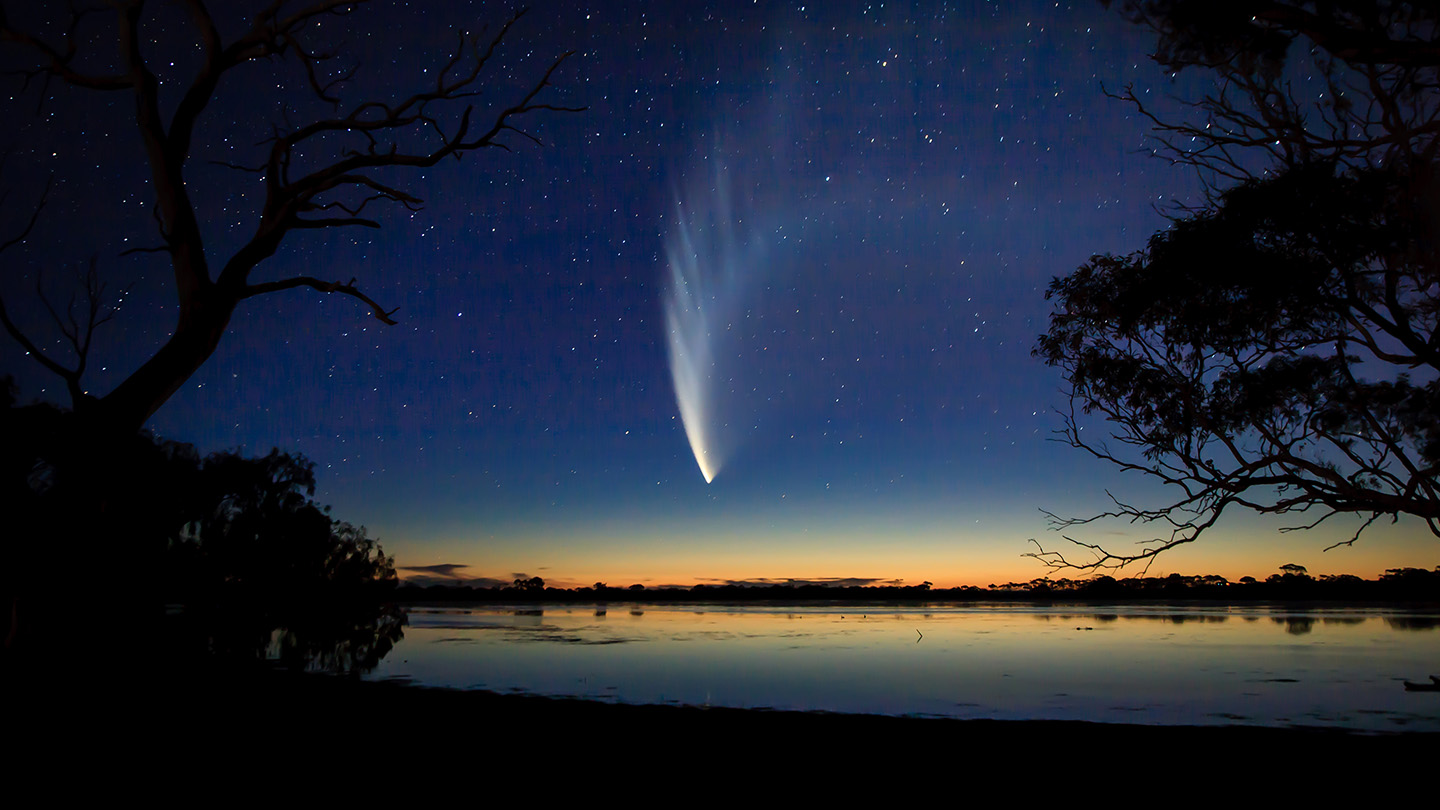
The chemical building blocks that gave rise to life on Earth probably didn’t come from comets.
Most comets would have been traveling too fast and at too steep an angle to Earth for prebiotic compounds to survive impact with the planet, researchers contend October 28 in Scientific Reports. While the study doesn’t completely rule out the possibility that comets brought these molecules to Earth, it contradicts the long-standing idea that comets seeded Earth with the chemicals necessary for life to arise.
“Even though we see that comets contain all of these molecules in really high concentrations, it’s not straightforward to go from there to saying we’re going to have all of these available for prebiotic chemistry on the surface of the Earth,” says Richard Anslow, a planetary scientist at the Met Office, the national meteorological service for the United Kingdom in Exeter.
Comets carry carbon- and nitrogen-containing molecules left over from early in the solar system’s formation. These molecules can react to form biologically important compounds like sugars and DNA. Scientists have long thought that comets could have delivered these building blocks to Earth when they collided with the planet during its first billion years.
But it’s important to revisit these ideas as our understanding of both comets and the early solar system improves, says Nicolle Zellner, a physicist at Albion College in Michigan who was not involved in the study.
In the new work, Anslow and colleagues used computer simulations to predict the likelihood that a chemical called hydrogen cyanide would survive a comet’s journey through Earth’s present atmosphere and its impact with the planet’s surface. The early Earth’s atmosphere was probably much denser, so would have been even more destructive.
The strong chemical bond between the carbon and nitrogen atoms in hydrogen cyanide can release energy that drives later chemical reactions necessary for life. It also makes the molecule particularly stable compared to other carbon-based chemicals.
“It’s probably one of the more robust molecules to surviving impacts,” Anslow says. “So if things look bad for hydrogen cyanide, then we think it’s going to be much harder for other, more complicated molecules that are more likely to be broken down during these impacts.”
Based on the simulations, a comet impact that kept hydrogen cyanide intact would be extremely unlikely, the team found. On average, the simulations suggest that only one impact would have been able to deliver a meaningful amount of hydrogen cyanide to the planet’s surface over more than a billion years. For hydrogen cyanide to survive the crash, the comet would have to be larger than 100 meters across, slow moving and traveling at an oblique angle to Earth.
A comet that met those narrow criteria would also have had to crash into land, rather than an ocean, to kick off any biologically useful chemistry. If the comet landed in the ocean, any hydrogen cyanide that survived would be diluted too quickly to trigger those reactions.
While still improbable, comets may have been more likely to deliver carbon-based molecules to Mars than to Earth, the simulations showed. Mars’ thinner atmosphere and smaller size meant that comets would impact at lower speeds. That could mean that more compounds could survive the collision.
If Earth’s carbon-based chemicals didn’t come from comets, they may have come from carbon-rich asteroids called carbonaceous chondrites, says Gordon Osinski, a planetary geologist at Western University in London, Canada, who was not involved in the study. Other sources might have included volcanoes and hydrothermal vents.
The study “definitely will make people think twice about comets being the originator for the delivery of organics,” Osinski says. “I hope other people will try to reproduce these results [and] then potentially try something similar with carbonaceous chondrites as well.”
Read the full article here