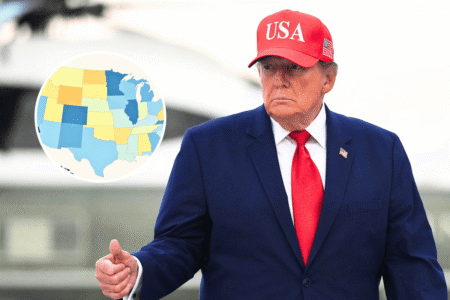


A Nobel Prize-winning economist has told Newsweek that President Trump’s trade policies and the ambiguity surrounding their implementation are pushing America toward an economic downturn.
The warning came from James Heckman, a professor of economics at the University of Chicago, who said: “The fear of tariffs and the uncertainty about their magnitude and duration is causing the recession.”
Newsweek has contacted the White House for comment.
Why It Matters
Heckman is one of many economists to issue similar warnings about a looming recession, while citing Trump’s tariffs and their inconsistent implementation as the main contributing factor. These have already been linked to major stock market swings over the past few weeks—fluctuating in line with the announcement of new tariffs or reports of potential exemptions—and have been pointed to by businesses and consumers as exacerbating uncertainty about America’s economic future.
What To Know
Heckman, who was awarded the 2000 Nobel Memorial Prize in Economics for his work on microeconometrics, said it was “too soon to say” whether Trump’s tariff policies had irreversibly changed or damaged America’s trading relationships.
However, he added that while a recession is not yet guaranteed, one is likely to occur in 2025, with other aspects of the administration’s agenda adding to the “uncertainty” that was making this outcome more probable.
Heckman’s comments come only days before the administration plans to unveil a host of new tariffs, in addition to those on steel and aluminum, as well as the country-specific tariffs on Canadian and Mexican imports and the increased tariffs on Chinese goods already in effect.
The president will also reveal the details of his “reciprocal tariffs” on countries that currently impose tariffs on imports or engage in other “unfair” trade practices against the U.S.
It remains unclear which countries will be subject to these measures, or the rate at which countries’ imports will be taxed when entering the U.S. On Sunday, President Trump said that these would initially apply to “all countries.” Two weeks earlier, Treasury Secretary Scott Bessent had said that the reciprocal tariffs would apply to the 15 percent of America’s trading partners—”the dirty 15″—who impose “substantial tariffs” on U.S. imports.
Trump said previously that the U.S. would match other nations’ duties like-for-like—”Whatever they charge us, we’re charging them.” Last week, however, the president walked this back, telling reporters that he would be “embarrassed” to impose equal tariffs “because they’ve charged us so much I don’t think they could take it.”
In addition to the reciprocal tariffs, the administration has also threatened to impose a 25 percent blanket tariff on all imports from countries which import Venezuelan oil “on or after April 2, 2025.”
Trump’s 25 percent duties on automobiles and certain car parts are due to take effect at midnight on Thursday.
What People Are Saying
Commerce Secretary Howard Lutnick told NBC News in early March that Americans should “absolutely not” expect a recession, telling Kristen Welker: “Donald Trump is a winner. He’s going to win for the American people. That’s just the way it’s going to be. There’s going to be no recession in America.”
White House Press Secretary Karoline Leavitt, speaking with reporters on Monday, said: “Wednesday, it will be Liberation Day in America, as President Trump has so proudly dubbed it. The cabinet will be here for the event—it’ll be our first Rose Garden event of this administration—you will all be invited to attend and cover this historic moment. The president will be announcing a tariff plan that will roll back the unfair trade practices that have been ripping off our country for decades. He’s doing this in the best interest of the American worker.”
Simon Johnson, Former IMF Chief Economist, recently told Newsweek: “The uncertainty caused by on-off tariffs and aggressive but inconsistent messaging from the White House is definitely contributing to postponement of investment and an economic slowdown.”
Jeffrey Roach, Chief Economist for LPL Financial, said: “Each recession begins with some exogenous shock to the economy, such as a terrorist attack, a banking failure, or a global pandemic. It’s possible—but not guaranteed—that a prolonged trade war could be that catalyst.”
What Happens Next?
On Wednesday, Trump is scheduled to give a speech on tariffs at the White House Rose Garden. Treasury Secretary Scott Bessent recently confirmed that the announcement on new tariffs would be made at 3 p.m. Eastern Daylight Time, Bloomberg reported.
Read the full article here