



Two weeks before the midterm elections and 21 months after he entered the White House for the second time, President Donald Trump is underwater in 41 states and every major battleground, according to new polling.
The figures come from Civiqs’ rolling tracker of registered voters, based on 137,330 responses collected between January 20, 2025, and October 19, 2026.
A Newsweek analysis compares the latest state ratings with those recorded when Trump began his second term, with net approval calculated as approval minus disapproval.
Nationally, 32 percent approve of Trump’s job performance and 61 percent disapprove, giving him a net approval rating of minus 29.
Need To Know
- Trump records positive net approval in nine states.
- Every major battleground is negative, led by Michigan at -28, Georgia at -26, and Nevada at -24.
- Kentucky has recorded the largest decline since January 2025, falling 36 points from +23 to -13.
- Trump has negative net approval in six states at the center of the battle for Senate control.
- Wyoming remains Trump’s strongest state at +14, followed by North Dakota at +11.
- Younger voters, independents and postgraduates remain among the groups most opposed to Trump.
Why It Matters
Presidential approval is not a forecast of individual races, but it helps define the national environment in which candidates compete.
With control of Congress at stake on November 3, Trump’s standing could influence turnout, campaign messaging and Republican candidates’ ability to distance themselves from an unpopular administration.
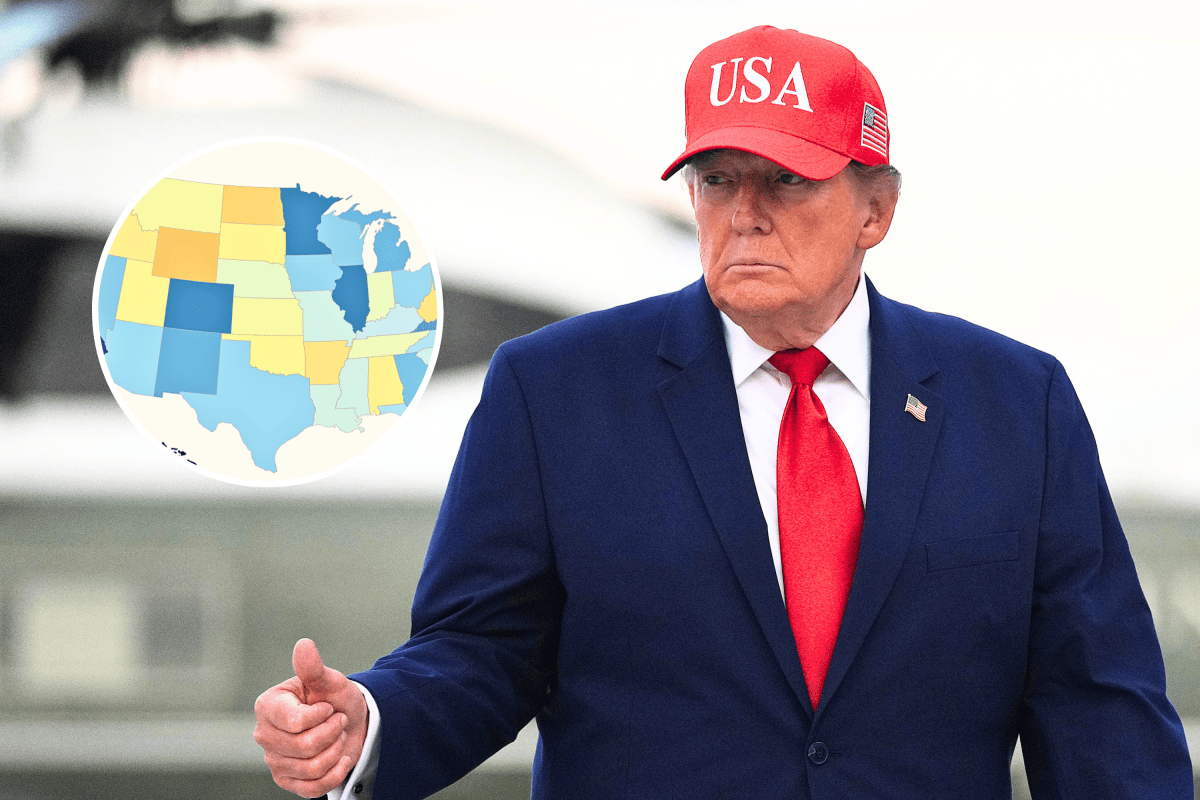
Use the map below to explore Trump’s net approval rating in each state two weeks before the midterms.
Nine States Still Rate Trump Positively
Trump’s remaining positive ratings are concentrated in Republican territory.
Wyoming is his strongest state at +14, followed by North Dakota at +11 and West Virginia at +8. Arkansas is at +7, while Idaho is at +4 and Alabama at +3.
South Dakota is at +2. Oklahoma and Utah are each at +1.
Those are the only nine states where approval exceeds disapproval. No state is tied.
Even among Trump’s strongest states, his position is considerably weaker than in January 2025.
His net approval has fallen 33 points from +47 in Wyoming, 23 points from +34 in North Dakota and 27 points from +35 in West Virginia.
What The Demographic Data Shows
The demographic breakdown helps explain the state-level map.
Among voters aged 18 to 34, 20 percent approve of Trump while 72 percent disapprove, producing a 52-point gap. Among those aged 35 to 49, the split is 25 percent approval to 66 percent disapproval.
Older voters are less negative, although Trump remains underwater. Among those aged 50 to 64, 40 percent approve and 54 percent disapprove. Voters aged 65 and older divide 42 percent approval to 53 percent disapproval.
Independents disapprove by 66 percent to 25 percent, while Republicans approve by 75 percent to 13 percent. Female voters disapprove by 66 percent to 28 percent, compared with a 55-to-37 split among male voters.
Education produces another divide. Trump’s approval stands at 20 percent among postgraduates, 31 percent among college graduates, and 36 percent among non-college graduates, with disapproval leading in every group.
Every Major Battleground Is Underwater
The battleground map remains difficult for Trump with two weeks of campaigning left.
His latest net ratings are:
- Arizona: -20
- Florida: -17
- Georgia: -26
- Michigan: -28
- Nevada: -24
- North Carolina: -17
- Ohio: -21
- Pennsylvania: -23
- Wisconsin: -23
Several battlegrounds were positive or evenly divided when Trump began his second term.
His net approval has since fallen 29 points from +8 in Ohio, 26 points from +9 in Florida, 24 points from 0 in Nevada, and 17 points from 0 in North Carolina.
Trump Is Underwater In Six Key Midterm States
Trump also records negative net approval in six states containing closely watched Senate contests: Maine at -33, Michigan at -28, Iowa at -22, Ohio and Texas at -21, and Alaska at -12.
All six races feature among the contests national forecasters identify as competitive in the battle for Senate control.
The figures show Republican campaigns fighting for undecided and persuadable voters in states where more people disapprove than approve of Trump’s performance.
Where Approval Has Fallen The Most
Trump’s net approval is lower in every state than it was on January 20, 2025.
The largest declines include:
- Kentucky: +23 to -13, down 36 points
- Wyoming: +47 to +14, down 33 points
- Idaho: +34 to +4, down 30 points
- Oklahoma: +31 to +1, down 30 points
- Ohio: +8 to -21, down 29 points
- Tennessee: +25 to -4, down 29 points
- Iowa: +6 to -22, down 28 points
- Texas: +6 to -21, down 27 points
- West Virginia: +35 to +8, down 27 points
- Florida: +9 to -17, down 26 points
- Mississippi: +15 to -11, down 26 points
- Montana: +25 to -1, down 26 points
Many of the sharpest declines have therefore occurred in states that initially gave Trump comfortable positive ratings, rather than in Democratic strongholds where opposition was already entrenched.
Deep Blue States Remain Firmly Negative
Trump’s weakest ratings remain concentrated in Democratic territory.
Hawaii records the lowest net approval at -61, followed by Maryland at -54 and Vermont at -53. Massachusetts stands at -49 and California at -47.
Connecticut records -45, Washington -44 and New York -42.
The decline in some of these states has been less pronounced because Trump began his second term with ratings already deeply negative.
What The White House Says
The White House has emphasized Trump’s role as leader of the Republican Party and argued that his record will help motivate the party’s coalition in the midterms.
Spokesperson Davis Ingle described Trump as the GOP’s “unequivocal leader, best messenger, and unmatched motivator,” saying the president is committed to maintaining Republican control of Congress.
Ingle pointed to tax cuts, prescription-drug costs, border security, energy production, private-sector employment and retirement accounts as evidence of the administration’s record. He framed the midterms as a choice between doubling down on Trump’s “winning, commonsense agenda” and supporting what he called Democrats’ “extreme liberal policies and obstruction.”
Newsweek’s reporters and editors used Martyn, our AI assistant, to produce this story. Learn more about Martyn here.
Contact Newsweek editor on this story: Edward Pearcey.
Read the full article here