


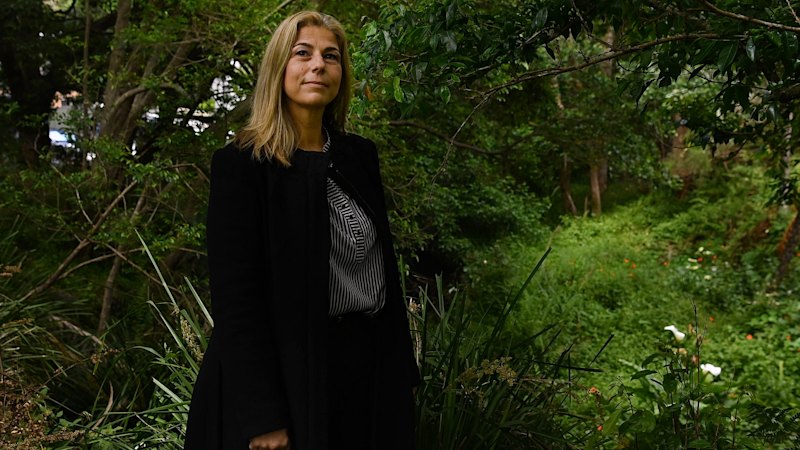
Queen Dunbar never carried a gun or wore a uniform, but counts herself among the most steadfast servants of Australia’s armed forces.
She’s been serving since 1996, when husband Adam enlisted in the army, starting a career that took him to Solomon Islands, Iraq and Afghanistan. He was discharged in 2015 after his post-traumatic stress disorder diagnosis.
Dunbar raised their children, Joshua and Sarah, in Sydney while Adam fought for Australia. She was 41 when Adam died by suicide in 2017, owing to injuries suffered in service. Their children were 15 and 11 at the time of their father’s death, while Dunbar worked three jobs to get by.
It took Dunbar, by her estimation, one year to realise she was a war widow. She credits her fellow war widows for helping her to “start breathing” again.
“Our sacrifices are not seen, and if they are seen, they are seen once or twice a year,” she said. “I was trying to make it through the pain and the grief, and knowing that I actually have a place where I belonged, changed my outlook on life.”
Dunbar is among more than 28,000 war widows in Australia, according to the Families of Veterans Guild, many of whom are preparing to honour their loved ones in Remembrance Day events this week.
Australian war widows often raised children, worked jobs and supported the home while their spouses fought in conflicts overseas.
Most veteran families experience financial stress, according to a survey conducted by the Guild last year, and three-fifths report their children have faced problems at school in the past year
Dunbar, who is NSW president of the Guild, considers herself underemployed, as she balances work as an English teacher and flight attendant with supporting her children.
Her daughter, 20, faces mental health challenges stemming from her father’s service, which Dunbar expects will be a lifelong struggle.
She has pushed the Department of Veterans’ Affairs to tailor support packages for specific families and improve aid for former soldiers as they transition into civilian life. Assistance often comes too late, Dunbar warned, resulting in devastating consequences for families struggling to stay afloat.
“My children’s wellbeing has impacted my employment because I’ve had to sit there and try to find support for my daughter,” she said. “My career has been impacted because of their needs that the department wasn’t able to meet.”
The Department of Veterans’ Affairs said it recognised there were persisting challenges in its delivery of tailored support, and that “work continues” to better understand families’ needs and priorities. It expects to have implemented two-thirds of recommendations from the Royal Commission into Defence and Veteran Suicide by the end of 2026.
Shirley McLaren, a 94-year-old who lives in a rural cottage south of Canberra, was booted from her family’s Defence accommodation two days after the funeral of her husband, Roy, a Royal Australian Air Force (RAAF) member who died unexpectedly on Christmas Eve 1972.
McLaren, who was one of the first to enlist in the Women’s RAAF as an 18-year-old in 1951, was 39 when Roy died. She had three small children and a dog in tow. McLaren had met her husband at a dance at Canberra’s Albert Hall in 1953, and Roy proposed shortly before he was posted to Korea.
She recalls receiving “no help at all” from any widows network as she packed her young family into a car and drove to Canberra, where they slept in sleeping bags in friends’ dining rooms while she picked up the pieces of her life.
McLaren dipped her toes into widows networks while juggling her responsibilities as a mother and breadwinner in subsequent years, but largely felt unwelcome by groups of elderly women whose husbands fought in earlier conflicts than Roy.
Now McLaren ensures that no new widow attending Guild meetings sits alone. Only a widow, she said, can understand the loss that comes from the death of a spouse in the service.
“You’ve gone from a couple, doing everything together, and suddenly, you’re on your own,” she said. “Tears are the price we pay [for love].”
McLaren pays tribute to Roy every week, laying six stems of rosemary at a photograph of her husband at her Royalla cottage.
She continues the tradition with her two great-grandchildren, Will and Tom, who have learned of their great-grandfather through stories told by their family.
“I encourage the widows who are coming for the first time to the group to never be ashamed of your tears,” McLaren said. “Talk about your husband, and you’ll find that we are all very supportive to help you through this grieving process because we’ve all been there.”
McLaren’s son, Noel, and granddaughter Brooke served in the Royal Australian Navy, while Will expects to join the Australian Defence Force once he finishes school next year. His enlistment would mark the fourth generation of service in the family.
McLaren’s great-grandsons have planted hand-made poppies in her yard, in a range of colours to honour the Diggers, nurses, wounded soldiers and animals that served in conflict.
The Families of Veterans Guild was established as the Australian War Widows NSW in 1946 by Jessie Vasey, seven months after losing husband George in World War II.
She wrote to 2000 widows as she grieved: “Real help for widows could only come from among themselves,” she wrote. “Now, as one of them, I am sure of it.”
More than 300 people joined the first widows meeting in Sydney in June 1946, sparking the creation of what is now the Families of Veterans Guild. War Widows Day has been commemorated on October 19, Jessie Vasey’s birthday, since 2022, through national services.
McLaren will lead the Ode of Remembrance at the Families of Veterans Guild’s inaugural Remembrance Day Lunch at the Australian War Memorial on Tuesday, to about 70 war widows, including Dunbar, and veteran families honouring those who served.
“[I] lost a wonderful, loving husband, the father of my children, the love of my life, so my remembrance goes out to all veterans, of course, who have served and are no longer with us,” McLaren said. “It doesn’t matter how long it is … the grief is very deep and long-lasting.”
If you are a current or former ADF member, or a relative, and need counselling or support, you can contact the Defence All-Hours Support Line on 1800 628 036 or Open Arms on 1800 011 046. Crisis support is also available from Lifeline on 13 11 14.
Get alerts on breaking news as it happens. Sign up for our Breaking News Alert.
 Daniel Lo Surdo is a breaking news reporter for The Sydney Morning Herald. He previously helmed the national news live blog for The Sydney Morning Herald and The Age.Connect via email.
From our partners
Read the full article here