



A fossil that has puzzled scientists for over 150 years is possibly the largest scorpion known to exist.
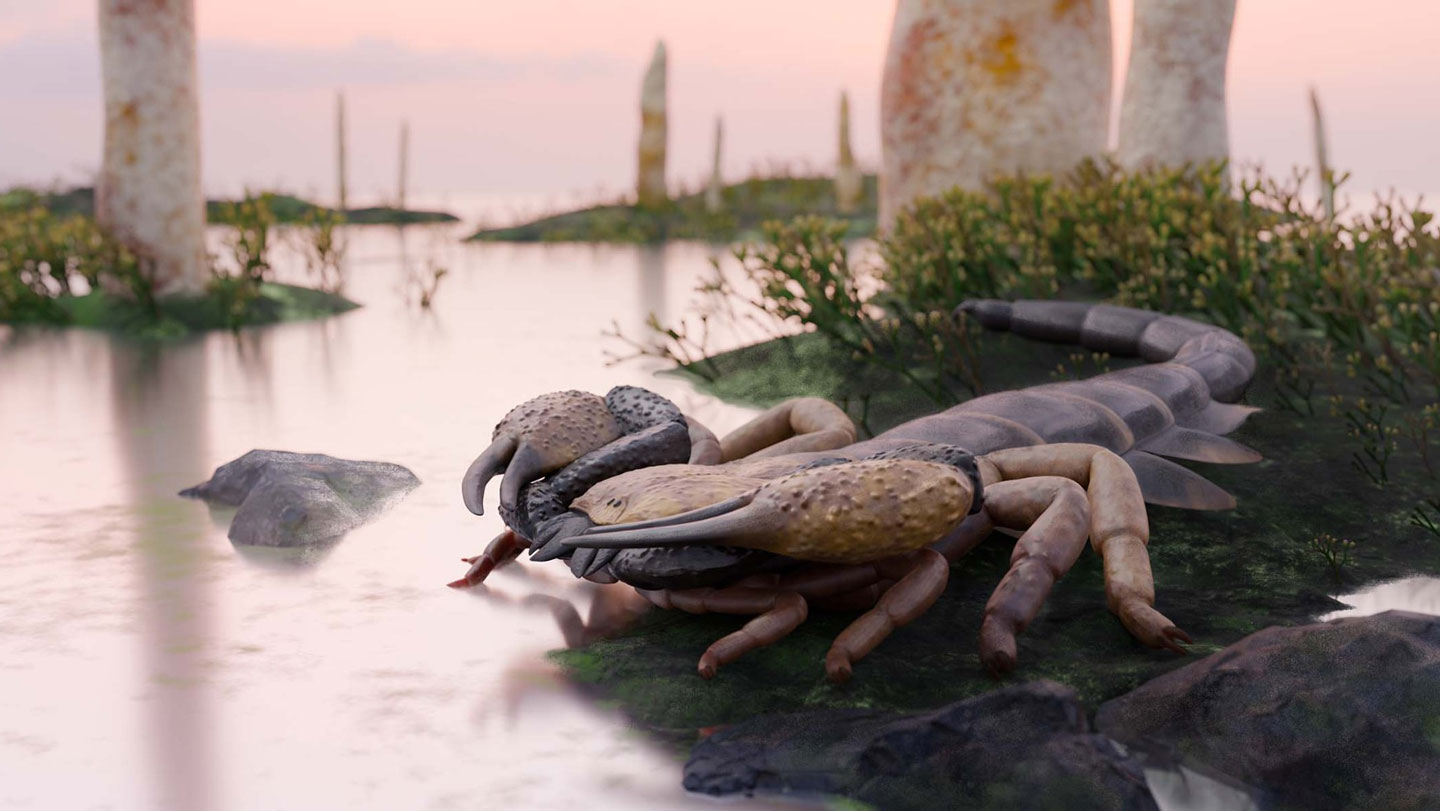
At about one meter long, the roughly 415-million-year-old Praearcturus gigas was four to five times the size of the largest modern scorpion species (Gigantometrus swammerdami), researchers report June 2 in Palaeontology. The findings indicate scorpions became massive far earlier than other arthropods, including the giant insects that appeared in the Carboniferous period at least 55 million years later.
Fragments of this novel species were discovered in 1870 in the St Maughans geologic formation in England. Since then, researchers have proposed that it was a giant woodlouse or a massive millipede-like creature. Studies in the 1980s suggested it was a scorpion, but the idea was never proven.
To demystify P. gigas’ identity, paleobiologist Richard Howard of the Natural History Museum in London and his colleagues photographed the fossils and made illustrations. P. gigas’ 15-centimeter-long pincer had a movable claw facing away from its fixed claw, like modern scorpions, as opposed to crustaceans like lobsters, where the movable claw points toward the fixed claw. The species also had ridges on its pedipalps — appendages with pincers — that several scorpion species rub against their body to make a hissing sound that wards off predators.
Comparing their photographs and illustrations to those of other ancient crustaceans and arthropods, images of a 430-million-year-old scorpion species — Eramoscorpius brucensis — confirmed P. gigas was a scorpion. Modern scorpions have a small, usually pentagonal sternum, Howard notes, but P. gigas and E. brucensis had unusually elongated, nearly triangular sternums with a groove down the middle. “E. brucensis was not discovered until 2015, so that key parallel was not evident beforehand,” he says.
P. gigas could have been one of the first terrestrial predators: It was unusually large for its time with no land vertebrates around to compete. It probably preyed on small land animals, as terrestrial life was still very new, Howard says.
Terrestrial resources weren’t plentiful enough to sustain such a large animal, Howard adds, so P. gigas may have also swum in rivers to prey on large species like armored fish and sea scorpions. “The rocks the fossils come from were deposited by rivers,” he says, indicating the scorpion may have lived in freshwater.
The nightmarish giant also has flaplike structures similar to the appendages lobsters use for swimming, but the scientists need more fossil evidence to confirm their function.
Read the full article here