



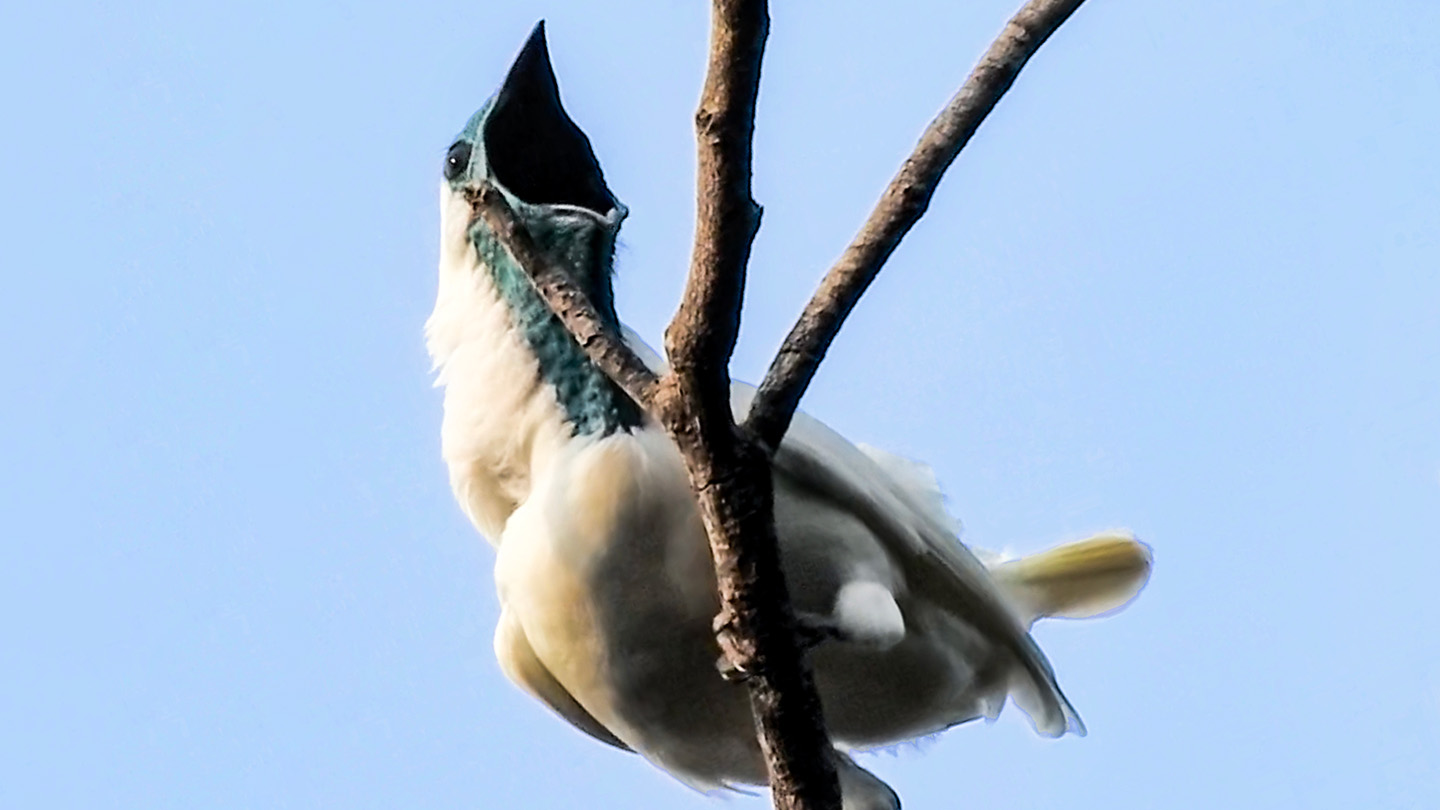
The bare-throated bellbird is loud. Very, very loud.
The explosive, metallic mating call of the snow-white male — a stout bird with a broad bill and distinctive blue-green throat patch — can top 130 decibels, louder than a jackhammer or a front-row seat at a Counting Crows concert.
That makes this South American forest dweller a contender for the title of world’s loudest bird. And now researchers think they know how it and other avian loudmouths produce such eardrum-rattling vocalizations.
Bigger bodies and, especially, wider beaks help these feathered screamers belt it out, behavioral ecologists João Menezes and Jeff Podos of the University of Massachusetts Amherst report September 29 in Evolution.
But what pushed some birds to evolve such volume in the first place remains a mystery. The researchers looked at mating behavior, habitat density and flight ability, but found no explanation that consistently held across species. “We weren’t able to find an overarching pattern that applies to birds in general,” Menezes says.
The quest to understand these sonic extremes dates back to 2019. That is when Podos and a colleague crowned the white bellbird (Procnias albus), an Amazonian cousin of the bare-throated bellbird (P. nudicollis), as a record-setting vocal powerhouse. Its 125-decibel calls were the loudest bird calls ever measured at the time.
Beyond the attention-grabbing number, the finding raised a broader question: What makes some birds so extraordinarily loud?
The honk of a Canada goose, for example, can reach chainsaw volume (100 decibels), while the chatter of a starling rarely rises above a dishwasher-level hum (70 decibels) — and ornithologists have surprisingly little understanding of why. Although scientists have spent decades cataloging the timing and frequency of birdsong, hoping to decode what birds are saying, the sheer loudness of bird voices has gone largely unexplored.
To get a read on the racket, Podos lugged a high-grade sound meter, the kind used to monitor noise levels in industrial workplaces, and a laser rangefinder into the woods, swamps and open fields around his home in western Massachusetts. He measured the calls of whatever birds he could find — warblers, sparrows, robins and more.
After logging a few dozen species, he enlisted Menezes, a then-grad student who at the time had recently joined his lab, to help turn the collection into a broader evolutionary analysis. Menezes measured bird vocalizations across his home country of Brazil, from the Atlantic Forest near São Paulo to the mountains surrounding Rio de Janeiro and beyond. He captured everything from the soft chirps of the dusky-throated hermit hummingbird to the piercing yelps of the red-legged seriema, a shaggy type of grassland bird.
All told, he and Podos compiled vocal volume data on 123 species, creating what they say is the largest such dataset to date.
The heftier the bird, the louder its call tended to be, and the same went for birds with broader beaks — a connection between anatomy and acoustic performance that biophysicist Gabriel Mindlin from the University of Buenos Aires in Argentina finds “sensible and plausible.”
“Larger birds have the potential to generate greater respiratory pressures and flows, while morphological features such as beak opening can affect how efficiently acoustic energy radiates,” says Mindlin, who studies birdsong but was not involved in the work.
Why evolution cranked up the volume on these avian megaphones, though, is a puzzle that remains, for now, unhatched.
Read the full article here