




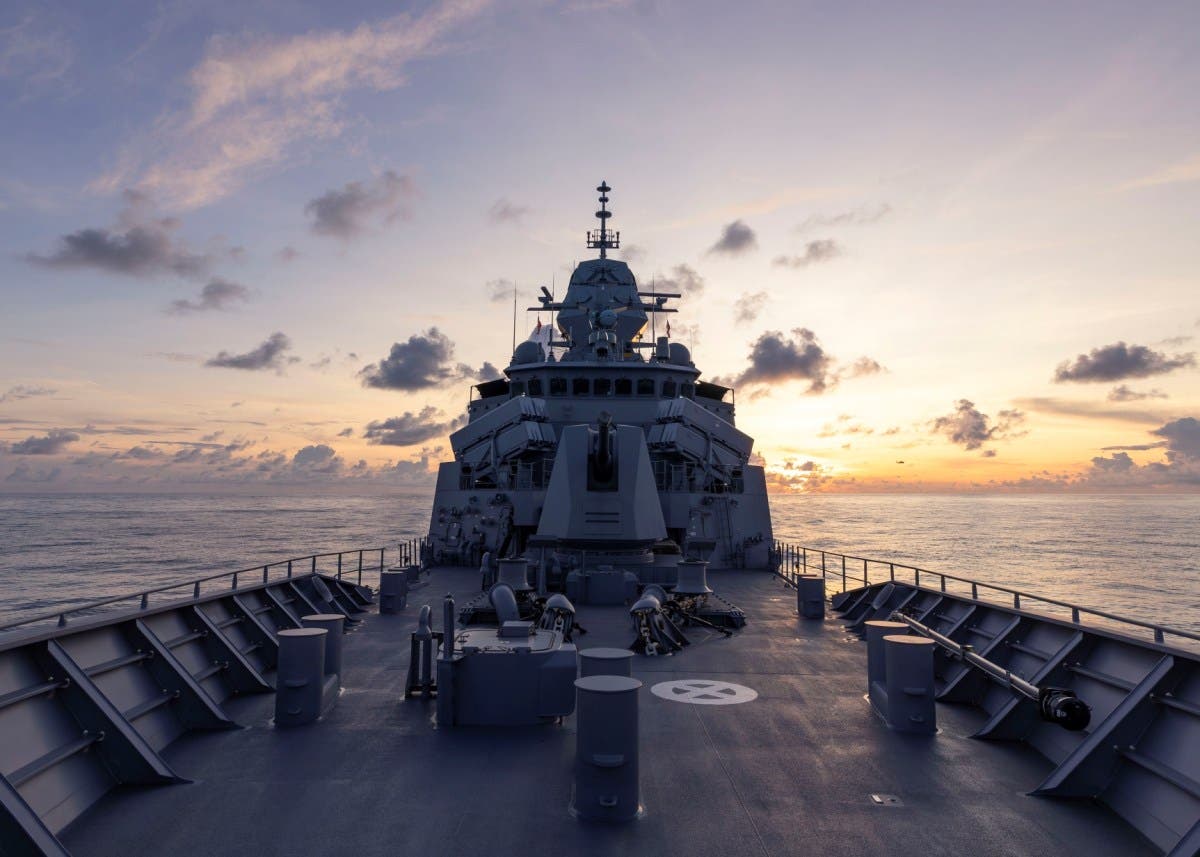
Australia, a key United States ally is maintaining its military presence in the South China Sea despite a close encounter with Chinese forces in the contested region earlier this month.
The Australian frigate HMAS Ballarat has conducted a routine transit in the South China Sea with support from the U.S. Navy, Australia’s Defense Department said on Thursday.
The Chinese Foreign Ministry did not immediately respond to a request for comment.
Why It Matters
Citing its so-called “historic rights,” China has made sweeping sovereignty claims over most of the waters in the South China Sea, overlapping with those of other countries in the region, which often leads to standoffs and clashes between rival maritime forces.
Facing China’s overwhelming naval and coast guard presence in the South China Sea, the U.S. and allied and partner nations, including Australia, have dispatched aircraft and vessels to conduct operations asserting freedom of navigation and overflight rights.
On October 19, an Australian P-8A maritime patrol aircraft had what Canberra called an “unsafe and unprofessional” interaction with a Chinese Su-35 fighter jet. Beijing rebutted the accusation, saying the Australian aircraft had intruded into Chinese airspace.
What To Know
Footage taken on October 19 and released by Australia’s Defense Department shows the Ballarat, which is armed with missiles, a 5-inch automatic rapid fire gun and torpedoes, patrolling undisclosed waters in the South China Sea during its mission, known as Regional Presence Deployment 25-4.
The U.S. Navy deployed a P-8A aircraft to support the Ballarat‘s transit, Australia’s Defense Department said. The warship was deployed in early September on a three-month mission to maintain Australia’s military presence in the Indo-Pacific region.
Regional Presence Deployments are conducted in accordance with international law, allowing Australia to exercise the right to freedom of navigation and overflight in international waters and airspace, according to Australia’s Defense Department.
“The South China Sea is a vital waterway for the entire international community,” said Australian Chief of Joint Operations Vice Admiral Justin Jones, adding that Australia’s military has conducted activities in the region for decades in accordance with international law.
Following the aerial encounter on October 19, the Chinese Defense Ministry urged its Australian counterpart to cease what it called “infringement, provocation and incitement,” and to “strictly restrain” its front-line forces to avoid undermining bilateral military relations.
During a meeting with the Chinese military in August, Australian Chief of the Defense Force, Admiral David Johnston, said all countries in the region must operate in a safe and professional manner at all times to avoid the risk of miscalculation or escalation.
What People Are Saying
Australian Commander Dean Uren, commanding officer of HMAS Ballarat, said in a press release on Thursday: “The Indo-Pacific is one of the world’s most important maritime areas. This training and engagement forms a critical part of our three-month Regional Presence Deployment. By maintaining this continuous presence alongside our allies and partners, we demonstrate our commitment to supporting an open, stable, and prosperous Indo-Pacific.”
Senior Colonel Jiang Bin, spokesperson for China’s Defense Ministry, said in a statement on October 22: “Australia has infringed upon and provoked China, yet slandered China’s defense actions as ‘unsafe’ and ‘unprofessional’. Such fallacies are utterly unacceptable anywhere…The Chinese military will continue to take necessary measures to resolutely safeguard national sovereignty and security, and firmly uphold regional peace and stability.”
What Happens Next
It remains unclear whether China has deployed military aircraft or vessels to shadow the Australian warship during its deployment in the South China Sea. In coordination with the U.S., Australia is expected to continue its military activities in the region.
Read the full article here