



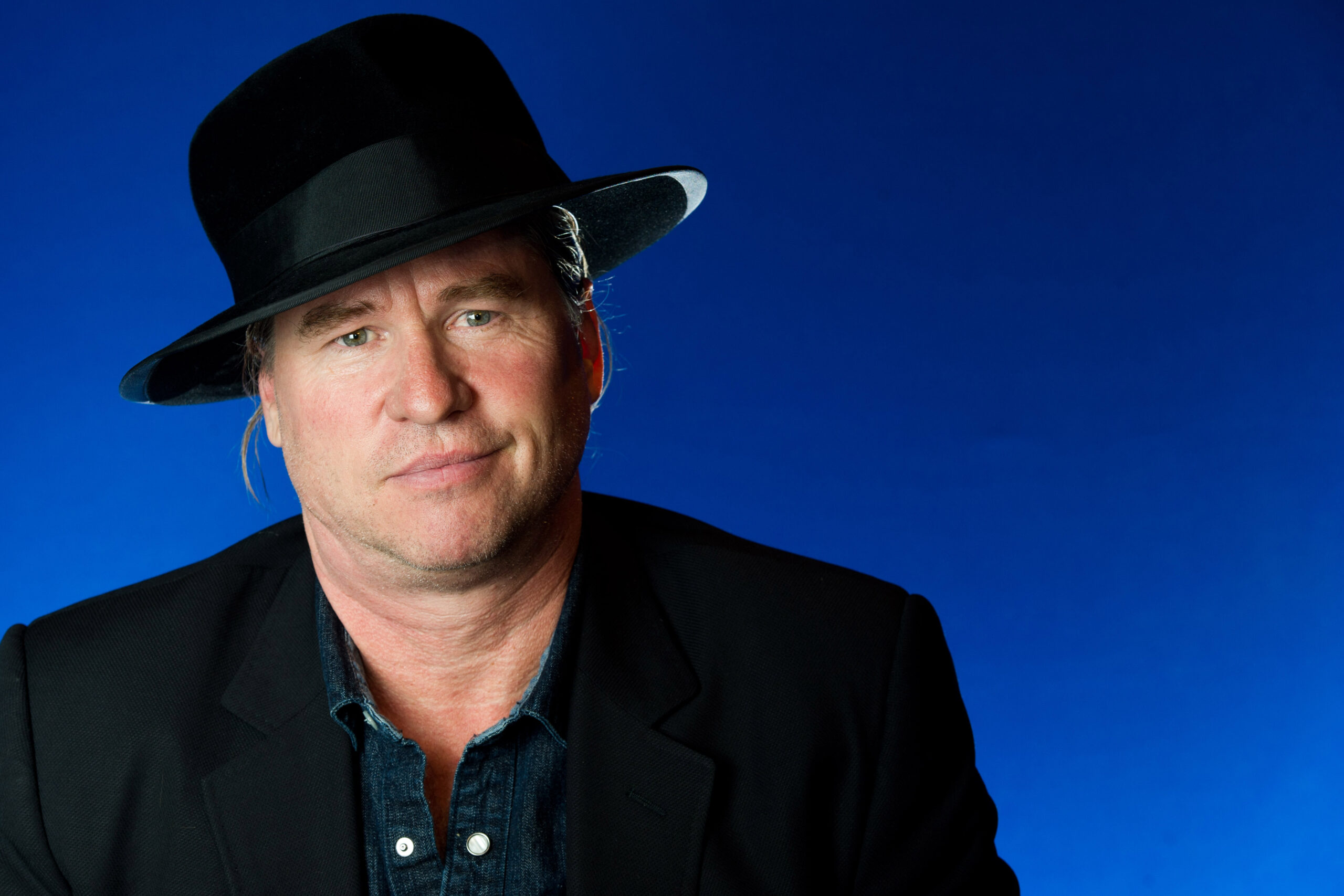
It was a poignant interview, the last Val Kilmer gave before losing his voice to throat cancer. An interview in which Kilmer that revealed great vulnerability and humility—two words not normally associated with the brilliant actor when he was at the peak of his powers. At least not within the movie industry. Kilmer died of pneumonia Tuesday in Los Angeles. He was only 65.
The Julliard-trained actor experienced a meteoric rise in the business starring in such blockbusters as Top Gun and Top Gun: Maverick, Batman Forever, Tombstone—and perhaps his most remarkable performance in Oliver Stone’s The Doors, in which he doesn’t merely play the part of Jim Morrison, he possesses it. Indeed, we never for a moment believe it is not Val Kilmer doing the singing. He was that good.
But Kilmer, like Morrison, was also that bad. Bad, that is, to work with, earning a reputation in the business that would cost him dearly. Something he admitted to a reporter for Norwegian television at Kilmer’s Malibu home.
“You have said you were full of yourself in your earlier career,” the reporter said. “In what way?”
“In every way,” Kilmer said, laughing at himself. “I had ideas, I had insecurities about myself that I projected on to the movie business. Just the sounds from my mouth. So absurd. Absurdly unrealistic. Apparently, I had an evil twin.”
“Do you think that people found it difficult to work with you,” the journalist asked.
“Yeah, what’s the one past difficult…impossible,” he admitted, again laughing at himself.
And then Kilmer turned serious. “Yeah, I’m kind of blacklisted. I haven’t gotten a studio job in 15 years.”
“Is your goal to get back?” the journalist asked after a brief pause.
“Yeah, I’d always watched movies and wondered what I’d be like in that part,” Kilmer reflected.
“If you get back, will you behave in another way?” Kilmer was asked.
“Yes,” laughing again. “In the way that gets me hired.”
Then came Kilmer’s admission—indeed, a moving confession—about the earlier version of himself.
“I was a dumb actor. I complained quite a bit when I was younger,” he said. “I didn’t appreciate the business that afforded me the lifestyle that I very quickly enjoyed. Very quickly. I starred in my first movie. I was the lead in the first play I did professionally. And now that I don’t have that privilege, I wish that I loved more. I want to be a better person. I try to figure that out every day, how to be more grateful.”
Perhaps the two scenes movie fans around the world are most grateful for in Kilmer’s remarkable career were one involving death and the other of rebirth.
The death scene comes near the end of the Western classic “Tombstone.” Doc Holliday, played brilliantly by Kilmer, is lying in a hospital bed, shivering and sweating simultaneously as a result of tuberculosis. His pal Wyatt Earp, played by Kurt Russell, enters the room as a priest leaves it.
“How are you feeling today, Doc,” Earp asks.
“I’m dying. How are you?” Holliday replies.
Earp tries his best to cheer his pal up, pushing playing cards into his hands. But Holliday quickly puts an end to the long-lasting game.
“You’re the most fallible, stubborn, self-deluded, bull-headed man I’ve ever known in my entire life, but with all that, you’re the only human being in my entire life that ever gave me hope,” Holliday tells his friend.
After sharing the story of his only love—and how he lost it—Holliday than tells his friend to leave him and chase the girl he recently met and loves.
Then came those last beautiful words of Holliday. “Wyatt, if you were ever my friend, if you ever had the slightest feeling for me, leave now. Please.”
To this day, it is impossible not to cry when that scene appears.
In the sequel to the movie that launched his career, fans did not know—and could not know—that his performance as the resurrected Pete “Iceman” Mitchell in the 2021 blockbuster Top Gun: Maverick would be his last.
The writers of the film brilliantly used Kilmer’s real-life situation—the loss of his voice to throat cancer—and weaved it into Iceman’s character and the movie’s plot line.
In the one scene in which Kilmer appears—all of three minutes or so long and the most powerful in the film—Maverick visits his old pal about some deep personal struggles. Iceman types five words that appear on his computer screen: “It’s time to let go.”
Maverick reacts to those typed words, bearing his heart to his old friend, and seeking his advice.
“The Navy needs Maverick. The kid needs Maverick. That’s why I fought for you. That’s why you’re still here,” Iceman says in a raspy voice made possible by state-of-the-art computer technology.
The two embrace. And then came the final, beautiful lines in the scene.
Iceman says: “One last thing. Who was the better pilot? You or me?
“This is a nice moment, Maverick replies. “Let’s not ruin it.”
Val Kilmer gave the world many nice moments. But for my money, the very best moment I’d ever seen in Kilmer’s long list of great moments on the screen was that interview with the Norwegian reporter not playing a part—but being himself. And those simple words he uttered with such regret and hope: “I wish that I loved more. I want to be a better person. I try to figure that out, every day, how to be more grateful.”
Kilmer’s great God-given talent was his way of inhabiting scenes of loss and grief, and bringing them to life so seamlessly through his characters.
At his best, Kilmer brought to life the words that Arthur Miller had for playwright Tennessee Williams upon learning of his death: “He made us all feel less alone.”
Read the full article here