



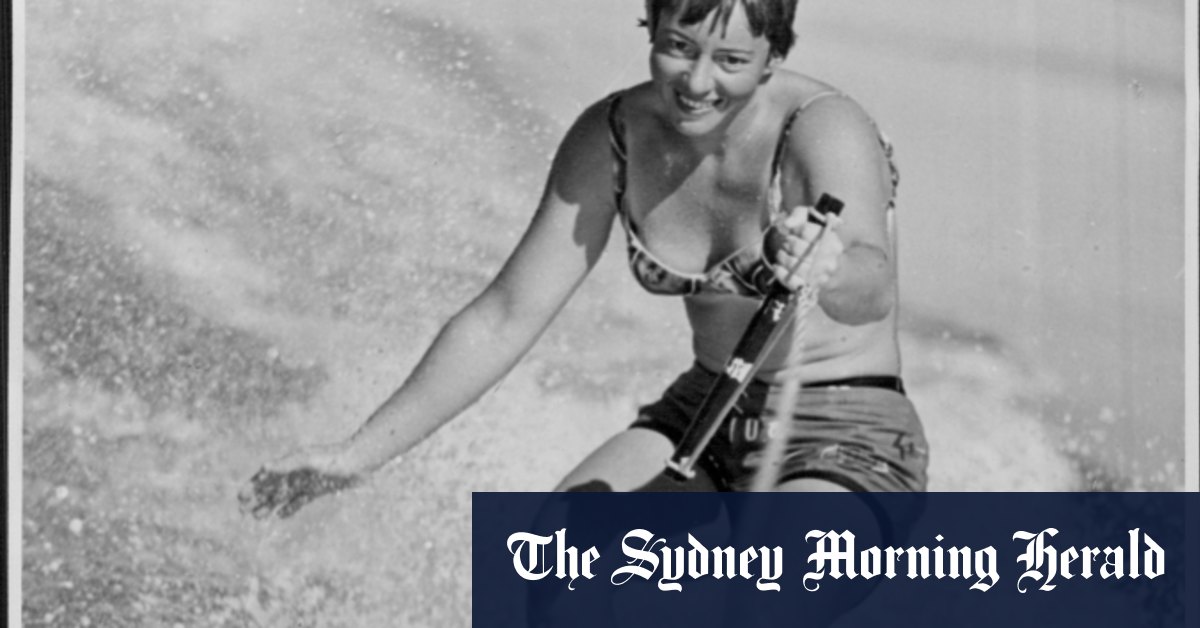
Phyllis is a natural storyteller, and she launches into one of her signature yarns. “I was surfing at Rainbow Bay one day and I had a pink rinse put through my hair. These guys were laughing. I said ‘What are you laughing at?’ They said ‘you’. They said ‘we haven’t seen anyone as old as you surfing.’
Surfing World cover with Midget Farrelly and Phyllis O’Donnell, 1964.Credit: Internet
Well I was only 29. Anyhow, one guy dropped in on me, I got him by his wetsuit and pushed him into the rocks. You know, don’t mess with the old girl.”
Phyll was no pushover, but she also says she wasn’t overly competitive. “When Midget and I won our World Titles at Manly there were about 60,000 people on the beach. No one thought that we would win. There was a girl, Lynda Benson, she used to play in the Gidget films, and she was a very fierce competitor. Lynda was favoured to win, but what happened is, they started to play some really nice music, and I totally relaxed. I just swayed along to the music, jazzed along the waves – I didn’t even know I was in a contest anymore.”
And so Phyllis O’Donnell, for whom surfing was a kind of dance, became Australia’s first female world champ, and her prize, as she loves to tell, was a carton of Craven A cigarettes. “And I smoked ’em all!”—she declares with a chuckle.
Phyllis’ story is demonstrative of the immense shifts seen in surfing over the past 50 years. She has heard about the World Surf League’s recent announcement of equal pay for women. A momentous step in surfing history, especially when compared with Phyll’s prize-winning experience. “I think it’s great,” she says. “The girls that surf now, they’ve got a good fortune ahead of them. As I said, I was happy with my Craven A cigarettes.”
In those days, being a world champ didn’t translate to a career in surfing, and it’s only in recent years that the top 17 have been able to rely on surfing as a sole source of income. But Phyllis had a penchant for the road, and so she did bar work to fund her travels around the world.
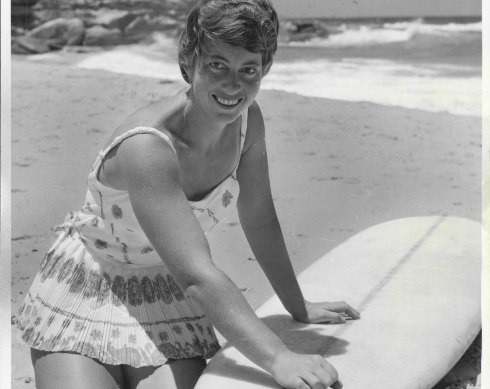
Women’s world surfboard champion 27-year-old Phyllis O’Donnell prepares to represent Australia in the International Surf-board championships in Honolulu, 1964.Credit: Fairfax
“I can’t believe I used to carry a whole tray of middies, of spirits and beer, holding it above my head!”
Phyll travelled to Hawaii, California and the South Pacific, but it was Puerto Rico, she tells, me, that stole her heart.
Other tributes:
Gail Austen: “In the surf, women were simply not welcome. Philly didn’t get that message or maybe she ignored it. Her answer was her courage, and talent. Her voice was used a lot to clear a pathway and prevent injury from the male surfers who did not put out a welcome mat.
“Surfing with Philly meant I got a wave and was assured a party afterwards in her flat opposite Rainbow Beach. Phyllis O’Donnell scored Australia’s first Surfing World Championship before Midget Farrell paddled out to make it two in a row adding the men’s title to the record books at Manly Beach in 1964.
“On the beach at D-Bah [Duranbah north of the Tweed River] in January 1971, upon my return from Europe, I attended a contest where the men and the boys were out with the good surf and the women were left to the poor surf.
“Philly was on the beach and was really fed up so I said to her why don’t we form the women’s surfing group and change things, so I was automatically the president and she was the secretary treasurer. AWSA then created surf contests for women throughout the east coast of Australia and we spent many hours driving south organising and competing in these events. Youngsters like Pamela Burridge and veterans like Isabel Latham became involved.”
Deb Wordsworth said: “She was our surfing [Edith] Piaf ( she was maybe five foot tall). She loved the water so much her mother said she was brought up on plankton. In the 1960s she was often accompanied in the surf by American women board riders in their Hawaiian bikinis. She could be quite wild. Kahlua was her choice of drink, resulting in what she used to call her ‘Kahlua Plans’. Sometimes a ‘plan’ involved a liaison.”
“Now that’s a beautiful place! I used to work at Twin Towns on the Gold Coast. I had a three-week leave of absence to attend a surfing competition. Well, I stayed in Puerto Rico 12 months. I was eight stone when I left, when I came back I was ten. Hamburgers, French fries, pancakes! But mostly rum, Emily, that was The Rum Trip.” Phyllis tells me this last part with a little twinkle in her eye.
But Hawaii is Phyllie’s first love. She’s been 18 times, loves to surf Sunset, and if ever, throughout her life, she has found herself floundering, her mantra goes like this: If in doubt, go to Hawaii. Phyllis is of tough stock, a woman of wry humour who doesn’t seem to take life too seriously. She shunned the idea of the nuclear family for a life of surfing and travel, in a time when to be a surfer meant going against the grain.
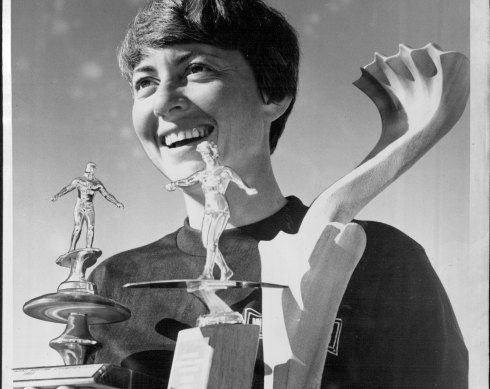
Phyllis O’Donnell of Banora Point, north NSW with some of her trophies.Credit: Fairfax
Phyllie always had her vices, just like the surf culture she’s a part of. While surfing grows cleaner and more respectable as it matures, it will always have its loose cannons. We breed them by our very nature – and aren’t we glad we do?
Reproduced with permission of Tracks surfing magazine.
Read the full article here