




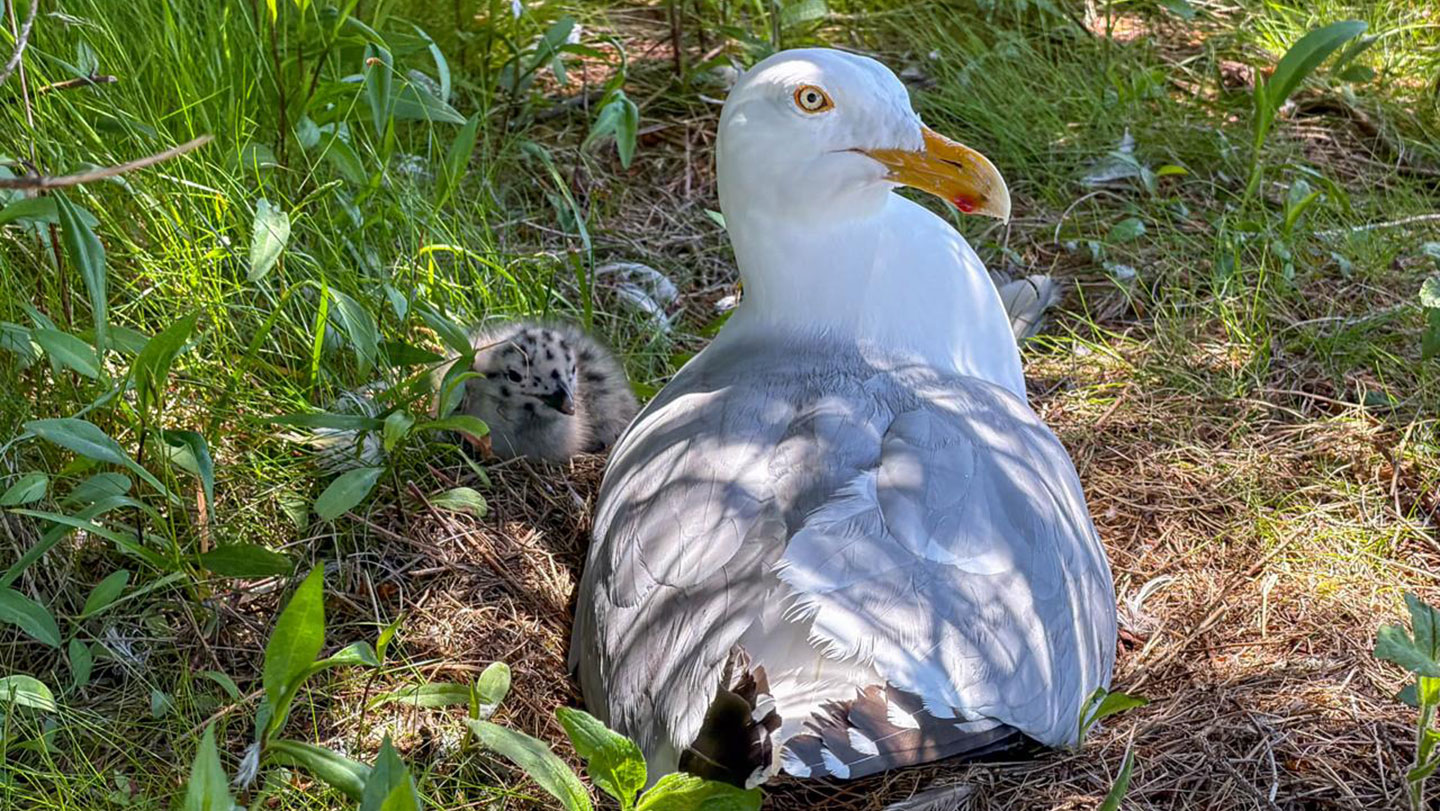
While many bird species go from egg to adult in months, some seabirds spend years in a sort of awkward adolescent phase, sporting darker, drabber plumage than the adults.
In American herring gulls, this immature coloring can function as a social signal, helping youngsters avoid aggression from breeding adults, researchers report June 4 in Animal Behavior. Using plastic models painted to resemble gulls of different ages, researchers found that adult gulls were less aggressive toward the gray and brown models of 1-year-old gulls than the bright white, gray and black models of adults.
The experiment “works toward answering why so many seabirds have this nonadult plumage retained for so long,” says Gavin Leighton, an evolutionary biologist at Buffalo State University who was not involved in the research.
Performing the study was no easy task. Breeding colonies of American herring gulls (Larus smithsonianus) are no place for the faint of heart. “At these colonies, there’ll be a nest every two to three feet, sometimes. They can be incredibly densely packed,” says Molly Hill, an undergraduate at Yale University at the time the research was conducted on Canada’s Kent Island in New Brunswick. “It’s just chaos when you are walking through — gulls flying everywhere, screaming, fighting with each other.”
Among the breeding adults and their chicks, researchers have also spotted immature gulls in these chaotic colonies. It’s not entirely clear why the young gulls are here in the first place, given that they no longer need parental care and don’t seem to be trying to mate. It’s a risky move for younger birds that may not yet have the skills to safely navigate these crowded, complicated social environments. Researchers hypothesized that the young birds’ distinct plumage might signal their immaturity to the breeding birds, helping shield the youngsters from adult aggression until they learn the rules of the colony.
To test this idea, researchers placed fake, painted gulls with first-year or adult colors near real nesting gulls and recorded their behaviors. Sometimes the nesting gulls barely reacted; other times they would make loud, territorial trumpet calls or perform grass-pulling displays. The gesture essentially conveys “this is my territory, this is my grass, I’m building a nest here, you should go away,” Hill says.
Nesting gulls acted aggressively toward the youngest models in about 30 percent of encounters, but were nearly 1.5 times more likely to be hostile toward adult models. Furthermore, they were slightly slower to react to the youngsters, waiting about seven seconds longer before getting aggressive. The results indicate that this immature coloring may help reduce conflict with adult birds, the researchers say.
“I think this opens the door to a lot of research in other seabirds,” Hill says. “There are many species of seabirds that have very similar extended delayed plumage maturation, even in completely unrelated lineages, like albatross and gannets.” Future research, she says, could explore the social or environmental factors that drive these disparate species toward similar patterns of development.
Read the full article here