

Examine, a free newsletter covering science, is sent every Tuesday. You’re reading an excerpt – sign up to get the whole newsletter in your inbox.
Already, this week, more than a million birds – grey-rumped, crimson-cheeked, fluro-crested and wag-tailed – have been spied and counted by Australians who normally may have ignored the flashes of feathers gracing their backyard skies.
The Aussie Bird Count, under way until Friday, is the nation’s biggest citizen science event. Last year, 64,000 bird-nerds took to their balconies, parks and gardens for 20-minute bird surveys that collectively racked up 5 million data points.
The resulting numbers help researchers track bird population trends, identify species under threat and monitor the health of local ecosystems – a particularly crucial endeavour this year given the dreaded arrival of H5N1 bird flu. The count has grown in popularity as birdwatching makes a major comeback.
But before this annual springtime snapshot of our urban avian life, there was a man who went by the alias Peregrine.
More than a century before the bird count and the modern resurgence of “twitching”, Peregrine – real name Michael Sharland – was one of Australia’s most prolific naturalists, with a particular verve for birds.
He filled scores of notebooks with observations of birdlife he recorded while flitting between Tasmania, Melbourne, Sydney, Alice Springs, Lake Eyre and Lord Howe Island, and took thousands of photos – all of which were passed to the Australian Museum shortly before his death in 1987.
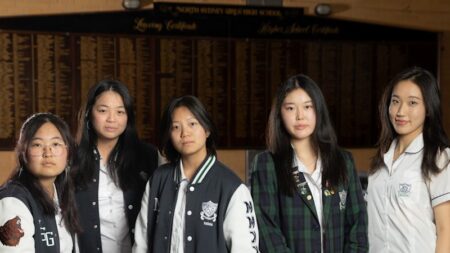
Now, the museum has recruited a flock of students from the University of Sydney to help digitise his copious notes, drawings and photographs, and the exercise has changed how they think about life, birds and science.
Australia’s original birder
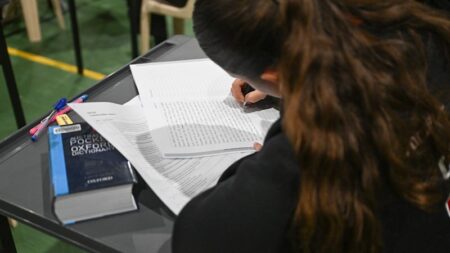
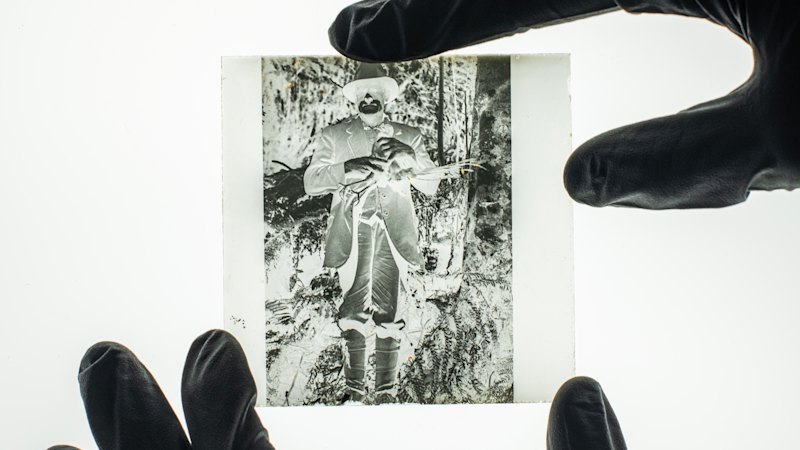
Scores of diaries, 2600 photographic negatives and 1600 prints collected by Sharland are in the process of digitisation at the museum.
“The records today are really important,” says Darcy Campbell, engagement manager at the museum’s archives, looking at one of Sharland’s records from Kellyville, Sydney.
“In the age of AI, we’re seeing a big return to crafting and the ‘real’ … We get a lot of students coming through who want to start their own field notebooks and diaries.”
The page, handwritten in 1939, notes the daily presence of hooded robins and grass parakeets, golden whistlers and black ducks and, on a warm day, the curious absence of brown treecreepers and dotterels.
The record is paired with a hand-drawn map of Kellyville marking the location of black falcon nests and sightings of cuckoo-shrikes, red-backed parrots and a striated pardalote.
Sharland would take these hand-sketched field recordings and type them into more official datasets, which have proved helpful to researchers.
“Scientists still use his egg collecting and nest records to understand breeding patterns,” Campbell says.
But while Sharland translated his field notes into data, he went the other way, too, writing up his encounters with flair into engaging stories for the public.
In newspapers including The Sydney Morning Herald, he rallied for the expansion of national parks, hailed bumper breeding years for moorhens on the edge of the city, and delighted in the fact a grey thrush in Sydney sang in a different “dialect” to those from Tasmania.
In his field notes, student Nidhi Dabadghav says, Sharland might quickly note his sighting of a lyrebird display with a curt description and a timestamp. But when writing about the same observation in the newspaper, he transformed it into a “concert”, a “performance” and a “dance”, capturing the masses with his lyrical missives from the bush.
“He has this very romantic side to him,” says Dabadghav. “You would think of a scientist and a naturalist as very empirical, but no, he is almost like a poet in the way he writes and even formats his work.”
A mile-long wire helps save the lyrebird
The lyrebird was one of Sharland’s obsessions. He was friends with Tom Tregellas, a man who lived in a log in the Dandenong Ranges so he could study the elusive birds up close.
Together in 1931, they helped broadcast the first live recording of the lyrebird’s extraordinary call.
They unspooled a microphone wire more than a mile long into the bush to make the historic recording of one of nature’s best mimics.
The kaleidoscopic call was played throughout Australia; a blend of cockatoo shrieks, kookaburra laughs, shrike-thrush calls, boobook hoots, fox barks and even blasts from a nearby quarry.
It was no meaningless stunt. In the early 20th century, the lyrebird had been forced to the edge of extinction due to land-clearing and people hunting them for their ornate tail feathers. Publicising the creature’s now world-famous call helped protect them for decades to come.
“He kind of fixated on the lyrebird, I guess because it could represent so many different birds and so many different sounds,” student Jasmine Digges says. “In our work, we’ve said Sharland is a bit of a lyrebird himself because he translates the sounds of the bush to the public.”
These students, many of whom are majoring in medicine, health and computer science, never imagined themselves ferreting through the ornithological notes of a bygone naturalist as part of their degrees.
But they’re coming away with a new appreciation for the cast of birds that animate our backyard skies and, alongside the thousands taking part in this week’s bird count, they’re learning the virtues of patience, passion and looking up.
“He was very holistic about the way he does things – he spent so long observing birds in so many different habitats, and I think you can apply that in health as well,” Digges, who’s majoring in medical science, says.
“It’s not just a person with a disease you’re dealing with. It’s a person who has a whole life, like a bird does, and you should acknowledge that whole lifespan and the way they operate in different facets of that life when you’re thinking about how to treat them.”
The Examine newsletter explains and analyses science with a rigorous focus on the evidence. Sign up to get it each week.
 Angus Dalton is the science reporter for The Sydney Morning Herald.Connect via X or email.
From our partners
Read the full article here